Broad targeting is one of the most debated tactics in Facebook and Instagram advertising today. Some advertisers scale fast with it — others burn through budget with no clear returns.
So what gives?
It comes down to this: broad targeting is not a one-size-fits-all strategy. It performs exceptionally well under the right conditions. But without those, it quickly breaks down.
Let’s unpack when it works, when it doesn’t, and how to know which side you’re on.
What Is Broad Targeting — and Why It’s Gaining Popularity
Broad targeting means you let Meta’s algorithm decide who sees your ads. You skip interest filters, demographic refinements, or custom audiences. Instead, you rely on the algorithm to match your creative with people likely to take action.
This strategy has grown in popularity as Meta’s machine learning improves. Advertisers are finding success by giving the platform more flexibility — not less.
But that flexibility can backfire if your offer or funnel isn’t optimized. Broad targeting can amplify what’s working — or what’s not.
If you need a refresher on targeting types, see Facebook Ad Targeting 101: How to Reach the Right Audience.
The Pros of Broad Targeting
When broad targeting works, it’s often because the advertiser has aligned the entire funnel — from ad creative to landing page — for cold audiences.
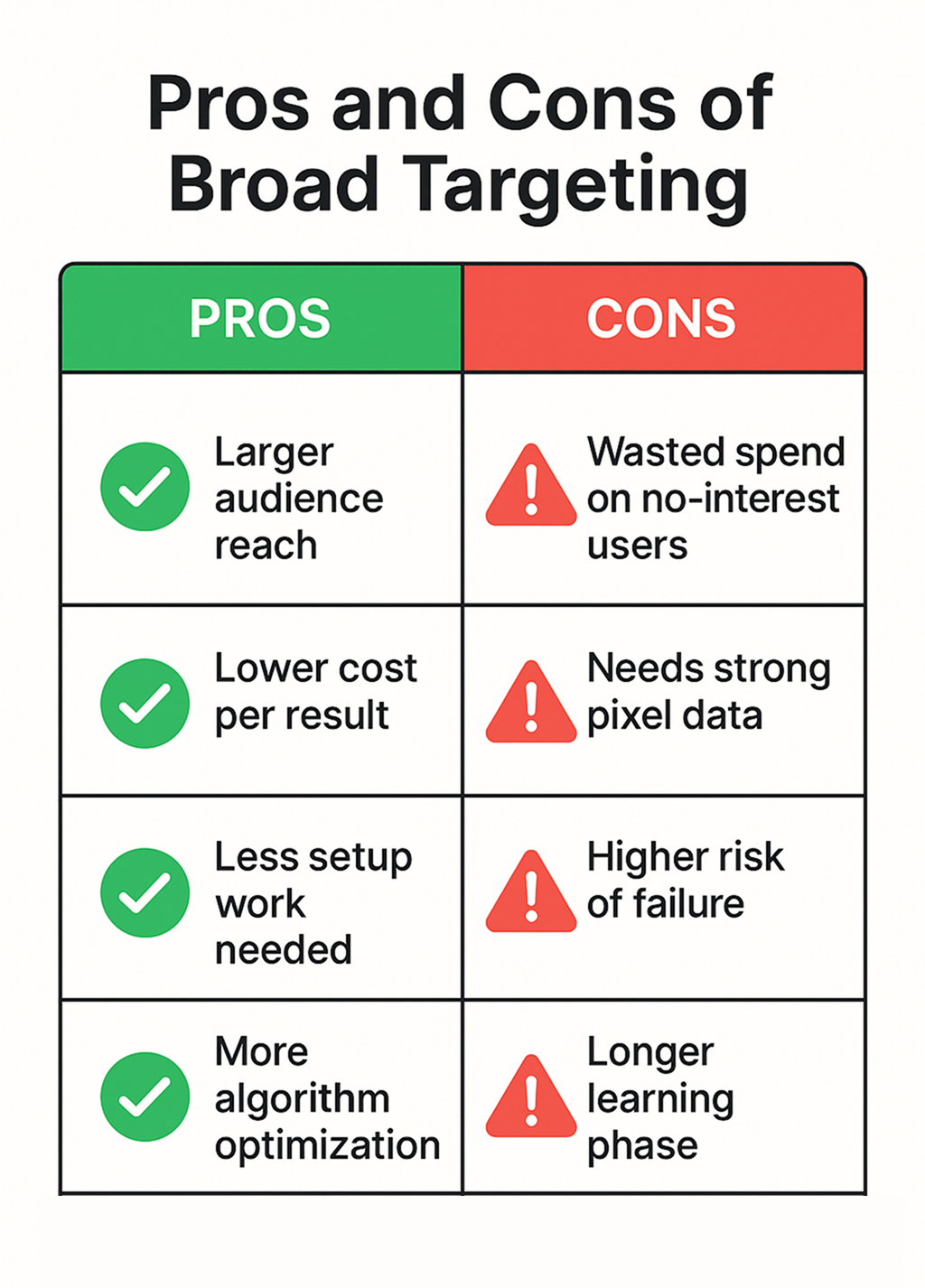
Key benefits:
-
Lower CPMs at scale
With fewer restrictions, Meta can access larger inventory, reducing ad delivery costs in competitive auctions. -
Faster testing and data collection
You reach diverse audience segments more quickly, allowing the algorithm to identify who converts best. -
Simplified campaign setup
No more obsessing over interest stacks or exclusions — broad targeting reduces manual guesswork. -
Stronger performance over time
With enough conversion signals, broad targeting improves automatically and becomes more efficient at finding buyers.
The Cons of Broad Targeting
Despite the benefits, broad targeting can cause real problems — especially for newer or niche brands.
Common risks:
-
Wasted budget on low-intent users
Without enough pixel data, the algorithm struggles to find qualified leads early in the campaign. -
Slower exit from the learning phase
If you don’t hit the necessary conversion volume, your ad set stays in learning, limiting performance. -
Poor creative fit
Broad targeting requires ads that hook and convert cold users immediately. Weak messaging gets scrolled past fast. -
Lack of control or insight
It’s harder to understand why something is or isn’t working when you can’t pinpoint the audience.
For help diagnosing a low-conversion setup, read Why You See 'Ad Set May Get Zero' on Facebook and How to Fix It.
When Broad Targeting Works — and Why
Some brands thrive with broad targeting. These are usually high-volume businesses with offers that don’t require much explanation or filtering.

Broad targeting works best when:
-
You sell mass-market or impulse-buy products
Think beauty, wellness, gadgets, or accessories. Products that nearly anyone could buy. -
Your site converts cold traffic well
Fast-loading, mobile-friendly, friction-free landing pages make a huge difference. -
You have proven creatives
Ads that follow winning patterns — short-form UGC, fast hooks, strong benefits — are essential. -
Your pixel has data
If you’re getting at least 50 conversions per week per ad set, Meta can optimize more accurately. -
You’re optimizing for purchase events
Avoid top-of-funnel objectives with broad targeting. Instead, train the algorithm on deep, high-intent actions.
You can learn more in How to Finish the Facebook Learning Phase Quickly.
Why Broad Targeting Fails for Many Brands
When broad targeting fails, it’s usually because the brand hasn’t earned the right to scale. Either the creative isn’t strong enough to work cold, or the funnel isn’t built for low-awareness users.
It often fails when:
-
Your product solves a niche problem
Broad audiences aren’t looking for B2B software, financial planning tools, or custom high-ticket offers. -
You’re early in your testing cycle
Without data, Meta has no idea who to target. You end up with irrelevant clicks and high CPAs. -
Your creative assumes familiarity
Ads that reference insider language, product specs, or features without context will flop. -
Your pixel hasn’t gathered signal data
Meta relies on conversion history. Without it, your ads drift in the algorithm without focus.
More on this in Retargeting vs. Broad Targeting: Which Strategy Drives Better Results?
How to Prep for Broad Targeting Success
You don’t need to abandon broad targeting if it hasn’t worked — but you do need to prepare for it.
Start with a tighter audience, test for conversions, then gradually remove restrictions as your pixel learns.
Steps to build toward broad:
-
Run interest- or lookalike-based campaigns first
These help collect the data needed for broad targeting to succeed. See Custom vs Lookalike Audiences: What Works Best for Facebook Campaigns?. -
Focus on purchase or lead conversions
Don’t optimize for clicks or views — train the algorithm on meaningful, profitable actions. -
Use creative that stops cold traffic
Short video testimonials, demos, or “TikTok-style” UGC outperform studio-polished brand videos in broad campaigns. -
Gradually widen targeting once conversions are stable
Duplicate your best ad set, remove restrictions, and monitor performance closely.
When to Stick with Narrow Targeting Instead
Not all brands are a fit for broad. Narrow targeting still wins when you need to speak directly to a well-defined group — and every dollar counts.
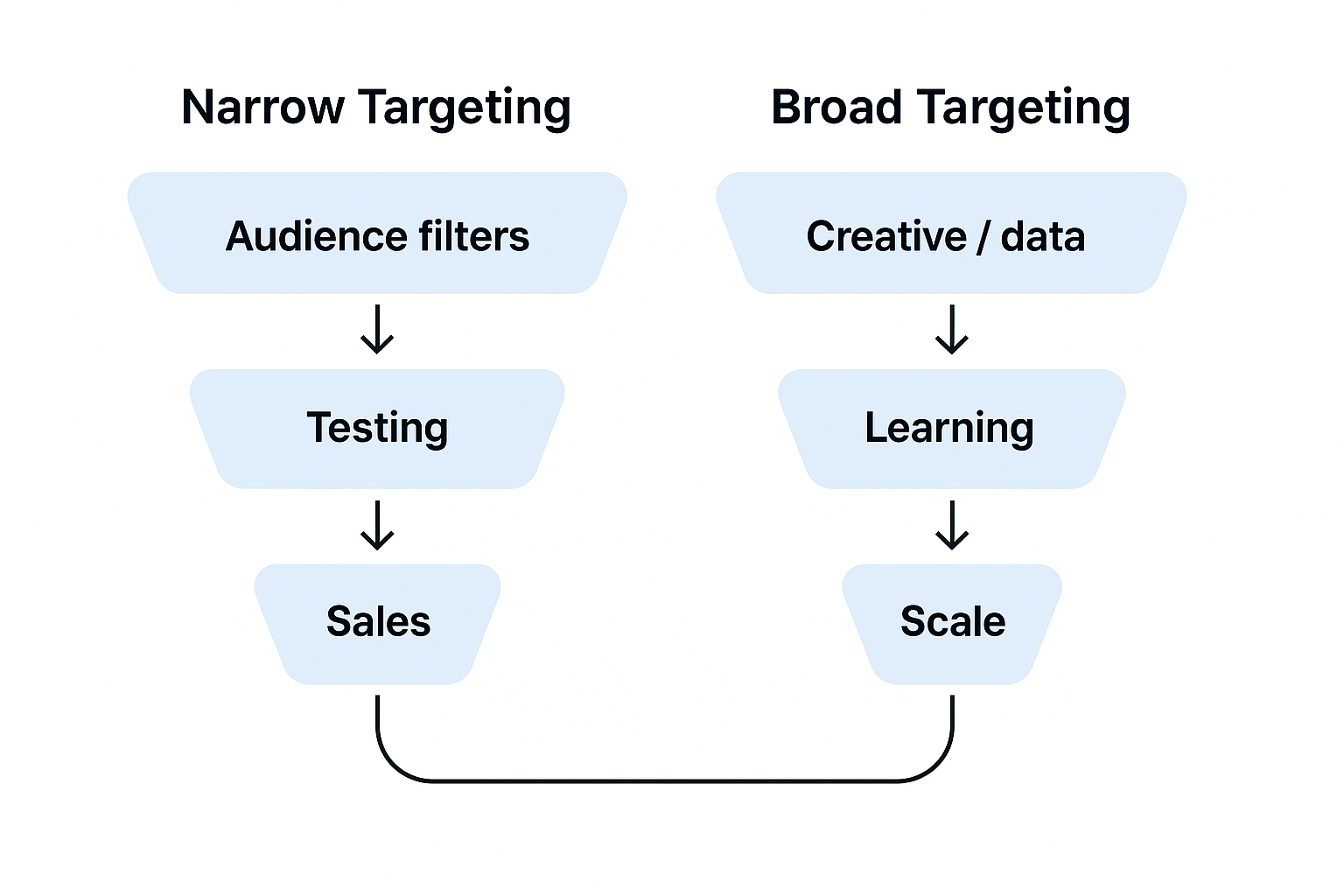
Use narrow targeting if:
-
You have a very specific customer avatar
Example: solo lawyers, triathlon coaches, or CTOs of startups. -
Your creative is designed for warm or educated audiences
Messaging that relies on prior knowledge won’t land with broad. -
You’re working with a small budget
Precision helps reduce waste when there’s no room to test blindly.
You can learn more about narrowing intelligently in Facebook Ad Targeting for Niche Professionals.
Final Thoughts: Should You Use Broad Targeting?
Broad targeting is neither a magic trick nor a flawed strategy. It’s a scaling tool — and like any tool, it only works if your foundation is solid.
Use broad targeting when:
-
You have a mass-market product;
-
You’ve proven creative that works cold;
-
You’re generating consistent conversions;
-
You want to scale efficiently and let Meta optimize freely.
Avoid broad targeting when:
-
You’re early in the testing phase;
-
Your product requires explanation or trust-building;
-
Your pixel is undertrained;
-
You need to control audience quality tightly.
Start small. Build signal. Scale smart. That’s the sustainable path to success with broad targeting.