Two campaigns can use identical audiences, creatives, and budgets while producing completely different results.
The difference is often campaign duration.
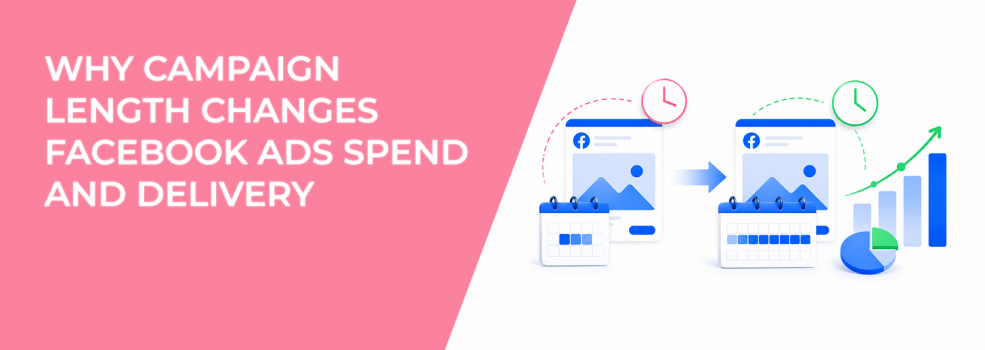
Most advertisers underestimate how heavily runtime affects Meta’s delivery behavior. Campaign length changes pacing speed, auction flexibility, optimization stability, and even audience quality over time.
The problem: advertisers assume delivery behaves the same regardless of runtime
Many advertisers think budget alone controls campaign behavior.
In reality, Meta also reacts heavily to the amount of time available for optimization.
A campaign running for 3 days forces the algorithm to behave differently than a campaign running for 30 days. The shorter the campaign, the more aggressively Meta must search for impressions and conversions immediately.
That compression often changes:
- CPM patterns,
- CPA stability,
- audience expansion behavior,
- placement allocation.
This is why short campaigns frequently feel unstable even when targeting and creatives remain identical.
Why short campaigns often spend aggressively early
Meta tries to gather conversion signals quickly during compressed runtimes.
That means the platform may:
- accelerate spend during the first 24–48 hours,
- expand into broader inventory faster,
- enter more competitive auctions immediately.
This creates higher volatility.
For example, an event promotion campaign running for 4 days may spend heavily during the first evening because Meta detects limited optimization time remaining. A longer evergreen campaign usually distributes spend much more gradually.
The article about what to watch in the first 24 hours of a Facebook campaign launch explains how early delivery behavior shifts during compressed optimization windows.
Longer campaigns give Meta more optimization flexibility
Longer runtimes create more stable delivery conditions.
The algorithm has additional time to:
- identify efficient audience segments,
- collect conversion feedback,
- avoid expensive auction periods,
- refine delivery patterns gradually.
This often lowers CPA volatility significantly.
For example, a SaaS lead generation campaign running continuously for several weeks usually produces cleaner optimization trends than repeatedly restarting short campaigns every few days.
Repeated resets force Meta to relearn delivery patterns constantly.
The solution: structure runtimes according to campaign objective
Different objectives require different campaign lengths.
A better planning structure looks like this:
- Evergreen prospecting campaigns. Usually perform better with longer runtimes because optimization improves gradually over time.
- Product launches and promotions. Can justify compressed runtimes because urgency changes user behavior.
- Creative testing campaigns. Often benefit from medium runtimes that provide enough data without overspending.
This approach aligns delivery conditions with the actual optimization goal instead of forcing every campaign into the same pacing structure.
The article about how to structure Facebook campaigns for faster learning explains how runtime affects learning stability inside Meta’s delivery system.
Actionable ways to improve delivery stability
Here are the most effective duration-related fixes advertisers can apply:
- Avoid restarting campaigns unnecessarily. Repeated resets interrupt optimization momentum and destabilize pacing.
- Use evergreen campaigns for stable acquisition systems. Longer runtimes often reduce CPA volatility substantially.
- Separate urgency campaigns from always-on campaigns. Promotional pacing behaves differently than long-term prospecting.
- Analyze spend distribution across full runtime windows. Daily fluctuations become misleading inside compressed campaigns.
The article about why Facebook Ads performance can fluctuate daily explains how delivery instability often comes from auction conditions and runtime compression simultaneously.
Final takeaway
Campaign duration changes Facebook Ads behavior far more than most advertisers realize.
Short runtimes force aggressive pacing and unstable optimization. Longer runtimes give Meta more flexibility to stabilize delivery and identify efficient conversion patterns. Advertisers who structure campaign length around optimization goals usually produce much cleaner performance trends over time.