Advertisers often ask: Why are my Facebook and Instagram ads doing great one day and tanking the next?
You’re not imagining it. Performance fluctuations are real, and they can be sharp. But they’re also explainable and manageable.
This article breaks down the core reasons for day-to-day performance changes and how experienced advertisers handle them without overreacting.
The Facebook Ads Engine Is Built for Constant Adjustment
Facebook’s Delivery System Is Always Rebalancing
Meta’s algorithm doesn’t deliver ads in a fixed way. Every ad competes in a dynamic system shaped by several changing variables:
-
User behavior changes daily. Attention spans, scrolling speed, and browsing intent fluctuate.
-
Advertiser competition rises or falls depending on the day, budget cycles, or promotions.
-
Placement availability varies. Feed, Reels, and Stories inventory depends on overall platform usage.
These shifts directly impact metrics like CPM and CTR, even when your campaign stays the same. The system is built to adapt. Your results reflect that adaptation.
The Learning Phase Is Often Misunderstood
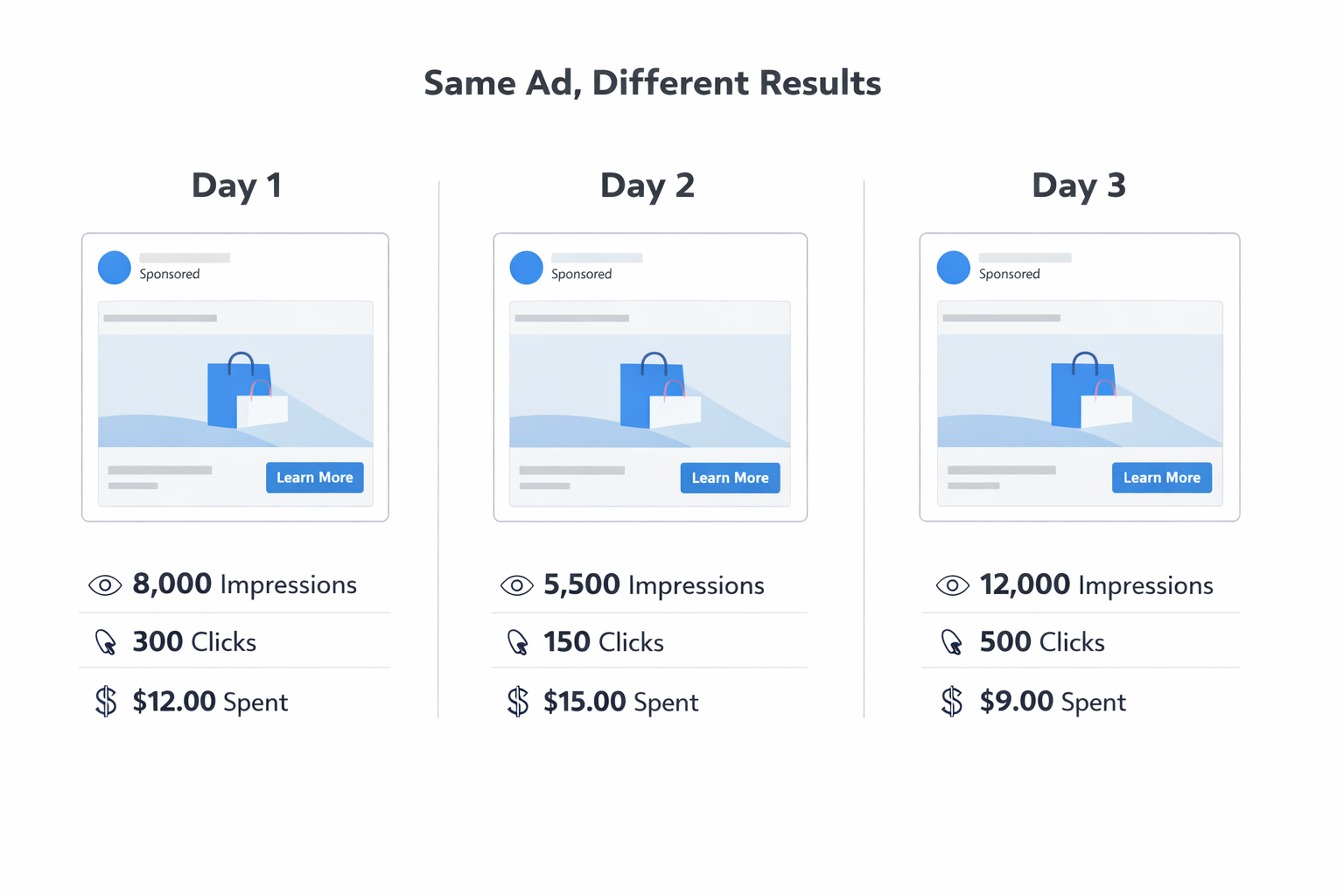
When you launch a new ad set or creative, Facebook enters a Learning Phase. During this period, the system experiments with delivery to find the best combinations.
What this means in real terms:
-
Performance will fluctuate, often sharply, during the first 24 to 72 hours.
-
Making edits too early (changing targeting, budget, or creative) resets the learning process.
-
Smaller audiences magnify volatility, since fewer data points can swing results more dramatically.
Many advertisers mistake these natural shifts for poor performance. But early instability is part of the platform’s design.
Here’s a deeper look at how to use the Facebook Ads Learning Phase to your advantage.
The Auction Environment Shifts Constantly
The Meta Ads Auction Is Always Changing
Every impression is decided in an auction. That auction reacts to supply and demand, which change daily and even hourly.
Key causes of variation:
-
Advertiser volume increases during holidays, major sales events, or industry-specific campaigns.
-
Competitor budgets fluctuate, raising the floor for bids in shared audience segments.
-
Platform trends shift. For example, if more users engage with Reels, inventory in Feed may shrink.
This explains why one day your CPM is $11 and the next it’s $18, without any change on your side. To understand this more deeply, see this article on how ad sets compete in Facebook's ad auction.
Budget and Bid Structures Affect Competitiveness
The way you structure your budgets and bids also determines how aggressively your ads compete in auctions.
For example:
-
A low daily budget can limit delivery during high-demand hours.
-
Switching to manual bidding without accurate benchmarks can reduce reach or overspend.
-
Scheduling ads for limited hours increases competition for a smaller window of impressions.
Advanced advertisers review auction diagnostics to monitor delivery pressure and understand what's really happening behind the numbers.
Human Behavior Isn’t Predictable

Audiences React Differently Based on Context
Your target audience may stay the same, but their context shifts. Behavior patterns depend on timing, devices, moods, and external events.
For example:
-
Weekday mornings may drive research-based clicks but few purchases.
-
Weekends might show strong mobile engagement, but lower conversion rates for higher-ticket items.
-
External events like news or sports can shift attention away from your category altogether.
These aren't problems with your ads. They're reminders that attention is limited and fluid.
Ad Saturation Leads to Performance Drops
Even top-performing ads lose effectiveness when shown too often to the same people. This is called creative fatigue.
Watch for:
-
Frequency creeping above 2.5, especially with small audiences or single-image creatives.
-
Declining CTRs with stable impression counts.
-
Drop in engagement or negative reactions in ad comments.
Proactive creative rotation is key. Don’t wait for results to fall apart before updating visuals or messaging.
If you’re seeing these signs, here’s how to spot and fix ad fatigue early.
Attribution and Tracking Create Noise
Conversion Lag Causes Misleading Results
Most Facebook conversions don’t happen right away. Users often click, browse, and then return days later to convert.
This creates a few problems:
-
A conversion might be reported three days after the click, making the original ad seem ineffective at first.
-
Pausing an ad too early could mean stopping a high-performing asset mid-cycle.
-
Comparing campaigns with different attribution windows leads to false conclusions.
Read more about attribution lag and how it affects your perception of ad performance.
Evaluating results over a 7- to 14-day window gives you more reliable insights.
Privacy Changes Hide Some Performance
Since the rollout of Apple’s App Tracking Transparency, Facebook can no longer track all user behavior across apps and devices.
This results in:
-
Fewer reported conversions, especially on iOS.
-
Weaker visibility into funnel performance, particularly for mobile-heavy stores or apps.
-
Gaps between Ads Manager and third-party tools, like Shopify or Google Analytics.
Solutions include using Conversions API (CAPI) and triangulating performance using multiple data sources, not just Facebook’s native reports.
How to Interpret and Manage Fluctuations Smarter
Focus on Trends, Not Single-Day Results
Smart advertisers avoid over-optimizing based on day-to-day numbers. Instead, they look at:
-
7-day averages for cost per result and ROAS to smooth out noise.
-
Week-over-week changes across creative, placements, and audience segments.
-
Conversion delay patterns, which help estimate how long users take to complete purchases.
This approach prevents rash decisions based on incomplete snapshots.
Build a System for Testing and Scaling
Reacting to every dip isn’t scalable. Instead, set up a clear framework for experimentation.
A few best practices:
-
Allocate 20 to 30 percent of budget for structured creative and audience testing.
-
Run tests for at least three full days, unless performance is clearly broken.
-
Use control groups or holdout audiences to validate what’s truly driving impact.
Consistency creates clarity. Systems prevent guesswork.
Use Facebook’s Automation to Reduce Volatility
You don’t need to manage every detail manually. Facebook provides tools that help stabilize delivery and reduce risk.
Use:
-
Campaign Budget Optimization (CBO) to automatically move spend toward better-performing ad sets.
-
Dynamic Creative to let Facebook find the most effective combinations of assets.
-
Automated Rules to scale or pause ads based on custom performance thresholds.
These tools support your logic. They’re not a replacement for strategy, but a multiplier when used correctly.
Final Thoughts
Daily fluctuations in Facebook ad performance are expected. They reflect how the system, the market, and users behave — not just how “good” your campaign is.
Once you understand how delivery algorithms, auctions, behavior shifts, and measurement gaps interact, fluctuations become less frustrating and more manageable.
Stay calm, follow your data, and focus on patterns, not panic.