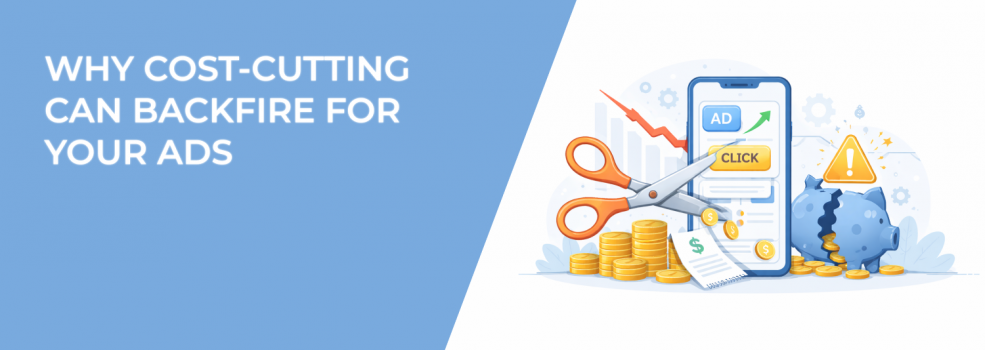
Reducing ad spend sounds smart — until it stalls your performance.
Many advertisers cut budgets, pause tests, or shrink campaigns when performance dips. But in doing so, they often break the very systems that drive growth.
This article explores why cutting costs in the wrong places can increase your actual costs — and how to cut inefficiency without killing performance.
Cost-cutting isn’t the same as cost-efficiency
Most platforms today — whether Meta, Google, TikTok, or others — reward learning.
They need volume to identify patterns, test hypotheses, and optimize delivery. That learning relies on a steady loop of impressions, clicks, conversions, and budget.
If you interrupt that loop too early, you lose valuable feedback. And without feedback, your campaigns become guesswork.
For a deeper breakdown, see Facebook Ad Budget Myths That Are Holding You Back.
Small budgets create misleading data
Low-spend campaigns often produce just enough data to mislead you — but not enough to guide strategy.
Here’s how:
-
Results fluctuate wildly. A $10/day test might see one conversion on Monday, none for three days, then one on Friday. That’s not performance — that’s noise.
-
Click-through rates skew on low volume. A single click on 50 impressions looks like a 2% CTR, but that number isn’t statistically useful.
-
Early results bias decisions. Advertisers kill good ads too early or scale bad ones because they misread short-term patterns.
Better data comes from signal density. That means: more events, across more segments, in shorter timeframes.
If you can’t afford that per campaign, reduce the number of variables — not the budget.
You can’t optimize what you never fed
Advanced optimization systems (even manual ones) rely on one thing: signal clarity.
You need enough actions to separate signal from noise.

But cutting costs often removes critical signals:
-
Fewer conversions mean poor optimization. No optimization model works well on 2 conversions per week.
-
No creative rotation means limited insights. If you test only one visual because it's "cheaper," you're guessing, not optimizing.
-
Over-trimming audiences limits pattern discovery. When you target too narrowly, you remove the chance to discover unexpected high-performers.
Instead of starving your campaign, invest in minimum viable scale. Enough data to learn. Enough variation to discover. Enough spend to move fast.
If you're unsure where to start, check out How to Improve Campaign Performance Without Increasing Budget.
The illusion of “cheap” creative
Poor-quality creative is one of the costliest decisions in digital advertising — not because it costs less, but because it delivers less.
A low-production visual may cost $0 to make, but if it fails to:
-
Grab attention in under 1 second;
-
Make your value proposition clear;
-
Connect emotionally or logically with your audience...
...then you’re not saving money. You’re paying for impressions with no return.
High-performing ads often look simple. But they’re backed by clear messaging, rigorous testing, and knowledge of the buyer's psychology.
Instead of reducing cost per asset, aim to increase output per asset. That means:
-
Testing multiple formats from one idea;
-
Using modular content to remix across platforms;
-
Focusing on clarity, not production gloss.
A single high-performing visual can outperform 10 budget ads — and scale far more efficiently.
Need help identifying the signs of creative fatigue? See How to Avoid Ad Fatigue and Keep Optimal Ads Costs.
Beware of false efficiency signals
Many campaigns look efficient in the short run — but only because they’re avoiding harder (and more profitable) segments.
Examples:
-
You get cheaper leads, but worse buyers. Cost per lead drops, but LTV tanks. You didn’t improve efficiency — you lowered quality.
-
You reduce CPL but increase CAC. If conversion rates drop post-click, you’ve shifted the cost — not lowered it.
-
Retargeting outperforms prospecting. Of course it does — those users already know you. But retargeting pools shrink fast.
Short-term efficiency often hides long-term fragility. Real performance requires net efficiency — not just isolated metrics.
Smart cost control means knowing where to cut
There are ways to save budget without hurting results. But they require precision.

Cut these:
-
Redundant audiences. Merge overlapping segments to avoid self-competition.
-
Low-impact placements. Monitor placement-level performance and trim what underdelivers (after enough data).
-
Stalled experiments. Kill variations with no learnings after a reasonable spend threshold.
-
Overbuilt structures. Simplify campaigns, reduce manual overrides, and let your structure breathe.
Keep these funded:
-
Top-performing creatives, even if CPMs rise. If conversion rates hold, they’re still efficient.
-
Prospecting with healthy ROAS, not just cheap leads. Sustainable growth comes from new acquisition.
-
Testing pipelines. Creative or targeting tests often lose money short-term but unlock scale.
Smart cuts come from pattern recognition — not fear-based reductions. Learn how to protect your core performance drivers.
Efficiency isn't always visible in-platform
Here’s where many teams go wrong: they optimize only for what’s trackable.
But many of the most valuable ad effects happen outside attribution windows:
-
Delayed conversions;
-
Brand lift;
-
Word-of-mouth triggered by ads.
When you cut budgets based only on tracked results, you risk removing high-value, low-attribution touchpoints.
This is especially true for:
-
High-consideration products;
-
Emerging categories;
-
B2B or complex sales cycles.
Middle-of-funnel campaigns often fall victim to budget cuts — yet they are essential for long-term conversion rates.
Budget decisions should include platform metrics — but also downstream impact, sales feedback, and buyer behavior analysis.
Final word
Cost-cutting sounds smart. But smart advertising isn’t about spending less — it’s about learning more, faster.
When you underfund, over-optimize, or over-control, you slow learning and lose clarity. The result? More spend chasing fewer results.
The solution isn’t bigger budgets. It’s strategic investment:
-
Spend enough to learn;
-
Test what matters;
-
Scale what works;
-
Cut what stalls learning.
In modern ad systems, data is leverage. And the fastest way to waste money… is to save it in the wrong place.