At some point, every advertiser opens Ads Manager and sees it. Cost per result is climbing, even though nothing “major” changed. The budget is the same. The audience looks fine. CTR has not collapsed.
So what happened?
In most cases, the auction is reacting to subtle shifts. Meta adjusts in real time, and small structural changes can push costs up faster than expected. If you understand what the system is responding to, the increase stops feeling random.
How the Meta Auction Actually Decides Your Cost
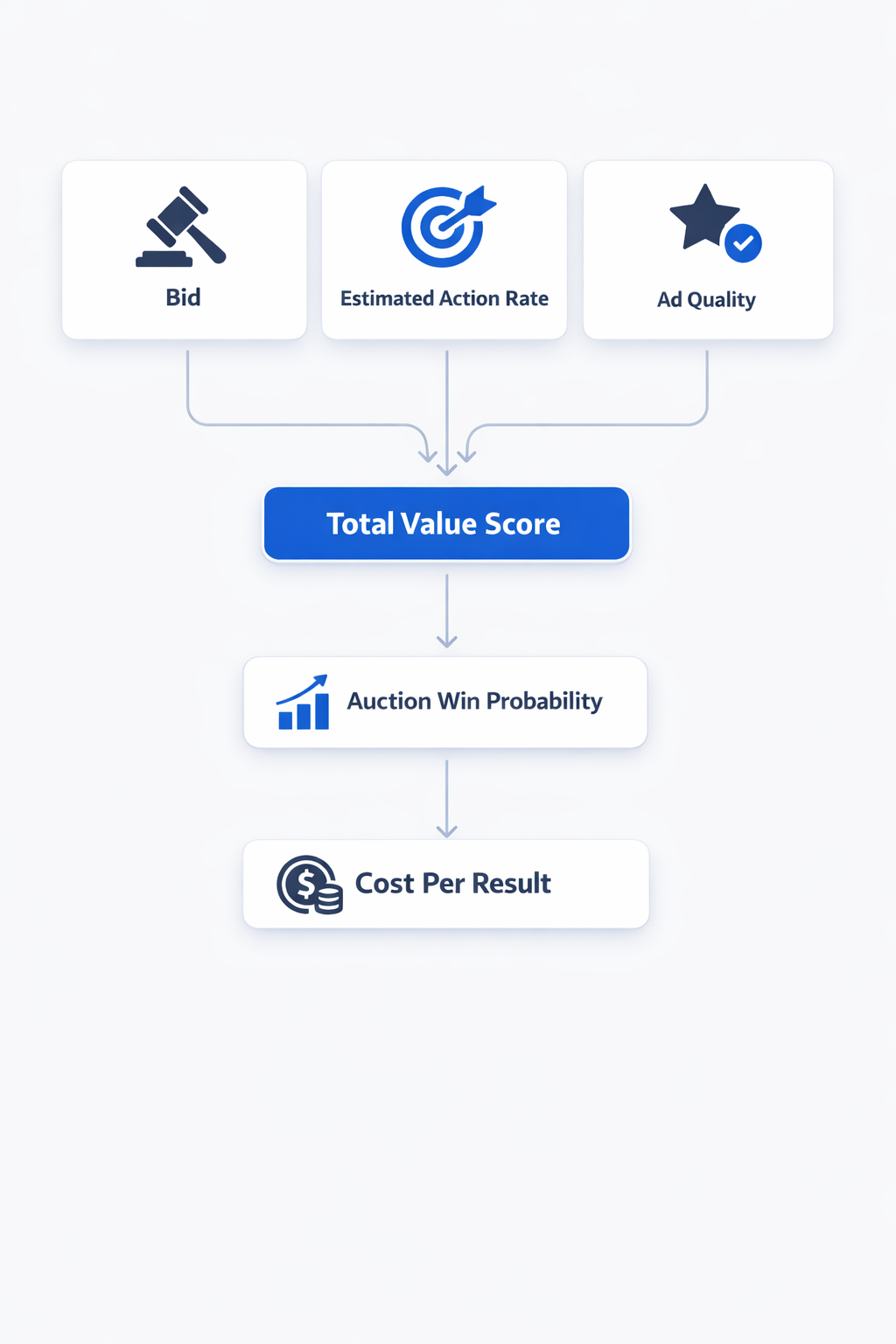
Meta does not charge you based only on your bid. Every impression goes through an auction that weighs three main components: your bid, estimated action rate, and ad quality. If you want a deeper breakdown of how this system works, read how the Facebook ad auction works and what affects delivery.
If any one of those elements weakens, you pay more to win the same impression.
Even when CTR looks stable, cost per result can rise. That is because estimated action rate depends on deeper signals. Meta evaluates who converts after the click, not just who clicks.
When post-click behavior shifts, the system recalculates value. Your cost moves with it.
Estimated Action Rate Quietly Declines
Estimated action rate predicts how likely a user is to convert. It is built from historical performance and real-time data.
Cost per result rises when:
-
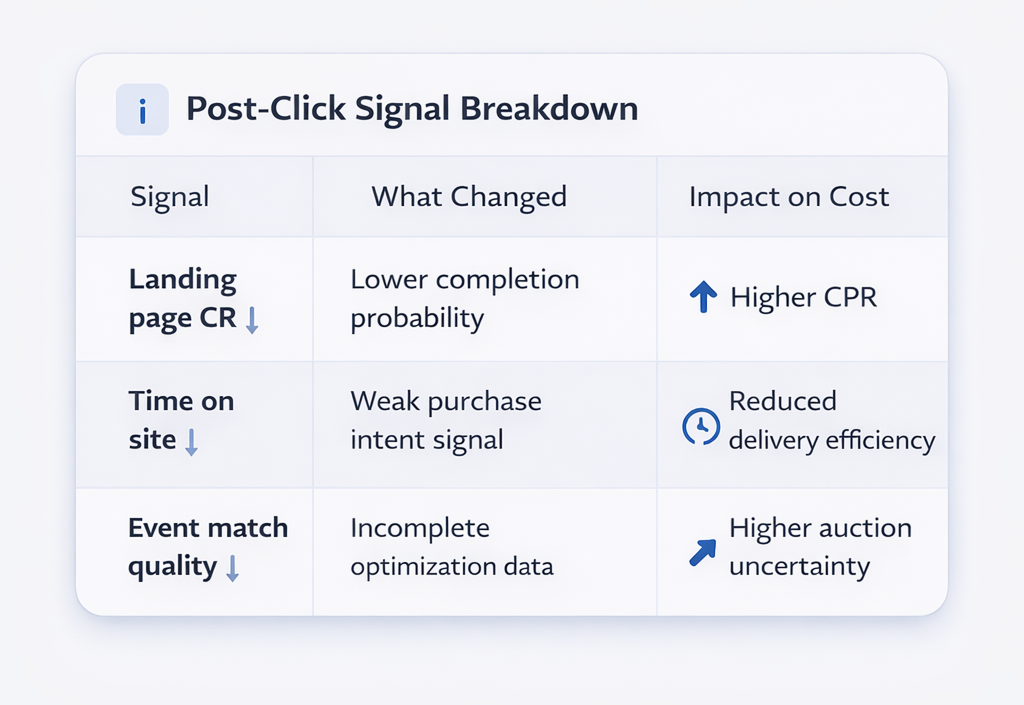
Landing page conversion rate drops; Meta detects weaker completion signals and reduces delivery efficiency.
-
Audience intent softens; prospecting expands into colder segments with lower buying readiness.
-
Tracking data becomes inconsistent; incomplete events reduce optimization precision.
The change does not need to be dramatic. A small drop in conversion rate across thousands of impressions is enough. If you suspect tracking issues, revisit your setup using a guide like how to set up and optimize the Facebook Pixel correctly.
Quality Ranking Slips Over Time
Ad quality ranking influences how competitive your ad is inside the auction. It is not static. It shifts as engagement patterns change.
Costs increase when:
-
Frequency climbs and engagement falls; repeated exposure lowers interaction rates.
-
Creative fatigue reduces engagement velocity; your ad becomes less competitive against newer ads.
-
Click behavior and on-site behavior diverge; users click but do not complete the action.
If you notice declining engagement before costs spike, review early warning signs of ad fatigue and how to fix it. Quality deterioration rarely happens overnight. It builds gradually, then shows up as higher costs.
Audience Saturation and Frequency Pressure
Audience saturation is one of the most common cost drivers. It often goes unnoticed because performance declines slowly.
As frequency rises, engagement patterns shift. Users scroll faster. Clicks become less intentional. Conversion rates begin to soften.
You may still generate results, but each one costs more.
Signs Your Audience Is Saturated
Watch for these signals:
-
Frequency rising above historical comfort levels; cost per result increases without a CPM spike.
-
Stable CTR paired with falling conversion rate; marginal users are entering the funnel.
-
Retargeting audiences shrinking; fewer high-intent users available for delivery.
If you are unsure whether your audience size is limiting delivery, review how audience size affects Facebook ad cost and performance. Expanding targeting aggressively can make things worse. Broader audiences often dilute intent and lower conversion efficiency.
Retargeting Pools Are Smaller Than You Think
Retargeting depends entirely on traffic volume. If website traffic declines, audience pools shrink immediately.
When pools shrink:
-
Competition intensifies among advertisers targeting similar segments.
-
Delivery becomes uneven; the system struggles to find qualified users.
-
Cost per result increases even if bids remain unchanged.
In these cases, the problem is not bidding. It is limited high-intent supply.
Competitive Pressure in the Auction
Sometimes the issue is external. Competition inside the auction changes constantly.
Seasonal budget increases, industry cycles, or aggressive scaling from competitors all affect CPM. If CPM rises and conversion rate remains flat, cost per result increases automatically.
This is pure math.
Market Shifts That Push Costs Higher
Common drivers include:
-
Seasonal demand spikes; multiple advertisers increase budgets simultaneously.
-
New competitors entering the space; auction density rises.
-
Budget surges from large accounts; smaller advertisers must bid more aggressively to compete.
If you want to understand cost pressure from a broader angle, explore what influences CPM on Facebook ads and how to keep it under control. Always compare CPM to your own historical baseline. Platform averages are not useful for diagnosis.
Scaling Budgets Too Quickly
Budget increases expand delivery into new audience segments. Not all segments convert equally.
When you scale fast, the system searches for additional inventory. That often means reaching lower-probability users.
The result is predictable. Conversion rate drops. Cost per result climbs.
What Happens During Aggressive Scaling
You may see:
-
Expansion into colder audiences; estimated action rate decreases.
-
Learning phase resets triggered by structural edits.
-
Audience overlap between campaigns; internal competition inflates CPM.
Gradual scaling allows performance data to stabilize. Rapid scaling stresses the system and exposes weak foundations.
Tracking and Signal Loss
Meta’s optimization depends on clean event data. When signals weaken, predictive accuracy declines.
Signal loss can come from small technical issues that go unnoticed.
Common disruptions include:
-
Pixel misfires; events fire incorrectly or double-count.
-
Server-side tracking gaps; event match quality drops.
-
Attribution changes; fewer reported conversions alter optimization signals.
When the system receives incomplete data, it becomes conservative. Conservative delivery often costs more.
Creative Fatigue Is More Subtle Than CTR
Many advertisers watch CTR to judge creative health. That metric alone is incomplete.
Engagement velocity matters more than static CTR. Meta compares how quickly your ad generates interactions relative to competitors.
As creative ages, velocity slows. Ranking weakens. CPM creeps up.
You may not notice until cost per result increases.
Funnel Friction Outside Meta
Cost per result is influenced by everything after the click. Small changes on your site can shift performance significantly.
If page speed slows or form complexity increases, conversion rate drops. Meta reacts immediately.
Even minor friction compounds at scale.
Common external drivers include:
-
Slower load times after website updates.
-
Changes to offers that reduce urgency.
-
Additional required form fields that lower completion rates.
When conversion rate falls, cost per result follows.
Diagnose Before You Adjust
When cost per result rises, resist the urge to change bids immediately. First identify which variable moved.
Start with these checks:
-
Compare CPM to historical benchmarks; isolate auction pressure from funnel issues.
-
Review conversion rate trends; confirm landing page stability.
-
Evaluate frequency and audience size; detect saturation.
-
Inspect tracking integrity; confirm event accuracy.
-
Assess creative age and engagement velocity.
Most cost increases trace back to a single structural shift. Once you isolate it, adjustments become straightforward.
Cost per result does not increase randomly. The system responds to measurable signals. When you identify which signal changed, the solution becomes much clearer.