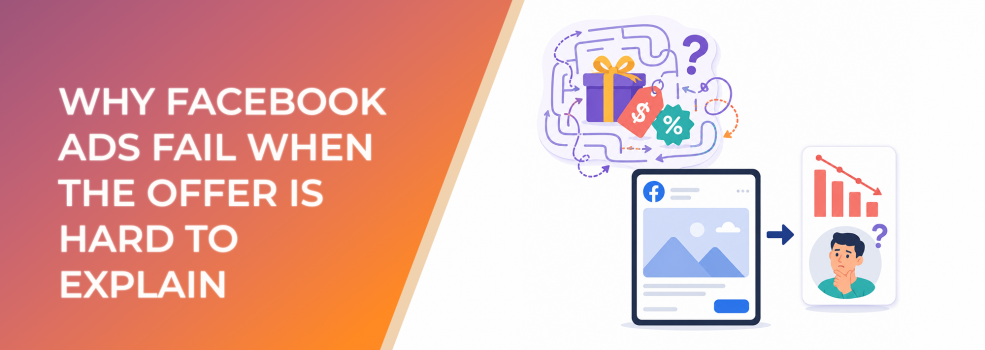
Some Facebook ads fail because the offer is not weak, but because it is hard to explain.
The business may be legitimate. The product may be useful. The team may have strong customer results. But if the audience needs too much context before understanding the offer, the ad is at a disadvantage from the first impression.
This affects B2B advertisers, SaaS companies, agencies, consultants, local service providers, ecommerce brands, affiliate marketers, and startups. The more explanation an offer requires, the more pressure it puts on the ad, the creative, the landing page, and the sales process.
Paid social is not a patient environment. If the offer cannot be understood quickly, budget often gets spent before demand gets created.
The Problem
The problem is offer complexity.
An offer is hard to explain when the audience cannot quickly answer:
What is this?
Who is it for?
What problem does it solve?
Why should I care now?
What makes it different from alternatives?
What should I do next?
A hard-to-explain offer may use too much internal language. It may combine several services into one package. It may be new to the market. It may solve a problem the buyer has not yet named. Or it may require the user to understand a process before understanding the benefit.
In Facebook Ads, this is risky because users are usually not actively searching for the offer. The ad has to create relevance quickly.
Why This Problem Hurts Performance
When the offer is hard to explain, the campaign often pays for confusion.
CPC can rise because the ad does not create immediate relevance.
CTR may be low because users do not understand the reason to click.
CPA can increase because people who click may still misunderstand the offer.
CAC can rise because sales teams spend more time explaining basic fit.
Lead quality can decline because form fills come from curiosity rather than qualified demand.
ROAS can weaken because the ad does not create enough confidence before the user reaches the landing page.
The biggest cost is not always visible inside Ads Manager. It often appears downstream as poor sales conversations, low show rates, weak demo quality, long sales cycles, refund requests, or confused support questions.
Common Scenarios Where This Happens
A B2B SaaS company sells a workflow automation tool but describes it using platform features instead of the business problem it solves.
A consultant offers a custom strategy package with several deliverables, but the ad does not explain the primary outcome.
An agency promotes “full-funnel growth systems” without clarifying whether it helps with lead generation, sales conversion, retention, attribution, or creative testing.
A local business offers a specialized service that customers only understand after a long explanation.
An ecommerce brand sells an innovative product but leads with technical details instead of the practical use case.
A startup creates a new category and assumes the audience already understands why the category matters.
In each case, the ad has to educate, position, differentiate, and convert at the same time. That is too much work for one short message.
Why the Problem Happens
This problem usually happens because teams explain the offer from the inside out.
They start with what the business does, how the product works, or what the team built. But buyers do not evaluate offers in that order.
Buyers usually start with their own situation.
They ask:
Is this relevant to me?
Does it solve a problem I already care about?
Is the outcome worth my attention?
Is this credible?
Is the next step worth the effort?
Another cause is feature overload. When an offer has many parts, teams try to include all of them in the ad. The result is a message with no hierarchy.
Hard-to-explain offers also happen when businesses avoid choosing a primary angle. They want the offer to sound valuable to every possible buyer, so the message becomes too abstract for any one buyer to feel urgency.
The Solution
The solution is to simplify the offer before writing the ad.
That does not mean dumbing it down. It means creating a message hierarchy that lets the audience understand the value in the right order.
1. Lead with the buyer’s problem, not the offer structure
Do not start by explaining the full product, process, or package.
Start with the problem the buyer already recognizes.
Weak:
“An AI-powered workflow intelligence platform for distributed teams.”
Stronger:
“Find the client approvals, task delays, and handoff gaps slowing down your remote team.”
The second version gives the user a reason to care before asking them to understand the system.
2. Reduce the offer to one primary outcome
A complex offer may have many benefits, but the ad should emphasize one main outcome.
For lead generation, that might be qualified calls, better-fit inquiries, fewer wasted sales conversations, or faster pipeline creation.
For ecommerce, it might be comfort, durability, confidence, convenience, speed, or identity.
For local services, it might be immediate availability, reduced risk, better results, or less hassle.
If the ad tries to sell five outcomes at once, none of them feels sharp.
3. Explain the mechanism only after the value is clear
The mechanism matters, but it should not appear before the buyer understands the benefit.
A useful structure is:
Problem → Outcome → Mechanism → Proof → CTA
For example:
“Stop paying for leads your sales team cannot close. Build campaigns around buyer-fit signals, qualification standards, and message angles that attract stronger prospects.”
The first sentence names the pain. The second explains the mechanism.
4. Replace abstract claims with concrete situations
Abstract claims make hard-to-explain offers even harder to understand.
Weak:
“Transform your operations.”
Stronger:
“Cut the manual reporting work your operations team repeats every Friday.”
Weak:
“Scale smarter.”
Stronger:
“Find the ad audiences that convert before increasing your daily budget.”
Concrete situations help the user picture the problem.
5. Use the landing page for depth
The ad should not carry the entire explanation.
Its job is to earn the next action with enough clarity and relevance. The landing page can explain the process, proof, pricing, examples, objections, and next steps.
If the ad needs five paragraphs to make sense, the offer needs a clearer entry point.
Risks and Considerations
Do not oversimplify the offer so much that it becomes misleading.
A simplified message should still represent what the product or service actually does. If the ad creates expectations the landing page cannot support, conversion quality may decline.
Also avoid removing the mechanism entirely. Buyers often need to know why the claim is believable. The key is sequence: value first, mechanism second.
Complex offers may require multiple campaigns for different awareness stages. Cold audiences may need problem education. Warm audiences may need comparison. Retargeting audiences may need proof or risk reduction.
Prerequisites and Dependencies
You need a clear ICP, a defined offer, and a primary conversion goal.
You also need a landing page that continues the same message. If the ad simplifies the offer but the landing page returns to dense internal language, users may lose confidence.
Reliable conversion tracking and sales feedback are also important. A simplified ad may increase clicks, but the real test is whether it improves qualified conversion rate, CPA, CAC, ROAS, and sales quality.
Practical Recommendations
Before launching ads for a hard-to-explain offer, write three versions of the offer.
First, write the full internal explanation.
Second, write a one-sentence buyer-facing version.
Third, write a short ad version that names the problem, outcome, and next step.
Then ask whether a cold prospect could understand the ad without a sales call.
Use this pre-launch check:
Can the buyer identify themselves?
Can they recognize the problem?
Can they understand the outcome?
Can they believe the mechanism?
Can they take the next step without confusion?
If any answer is no, simplify before launch.
Final Takeaway
Facebook ads fail when the offer is hard to explain because the campaign spends budget before the audience understands the value.
The fix is not to cram more explanation into the ad. The fix is to create a clearer message hierarchy: buyer problem, primary outcome, believable mechanism, proof, and next step.
Related LeadEnforce Articles
- Define Your Unique Value Before Creating Facebook Ads — Helps clarify why a specific buyer should choose the offer before ad creation.
- How To Stop Facebook Ads From Sounding Generic With Better Offer Framing — Shows how to frame an offer around a specific buying situation.
- Why Facebook Ads Struggle When Your Business Sounds Like Everyone Else — Explains why unclear differentiation makes ads harder to act on.
- Why Facebook Ads Blend In When Your Differentiator Is Missing — Useful for diagnosing whether the offer lacks a clear reason to choose it.