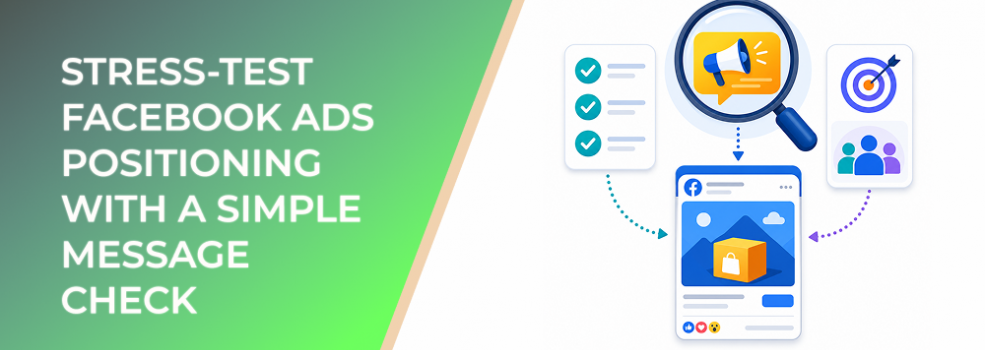
Many Facebook ad problems are positioning problems disguised as creative problems.
The team sees weak CTR, rising CPA, poor lead quality, or unstable scaling and assumes the ad needs a new image, shorter copy, or a different CTA. Sometimes it does. But often, the deeper issue is that the positioning was never pressure-tested before launch.
Positioning determines who the ad is for, what problem it owns, why the offer is different, and why the buyer should care now.
If that foundation is unclear, every campaign decision becomes harder.
The Problem
The problem is building Facebook ads before checking whether the positioning is strong enough to support performance.
Weak positioning can still produce a professional-looking ad. The copy may be grammatically correct. The creative may follow best practices. The campaign may be set up correctly.
But the message may not answer the questions that matter:
Who exactly is this for?
What painful situation does it address?
What outcome does it make possible?
Why is this offer different from alternatives?
What proof makes the claim credible?
What next step makes sense for this buyer?
Without those answers, the campaign is not testing a strong position. It is testing a vague idea.
Why This Problem Hurts Performance
Poor positioning hurts performance across the funnel.
At the ad level, users do not feel enough relevance to stop and engage. That can weaken CTR and increase CPC.
At the audience level, targeting becomes less disciplined because the team has not defined who the message is meant to persuade.
At the landing page level, visitors arrive with unclear expectations. That can reduce conversion rate.
At the lead level, the campaign may attract people who like the category but do not have the right problem, budget, authority, or urgency.
At the scaling level, vague positioning makes winning ads harder to repeat. If the team does not know why an ad worked, scaling becomes guesswork.
Common Scenarios Where This Happens
A SaaS company promotes “save time across your workflow” but does not define the role, workflow, or cost of the problem.
A B2B lead-generation team advertises “more qualified leads” without explaining the qualification standard or acquisition mechanism.
An ecommerce brand says “premium product” but does not clarify whether the positioning is based on durability, design, ingredients, identity, comfort, or use case.
A local service business promotes “trusted experts” but does not connect the service to an urgent local buying moment.
An agency creates multiple ads with different visuals but the same vague positioning underneath.
These advertisers are not lacking activity. They are lacking a strong pre-launch positioning check.
Why the Problem Happens
Positioning problems happen because advertisers often separate strategy from execution.
They treat targeting, copy, creative, offer, and landing page as separate tasks. But in a strong campaign, those pieces should reinforce one position.
Another reason is pressure to publish quickly. When a campaign needs to go live, teams may approve the first message that sounds clear internally.
Internal clarity is not enough. The message must be clear to the buyer.
Positioning also weakens when teams avoid tradeoffs. Strong positioning usually chooses one buyer, one problem, one primary outcome, and one reason to believe. That feels limiting, but it makes the ad easier to understand and evaluate.
The Solution
The solution is to run a simple positioning message check before campaign setup.
Use six questions.
1. Buyer check: who is this for?
The answer should be specific enough to guide copy and targeting.
Weak:
“Business owners.”
Stronger:
“Local home-service business owners who need more booked appointments from nearby homeowners.”
The stronger answer tells the creative team what language, proof, and offer angle may matter.
2. Pain check: what problem does the buyer recognize?
A good ad does not only describe the product. It names the buyer’s friction.
Weak:
“Improve your operations.”
Stronger:
“Stop losing hours every week reconciling inventory data across spreadsheets and sales channels.”
The second version creates recognition.
3. Outcome check: what result is the buyer trying to achieve?
The outcome should be concrete enough to evaluate.
Weak:
“Better results.”
Stronger:
“More qualified demo requests from operations leaders at mid-market logistics companies.”
A clear outcome helps the advertiser judge quality, not just activity.
4. Mechanism check: how does the offer create the outcome?
The mechanism explains why the claim is believable.
Examples include a process, data source, product feature, service model, audience strategy, specialization, guarantee, workflow, or delivery method.
Without a mechanism, the offer sounds like a promise. With a mechanism, it becomes easier to believe.
5. Proof check: why should the buyer trust it?
Proof can include reviews, examples, process detail, visible demonstrations, benchmarks from past campaigns, customer language, or niche expertise.
The proof should support the main claim.
Do not use proof as decoration. Use it to reduce doubt.
6. Fit check: does the audience source match the position?
This is where many pre-launch checks fail.
An ad may have a strong message, but if it is shown to the wrong audience, the results will be misleading.
Ask:
Where does this buyer already spend attention?
Which communities, profiles, competitors, creators, roles, or professional filters signal relevance?
What audience source would make this positioning test cleaner?
A strong positioning check should connect the message to reachable audience signals.
How LeadEnforce Helps
LeadEnforce can support the fit-check part of positioning.
When your positioning depends on a specific audience, you need more than a broad demographic assumption. LeadEnforce helps advertisers create audience tests from Facebook groups, Instagram profile followers and engagers, LinkedIn-derived professional data, and custom social-profile sources. Its official feature pages describe these audience-building options, including Facebook group targeting, Instagram targeting, LinkedIn audience creation, and custom audiences from social profile links.
That makes the positioning check more practical.
For example:
If the position is built for agency owners, you can test audiences connected to agency communities, professional criteria, or relevant Instagram profiles.
If the position is built for competitor-aware ecommerce buyers, you can test audiences connected to niche Instagram profiles or engagement sources.
If the position is built for B2B decision-makers, you can test professional audiences based on role, company, or industry criteria.
LeadEnforce does not replace positioning strategy. It helps advertisers turn positioning assumptions into audience tests that are easier to interpret.
Risks and Considerations
A simple message check can expose uncomfortable problems.
You may discover that the offer is too broad, the buyer is poorly defined, the proof is weak, or the audience source is not strong enough.
Do not ignore those issues just to launch faster.
Also avoid over-narrowing. A highly specific position can improve relevance, but if the audience is too small, delivery may be unstable and frequency may rise quickly.
If using LeadEnforce, remember that source-based audiences still need validation. A community, profile, or professional segment can look relevant and still perform poorly if the offer, message, creative, or landing page is weak.
Prerequisites and Dependencies
You need a clear ICP, a defined campaign objective, a specific offer, and a landing page that matches the message.
You also need success metrics that reflect business quality. Do not judge positioning only by CTR. Track qualified leads, conversion rate, booked-call quality, CAC, CPA, ROAS, sales feedback, and pipeline quality.
If using LeadEnforce, you need relevant source audiences: Facebook groups, Instagram profiles, Instagram engagers, LinkedIn-derived professional criteria, or custom social-profile data that genuinely match the positioning hypothesis.
Practical Recommendations
Before building your next Facebook ad, write one positioning sentence:
“For [specific buyer], who struggles with [specific problem], this offer helps achieve [specific outcome] through [specific mechanism], supported by [proof].”
Then pressure-test it with five checks:
Could the buyer recognize themselves?
Is the pain specific?
Is the outcome valuable?
Is the mechanism believable?
Can we reach an audience that fits this position?
If the answer to any question is weak, fix the positioning before building ads.
Once the position is clear, create separate ad concepts for different angles. Do not test five versions of the same vague idea. Test meaningful positioning differences.
Use LeadEnforce when the positioning depends on reaching people connected to specific communities, profiles, professional roles, or social-profile signals.
Final Takeaway
Facebook ad positioning should be stress-tested before campaign setup.
A simple message check can reveal whether the ad has a clear buyer, pain, outcome, mechanism, proof point, and audience fit. When those elements are aligned, the campaign has a stronger foundation and the results become easier to interpret.
To test clearer positioning against more intentional Facebook and Instagram audience sources, join the free 7-day LeadEnforce trial period.
Related LeadEnforce Articles
- Plan Facebook Ads So Creative, Audience, And Goal Stay Aligned — Helps connect campaign objective, audience, creative, and message before launch.
- Define Who Your Facebook Ads Should Reach Before You Launch — Explains how audience definition shapes targeting, messaging, and campaign quality.
- Why Audience Uncertainty Weakens Facebook Ads Before Launch — Shows why unclear audiences create vague messaging and noisy tests.
- How To Fix Weak Facebook Ads With Sharper Positioning — Gives a deeper positioning framework for weak ad messages.