Stabilization refers to the period when Facebook’s ad delivery system is learning how to deliver ads most efficiently. When a new campaign, ad set, or major edit is launched, Facebook begins testing different variables such as audience segments, placements, and delivery patterns.
An ad set is considered stabilized once it exits the learning phase and performance becomes more predictable. Before this point, metrics often fluctuate and should not be judged too quickly.
Why Facebook Ads Don’t Perform Consistently at the Start
1. The Learning Phase Requires Data
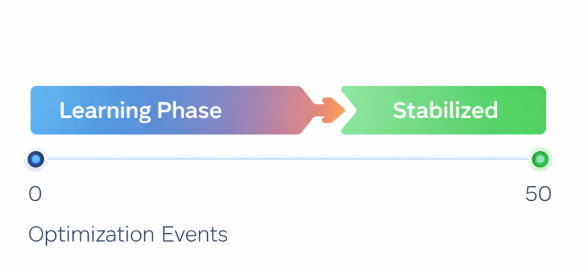
Example trend of cost per result fluctuating widely during the first week of a Facebook Ads campaign before stabilizing
Facebook’s algorithm depends on conversion data to optimize delivery. Meta states that an ad set generally needs around 50 optimization events within a 7-day period to exit the learning phase. Without sufficient data, the system cannot accurately predict who is most likely to convert, which leads to unstable results early on.
2. Audience Testing Takes Time
At launch, Facebook explores multiple micro-segments within the selected audience. It tests different combinations of demographics, behaviors, placements, and delivery times. This exploration phase often results in higher costs and inconsistent conversion rates during the first days.
3. Budget and Delivery Calibration
In the early stages, Facebook adjusts ad delivery to align with the daily budget. Industry benchmarks show that cost per result can fluctuate by 30–40% during the first week of a campaign before settling into a more stable range.
4. Creative Performance Is Still Being Evaluated
Facebook continuously evaluates ad creatives based on engagement, relevance, and predicted conversion likelihood. Strong creatives receive increased delivery over time, while weaker ones are gradually deprioritized. This evaluation process requires sufficient impressions and cannot happen instantly.
How Long Does It Take for Facebook Ads to Stabilize?
For most campaigns, stabilization occurs within 5 to 7 days, assuming:
-
The campaign generates enough conversion events
-
Budgets are not overly restrictive
-
Major changes are avoided during this period
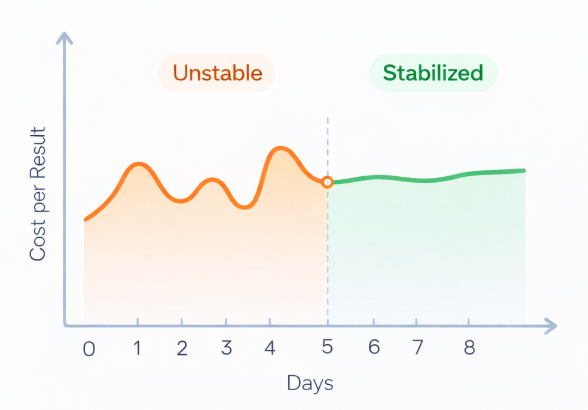
Approximate number of optimization events required for Facebook Ads to exit the learning phase and stabilize performance
For lower-volume campaigns or high-ticket offers, stabilization may take 10 to 14 days, especially when conversions occur less frequently.
What Can Delay Stabilization?
Certain actions can reset or prolong the learning phase:
-
Budget changes exceeding 20–30%
-
Editing targeting, placements, or optimization events
-
Replacing or heavily modifying creatives
-
Frequently pausing and restarting ad sets
Each of these changes forces the algorithm to re-learn, delaying stable performance.
Best Practices During the Stabilization Period
Avoid Early Optimization
Optimizing based on one or two days of data often leads to worse long-term results. Meta has reported that campaigns adjusted too early frequently experience higher costs over time compared to campaigns allowed to complete the learning phase.
Focus on Performance Trends
Instead of reacting to daily fluctuations, analyze performance over rolling 3–7 day windows. This provides a clearer picture of how the campaign is actually performing.
Keep Budgets Consistent
Stable budgets help Facebook learn faster and more accurately. Gradual budget adjustments are far more effective than aggressive changes during the learning phase.
Why Patience Pays Off
Campaigns that are allowed to stabilize typically show:
-
More consistent cost per result
-
Improved conversion rates
-
Better budget efficiency
-
Clearer data for scaling decisions
Industry data suggests that campaigns allowed to fully stabilize can achieve 15–25% lower cost per acquisition compared to campaigns optimized prematurely.
Related Articles You May Find Useful
Final Thoughts
Facebook Ads are not designed to deliver optimal results immediately. The stabilization period is a critical phase where the system learns how to deliver ads efficiently. Allowing campaigns the time they need to stabilize creates a stronger foundation for consistent performance and scalable growth over the long term.