When a new Facebook campaign launches, performance rarely stabilizes immediately. Cost per result may fluctuate, conversions may appear in uneven bursts, and delivery patterns often change during the first few days.
This behavior does not necessarily indicate a problem with targeting or creative. In most cases, it reflects how Meta’s delivery system collects behavioral signals before committing budget to specific users.
Optimization requires real interaction data. Until enough signals accumulate, the system continues testing different segments of the audience.
The Algorithm Starts by Testing Multiple Audience Segments
When a campaign begins delivery, Meta does not immediately focus on a single group of users. Instead, the system distributes impressions across several behavioral clusters inside the targeted audience.
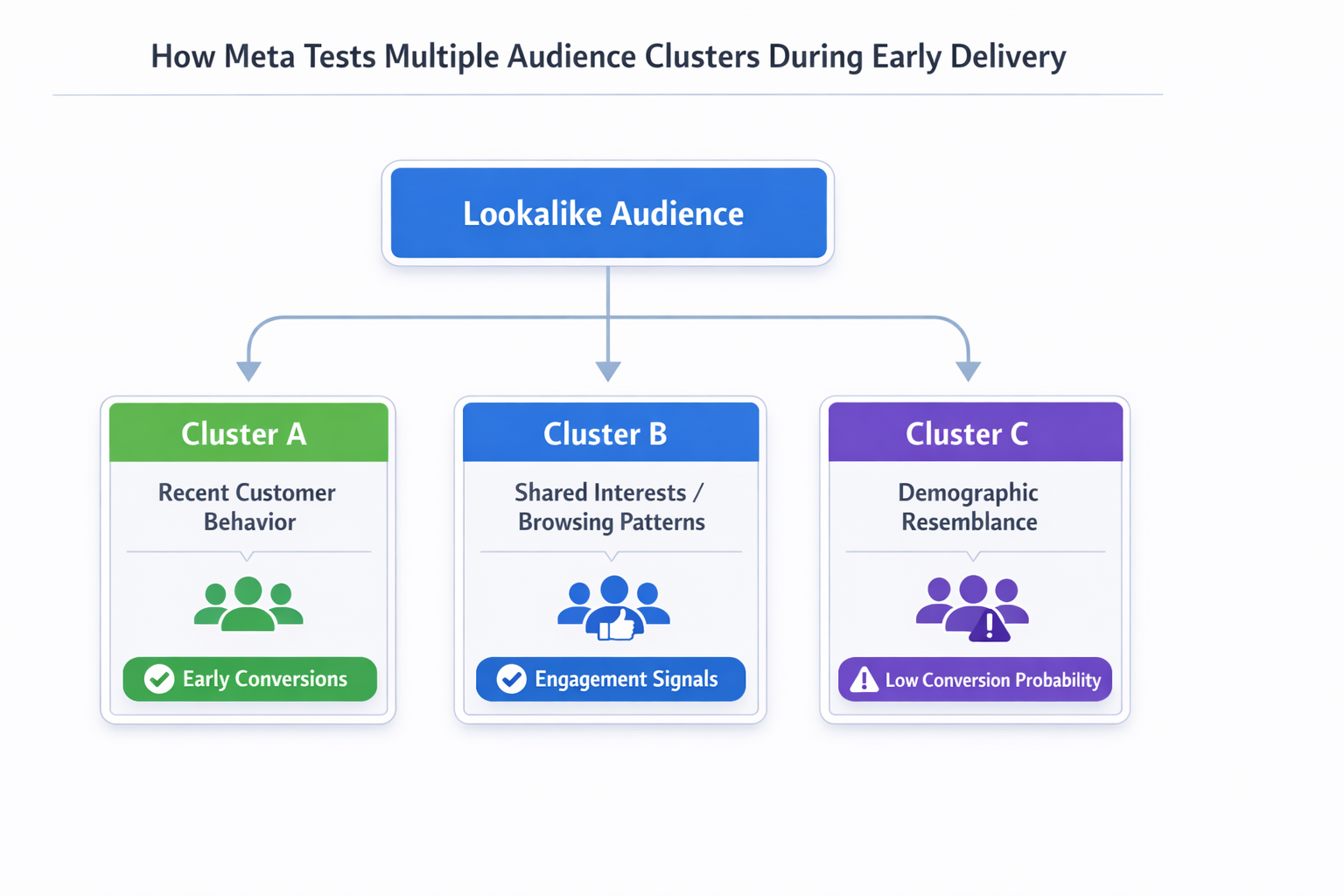
For example, a campaign using lookalike targeting may initially reach multiple groups:
-
Users closely resembling recent customers.
These individuals often generate early conversions because their behavior strongly matches the seed audience. -
Users with partial behavioral overlap.
They may share interests or browsing patterns with customers but lack recent purchase activity. -
Users connected through weaker demographic similarities.
These segments allow the algorithm to test whether certain attributes still correlate with conversion probability.
Early performance may appear inconsistent because each cluster responds differently. Some segments produce conversions quickly, while others generate engagement without meaningful outcomes.
This exploratory stage is also why campaigns using lookalikes often stabilize gradually rather than immediately. If you want to understand how these audiences are constructed, the mechanics are explained in The Ultimate Guide to Facebook Lookalike Audiences.
Optimization Requires Enough Conversion Signals
The delivery system improves targeting only after receiving enough conversion feedback. Without sufficient signals, the model cannot reliably determine which audience patterns matter.
Several types of interaction contribute to optimization:
-
Confirmed conversions.
Purchases, leads, and sign-ups provide the strongest signals because they reveal the behavioral traits of users who completed the intended action. -
Intermediate engagement signals.
Clicks, landing-page views, and time spent on the website indicate partial intent and help estimate conversion probability. -
Negative engagement indicators.
Rapid scrolling, ad hiding, or extremely short page visits suggest weak audience fit and help the system reduce exposure to certain segments.
When conversions appear slowly, the algorithm continues experimenting with different audience clusters. Campaigns with small budgets or rare conversion events often require more time to stabilize.
A broader explanation of how these audiences influence delivery can be found in Everything You Need to Know About Facebook Ads Audiences.
The Learning Phase Reflects Data Stability
Meta describes the early stage of campaign delivery as the learning phase. During this period, the system actively tests delivery patterns while collecting behavioral feedback.
The learning phase does not end after a fixed number of hours. It ends when the algorithm receives enough consistent signals to make reliable predictions.
Several factors influence how quickly this happens:
-
Conversion frequency.
Campaigns generating frequent conversions usually stabilize faster because patterns become visible quickly. -
Audience size and diversity.
Larger audiences contain more behavioral variation, which increases exploration but eventually produces stronger signals. -
Budget relative to event volume.
Very small budgets slow the feedback loop because the system gathers data more slowly. -
Creative engagement quality.
Ads that generate strong engagement provide early signals that guide the algorithm toward promising audience segments.
Audience structure also plays a role in optimization speed. The article Maximizing ROI Through Facebook Audience Segmentation explains how segmentation decisions influence campaign performance.
Frequent Edits Can Restart Optimization
Early volatility often causes advertisers to intervene too quickly. Adjusting campaigns repeatedly during the first few days can delay optimization rather than improve it.
Several common changes interrupt the learning process:
-
Large budget adjustments.
Significant increases or decreases force the system to redistribute impressions across new inventory. -
Targeting changes.
Modifying audience parameters introduces new user segments that require fresh testing. -
Optimization event switches.
Moving from add-to-cart optimization to purchase optimization changes which signals the algorithm prioritizes. -
Creative replacements.
New ads produce different engagement patterns, forcing the model to evaluate performance again.
When these edits occur frequently, the campaign never produces stable behavioral data. The algorithm continuously restarts its evaluation process.
A deeper explanation of how different audience types behave in Meta campaigns can be found in The Complete Guide to Warm, Cold, and Custom Audiences in Meta Ads.
Signs That Optimization Has Stabilized
Once the system gathers enough signals, campaign metrics begin to stabilize. Several patterns usually appear.
| Signal in Ads Manager | What You Will Notice | What It Means |
|---|---|---|
| Cost per result volatility decreases | CPA still moves slightly day-to-day, but large spikes become rare | The algorithm has identified users more likely to convert |
| Delivery concentrates in certain users | Frequency increases for a smaller portion of the audience | Meta is prioritizing segments with higher conversion probability |
| Conversions appear at regular intervals | Results occur steadily rather than in random bursts | The system has enough data to predict which impressions are most valuable |
These signals indicate that the algorithm has identified behavioral patterns associated with conversion probability.
Final Takeaway
Facebook Ads rarely optimize instantly because the delivery system must observe real user behavior before prioritizing specific audience segments. The first few days of a campaign typically involve testing, signal collection, and gradual narrowing of delivery.
Allowing the algorithm enough uninterrupted time to gather reliable signals often leads to more stable and more efficient performance.