Messenger campaigns often create useful conversations that never become clear data. A user may ask for a price, speak with a rep, book a call, or buy later, but the campaign may only record the early chat activity.
That creates a learning problem.
Meta can optimize better when it receives clear signals about valuable outcomes. If the only visible event is “conversation started,” the system has less information about which users actually became buyers.
The problem: The campaign sees the chat, but not the buyer
A Messenger campaign can look active while still hiding the most important moment in the journey.
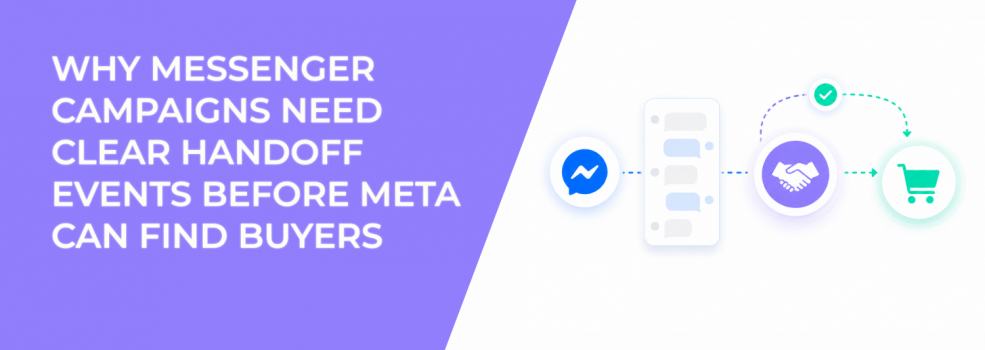
The user clicks the ad, enters Messenger, talks to the business, and then moves to a phone call, checkout page, CRM pipeline, or offline purchase. If that final handoff is not tracked, the campaign may not learn which chats produced value.
This is especially common for service businesses, B2B companies, local providers, and high-ticket offers. The sale rarely happens inside the first message. It happens after a rep qualifies the user, sends a quote, books a consultation, or moves the lead into the CRM.
If that handoff is invisible, Meta may keep finding people who start conversations but do not move forward.
This is where advertisers need to understand how Meta measures user signals. The algorithm does not only need audience inputs. It needs outcome feedback.
Why vague handoffs weaken optimization
A handoff event is the moment a chat becomes a meaningful business action. It can be a booked call, qualified lead, quote request, checkout link click, deposit, purchase, or CRM stage change.
Without that event, every conversation can look similar from the campaign’s point of view.
Here is the difference:
- Weak signal: User started a Messenger conversation.
- Better signal: User answered qualification questions and requested pricing.
- Strong signal: User booked a call, paid a deposit, or completed purchase.
The stronger signal gives the system a clearer pattern. It can start learning which users are more likely to create business value, not just message volume.
This matters for CPA and ROAS because the campaign can otherwise optimize toward the cheapest visible action. Cheap chat starters are not always close to revenue. Stronger handoff events help push delivery toward users who resemble actual buyers.
The solution: Define the handoff before scaling the campaign
Before increasing budget, decide which Messenger action proves that the conversation is valuable.
For an e-commerce brand, it might be a checkout link click or purchase. For a clinic, it might be a booked appointment. For B2B, it might be a qualified demo request. For a local service business, it might be a quote request with location and job type confirmed.
Do not choose a handoff event because it is easy to track. Choose it because it reflects real sales progress.
A good handoff event should meet three conditions:
- It happens after meaningful intent. The user has done more than say hello or ask a vague question.
- It connects to revenue. The event should predict a sale, booking, qualified lead, or pipeline opportunity.
- It can be recorded consistently. Sales or automation must capture it the same way every time.
If the event is inconsistent, the data becomes noisy. One rep might tag a lead as qualified after one answer. Another might only tag after a call. That makes optimization harder.
How CAPI fits into Messenger campaign tracking
Meta’s Conversions API can send marketing data, including messaging events, from business systems back to Meta. That can help connect Messenger activity with later outcomes such as qualified leads or purchases.
This is where many advertisers compare Pixel vs CAPI. The Pixel works well for website behavior. CAPI can help send server-side or CRM-based events that happen outside a normal website session.
For Messenger campaigns, that matters because the conversion may happen in chat, in a CRM, or after a manual sales follow-up.
A simple setup might send events such as:
- QualifiedLead. The user answered key questions and fits the offer.
- BookedAppointment. The user selected a time or confirmed a consultation.
- Purchase. The user paid through a link, invoice, or connected checkout.
- ClosedWon. The CRM confirms that the lead became a customer.
You do not need to send every possible event. Start with the one or two events that best reflect real progress. If setup feels too technical, review how to use Conversion API without a dev team.
Real scenario: Sales closes deals, but Ads Manager sees only chats
A B2B agency runs Messenger ads to book strategy calls. The campaign generates many conversations, and sales closes some deals after calls. But Ads Manager only sees the first message event.
The campaign may keep bidding for users who like to ask questions in Messenger, not users who book and show up.
A better setup would tag “qualified call booked” after the user answers fit questions and selects a time. That event is closer to revenue. Once the campaign receives enough of those events, the data becomes more useful for optimization decisions.
The same logic applies to service businesses. If a roofing company only tracks Messenger replies, it may attract many people asking for rough prices. If it tracks completed quote requests with ZIP code and project type, the campaign has a cleaner signal.
Final takeaway
Messenger campaigns need clear handoff events because the sale often happens after the chat starts.
If Meta only sees the first conversation, it may optimize toward people who talk, not people who buy. Define the handoff, track it consistently, and send cleaner outcome data back into the system.
The better the handoff signal, the easier it becomes to scale beyond cheap conversations.