Meta’s ad platforms no longer reward advertisers who try to control every variable. Instead, the algorithm favors patterns — repeatable behaviors that predict results — over granular definitions like interests or job titles.
This shift isn’t just technical. It impacts how you structure your campaigns, define your audiences, and test creatives.
What Meta’s Algorithm Is Really Optimizing For
Meta’s ad delivery is now heavily driven by machine learning. Rather than serving ads based on precise traits, it serves them based on predicted outcomes.
The platform watches how users behave over time, then tries to match ads to those behaviors. It’s not about finding a “34-year-old male entrepreneur from Austin.” It’s about finding someone who behaves like your best customers.
This logic aligns with Meta’s broader move toward signals over static segments, as explained in Signals, Not Segments: The New Way Meta Measures Users.
Here’s what that looks like in practice:
Meta tracks patterns such as:
-
A user who regularly clicks on product links in the evening, after scrolling through multiple video ads;
-
A user who adds products to cart, but only completes purchases when shown urgency (limited-time offers or countdowns);
-
A user who shares ads via DM, usually for items in a specific category, like fitness equipment or skincare.
These users may not share any demographic overlap. But their behavior makes them valuable, and Meta’s algorithm recognizes that.
Why Narrow Targeting No Longer Works the Way It Used To
Many advertisers still try to outsmart the algorithm by setting up tight, highly filtered audiences. That strategy now works against them more often than not.
Let’s look at why.
| Targeting Approach | What You See | What Meta Sees | Outcome |
|---|---|---|---|
| Narrow (Interests + Filters) | Highly defined persona | Too few users to detect patterns | Slower learning, high CPM |
| Broad (minimal filters + exclusions) | Vague audience | More behavioral variation | Faster optimization, lower cost |
First, you’re working with limited data:
-
Meta removed thousands of interest-based categories, especially around personal identity, politics, and health;
-
Apple’s App Tracking Transparency (ATT) limits third-party tracking across apps and websites;
-
Most users no longer allow apps to collect detailed behavioral data outside the platform.
That means your targeting options are less precise than they appear.
Second, narrow targeting often slows down learning:
When your audience is too small, Meta’s system can’t gather enough signal to optimize delivery. That leads to:
-
Higher CPMs (cost per 1,000 impressions);
-
Slower or incomplete learning phases;
-
Increased volatility in ad performance across days.
This is why broad setups often outperform narrow ones, as outlined in Broad Targeting: When It Beats Narrow.
In short, you’re limiting the machine’s ability to find the patterns that lead to conversions.
Third, machine learning improves with scale:
The more data Meta sees, the better it can predict outcomes. That includes:
-
Click-through behavior;
-
In-app purchases;
-
Time spent watching videos or engaging with content.
Wider audiences give the algorithm more data points, which results in better predictions and more efficient ad spend.
But here’s a critical point: broad targeting isn’t always the answer. If your product, audience, or offer requires more control — for example, a high-ticket service or a B2B niche — blindly going broad may waste budget. The right strategy depends on understanding your goals, how your audience behaves, and what signals the algorithm needs to optimize delivery.
That’s why testing different targeting approaches is still essential. Let performance, not preference, guide your decisions.
How to Align Your Strategy With Pattern-Based Delivery
Advertisers who perform best on Meta platforms today are those who stop micromanaging and start shaping better conditions for the algorithm to work with.
That doesn’t mean you stop making decisions. It means you make different ones, focused on inputs rather than restrictions.
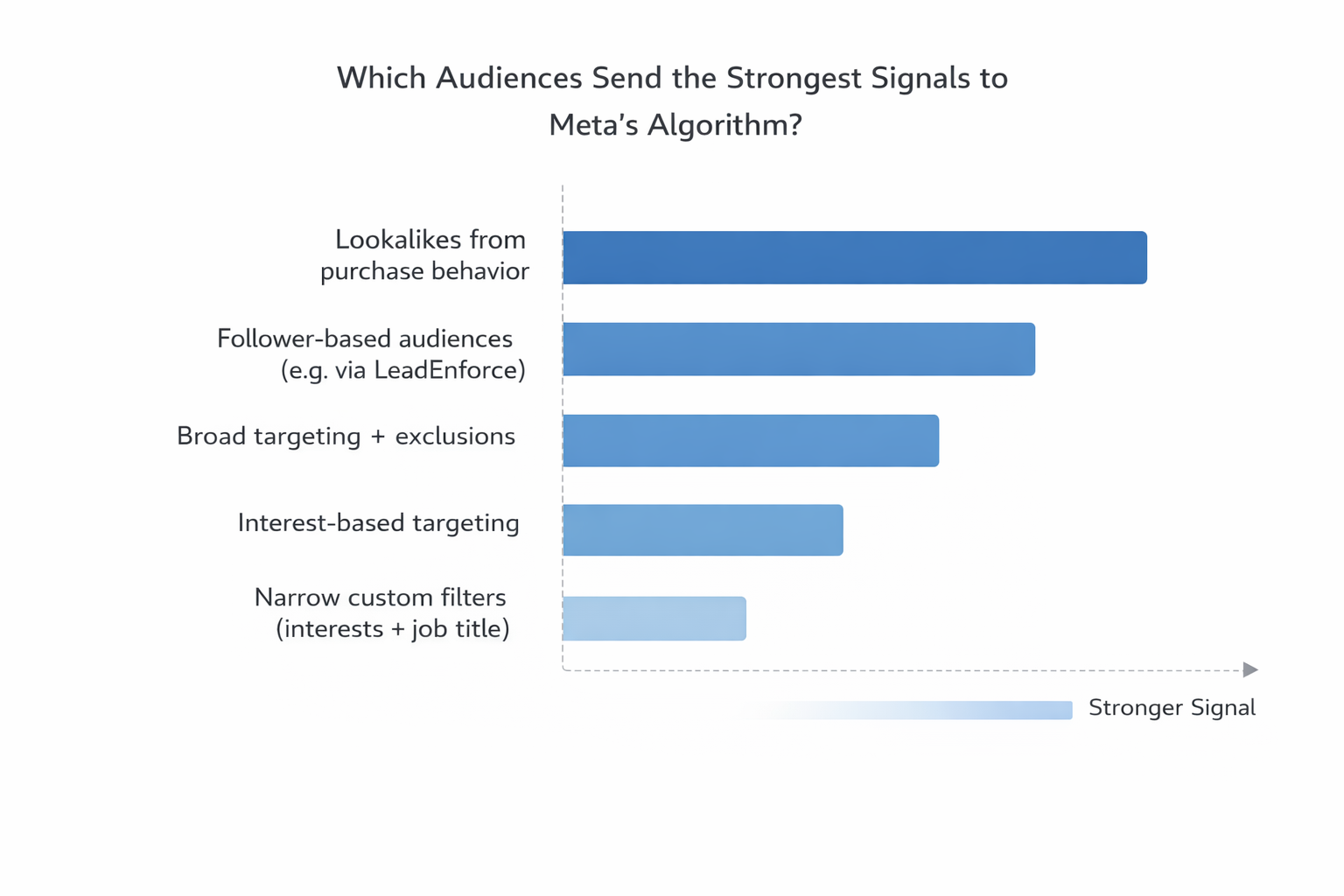
Here’s what to focus on instead:
1. Audience structure that provides useful signals
Avoid overly complex audience filters. Instead, think about how your inputs help Meta identify patterns.
For example:
-
Use follower-based targeting through tools like LeadEnforce, which lets you reach users who already follow competitor accounts or groups. This approach reflects how behavior-based targeting outperforms static interests, as discussed in Behavior-Based Facebook Targeting: The Secret Weapon of Top E-commerce Brands;
-
Limit filters to basic parameters like age range, location, or language, just enough to exclude irrelevant users without restricting learning;
-
Consider using broad targeting plus exclusions (e.g., exclude past converters) to let Meta find new behaviorally similar users.
The goal is to create an environment where Meta’s algorithm can work with real behavioral data. Tools like LeadEnforce are designed for this exact purpose, as explained in How LeadEnforce Simplifies Audience Segmentation for Better Ad Results.
2. Clear conversion signals
Meta needs accurate feedback to improve performance. Weak signals (like page views or video plays) don’t help the algorithm understand what matters.
Strong conversion signals include:
-
Add to cart events with product value attached;
-
Leads with verified contact info submitted through forms;
-
Purchases or subscription signups tracked via Pixel or Conversions API.
If Meta can’t see the end goal clearly, it can’t optimize toward it.
3. Creatives that reflect user behavior, not assumptions
Rather than guessing what your audience wants, look at what they already respond to. Focus on creative elements that align with actual behaviors, like:
-
Using UGC-style video if your best users engage with reviews and tutorials;
-
Running carousel ads for products with multiple features or variations;
-
Including short, active CTAs that match in-app behavior (e.g., “Tap to see sizes,” “Swipe for details”).
The point is to make it easy for users to act, and for Meta to recognize which actions lead to conversions.
Why Pattern-Based Campaigns Scale Better
When you rely on behavior rather than narrow traits, your campaigns become more flexible. You’re no longer limited to a rigid user persona. Instead, you’re targeting behaviors that cut across age, gender, or interest.
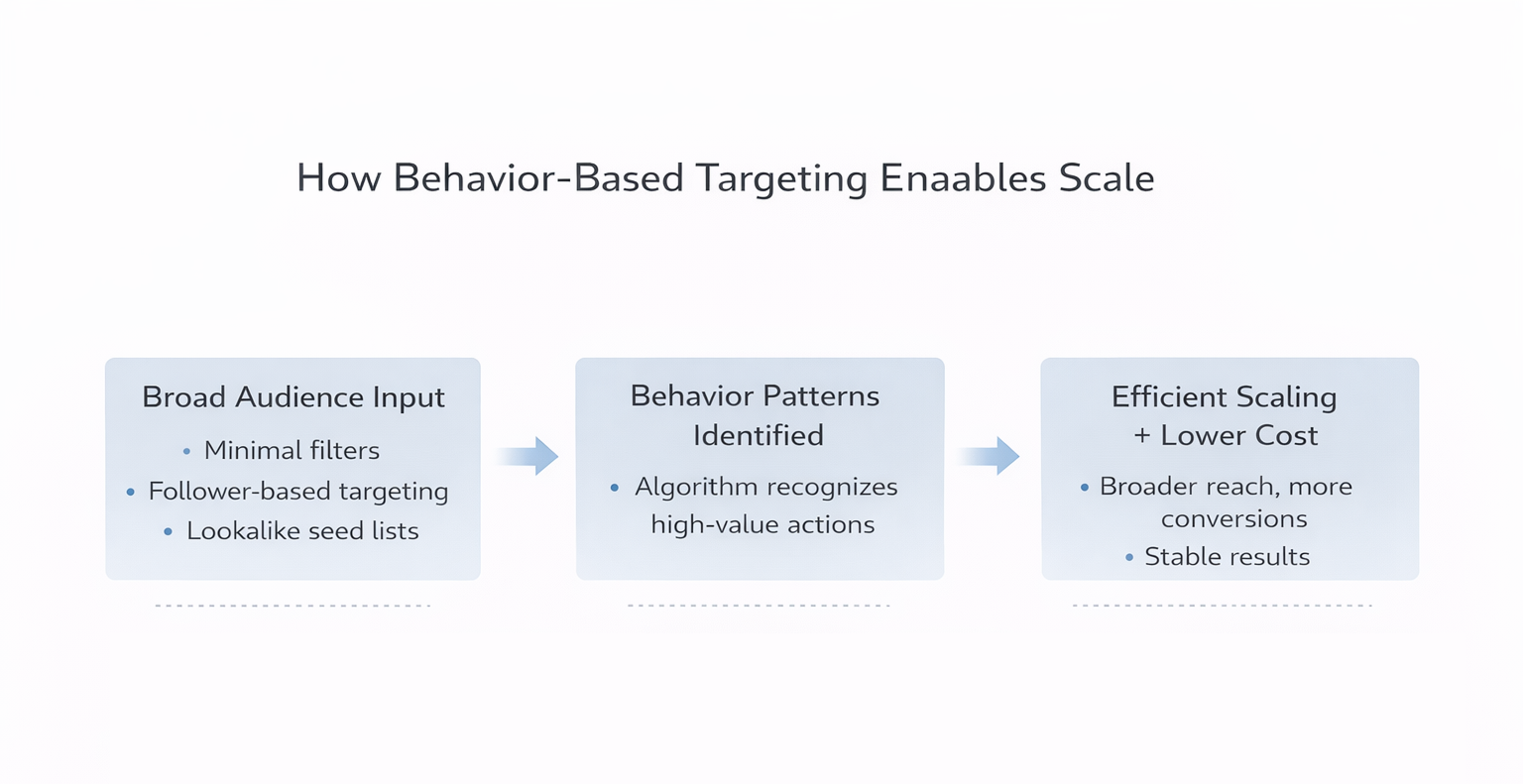
Meta’s algorithm handles scaling more efficiently when:
-
It can recognize high-performing behavior across thousands of users;
-
It isn’t restricted by small audiences or hard filters;
-
It has enough signal to understand which parts of your funnel are working.
That’s why pattern-based campaigns often stabilize faster and cost less over time. They work with Meta’s system, not against it.
Precision Still Matters — Just in Different Areas
None of this means you should stop optimizing. It means you should shift where your effort goes.
You’ll get better results by applying precision to things Meta can’t control for you.
Focus your precision on:
-
Creative testing, including image styles, video formats, or hooks in the first three seconds;
-
Landing page UX, ensuring fast load times and frictionless checkout;
-
Offer structure, such as bundles, cross-sells, or first-time buyer incentives.
These areas directly impact how users respond to your ads. And user response is what fuels the algorithm.
Final Thoughts
Meta doesn’t need perfect targeting from you. It needs the right signals, the right creative environment, and room to observe behavior.
The advertisers who win are those who guide performance, not force it.
Instead of chasing precision, start building conditions where patterns can emerge. That’s how Meta learns. And that’s how your campaigns become more efficient over time.