Many digital advertising strategies work great at the start — then crash as soon as you try to scale.
Clicks slow down. Costs go up. ROAS tanks. And it's not always clear why.
But there’s a common reason behind most failures: advertisers stop at the first funnel. They plan for the first purchase, but not for what comes next. They don’t build systems to turn clicks into customers — or customers into repeat buyers.
Let’s break down why this happens, and how to fix it using smarter audience targeting, better creative planning, and full-funnel thinking.
Most advertisers build only the first funnel
At first, it makes sense to focus on quick wins. You run a few campaigns, find your best-performing ad, and push for sales.
But this "launch and hope" strategy only works for a short time. It rarely survives long enough to deliver stable growth.
What a first-funnel setup usually looks like:
You’ll see this setup across thousands of ad accounts:
-
Single CTA landing page, focused only on one offer or product;
-
Cold traffic campaign, optimized for purchases or leads;
-
No segmentation, no email capture, no loyalty flow;
-
Broad retargeting, like “add to cart but didn’t buy” with no message match.
These setups often get initial results. But once your warm audience is exhausted — or creative fatigue kicks in — performance drops fast. Ad fatigue is a common killer of performance and can creep in faster than expected.
You need a second layer — and a plan for everything after the first conversion.
What happens when the first funnel fails
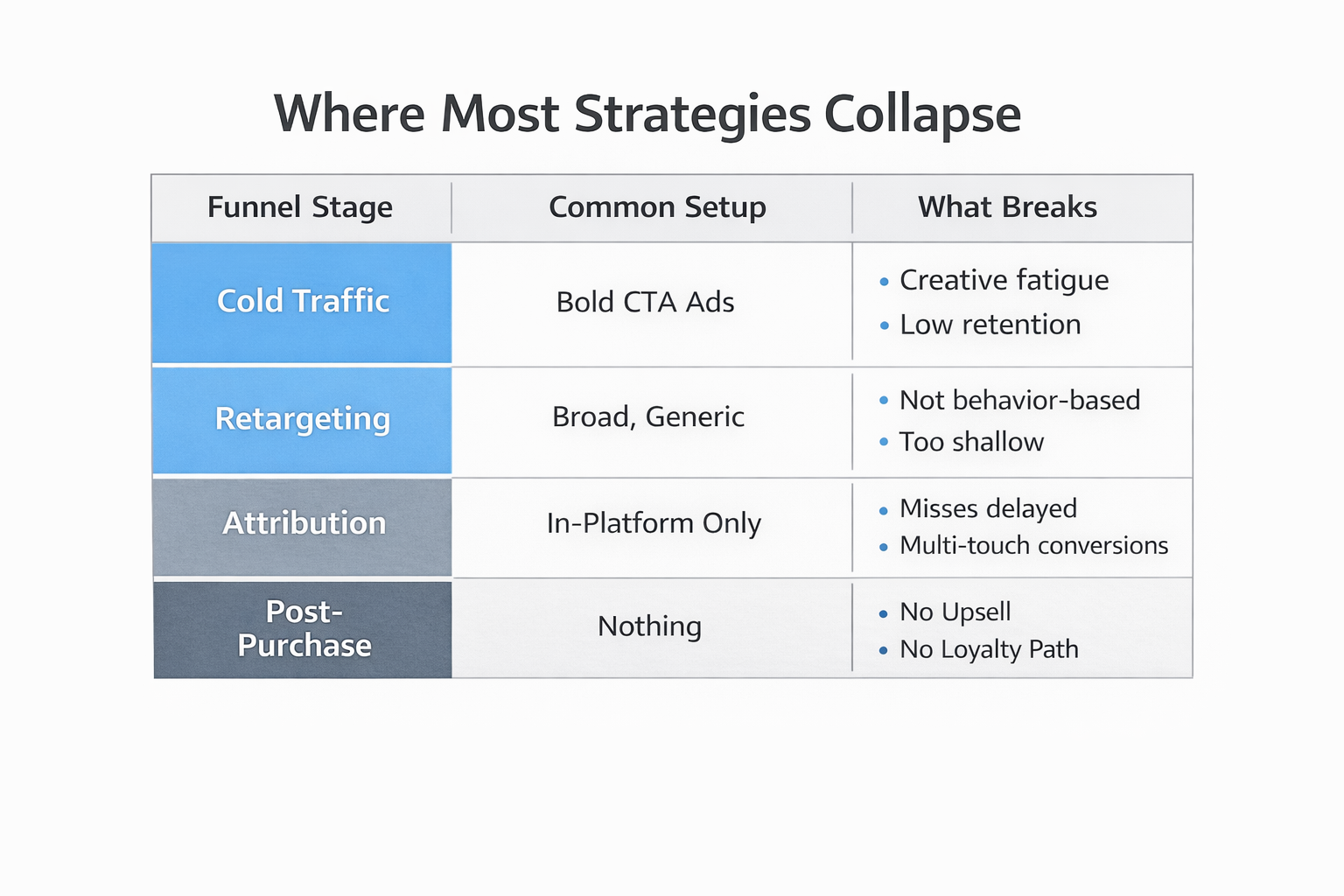
When your strategy only handles the first click, cracks start to show. Here’s where most campaigns fall apart.
1. You stop showing up
If your cold traffic sees one ad and never hears from you again, they’ll forget your brand. Fast. Facebook and Instagram are noisy. If you're not following up — through retargeting, email, or organic content — you’re invisible.
2. Retargeting doesn’t work well
Generic “cart abandoner” ads used to work. Today, they’re expensive and overused. If your retargeting pool is too small — or you didn’t collect emails or build engagement audiences — you won’t have anyone left to market to. This retargeting guide breaks down how to rebuild that layer properly .
3. Your creative runs out of steam
First-funnel creative is often short-term. Think: big hooks, urgency, discounts. But without fresh content or deeper messaging, your ads hit frequency 5+ and performance drops. If you don’t rotate or layer your creative, ROAS dies.
4. Attribution misses the real story
Meta’s default attribution model (7-day click, 1-day view) works fine for fast sales. But what if your product takes longer to sell? You’ll think the ad failed, when really, the sale came a few days later — or on another device. The Facebook Attribution Tool helps fill in the missing data gaps.
Example: how this collapse looks in real life
Let’s say you’re selling skincare products. You launch a Facebook campaign with 2 great ads and target women aged 25–45 using a broad interest-based audience.
For 3 days, it works. You get purchases.
Then, performance crashes.
What happened?
-
Your best buyers already saw the ad;
-
The ones who clicked didn’t buy — and now they’re not being retargeted;
-
Your budget keeps reaching new people, but the ad is no longer fresh;
-
You get no repeat purchases because there’s no second campaign.
Without a plan beyond day one, even strong campaigns burn out fast.
How to build beyond the first funnel
The key to long-term performance is planning what happens after the click. That means thinking about your audience, creative, data, and offers in new ways.
Let’s walk through how to build that.
Step 1: pre-target people
The easiest way to get better results? Start with better people.
Most brands rely too much on broad targeting or lookalikes. Instead, find interest proxies — real communities your audience already follows or trusts.
For example:
-
Selling parenting products? Target followers of parenting influencers;
-
Running ads for a digital marketing course? Target people who follow top ad strategists;
-
Launching a SaaS tool for realtors? Target real estate educators and local expert pages.
These audiences are warm by nature. They’ve already shown interest in your niche. That makes your messaging easier and your CTRs higher — before you even run the ad.
Step 2: structure retargeting by behavior
Instead of one big “retargeting” audience, segment it based on what people actually did.
Here’s a smarter retargeting setup:
-
Page viewers, no engagement → Show brand intro or social proof ad;
-
Engaged, didn’t click → Show deeper product value or problem-solution video;
-
Clicked, no purchase → Show offer-focused ad or urgency (e.g. limited-time bonus);
-
Purchased once → Show loyalty, upsells, and usage education content.
Each group has different objections. Your creative and offer should match where they are — not where you wish they were.
Step 3: build a creative system, not just assets
Good performance doesn’t come from one good ad. It comes from a creative system — a mix of messages, visuals, and proof that speak to people at different funnel stages.
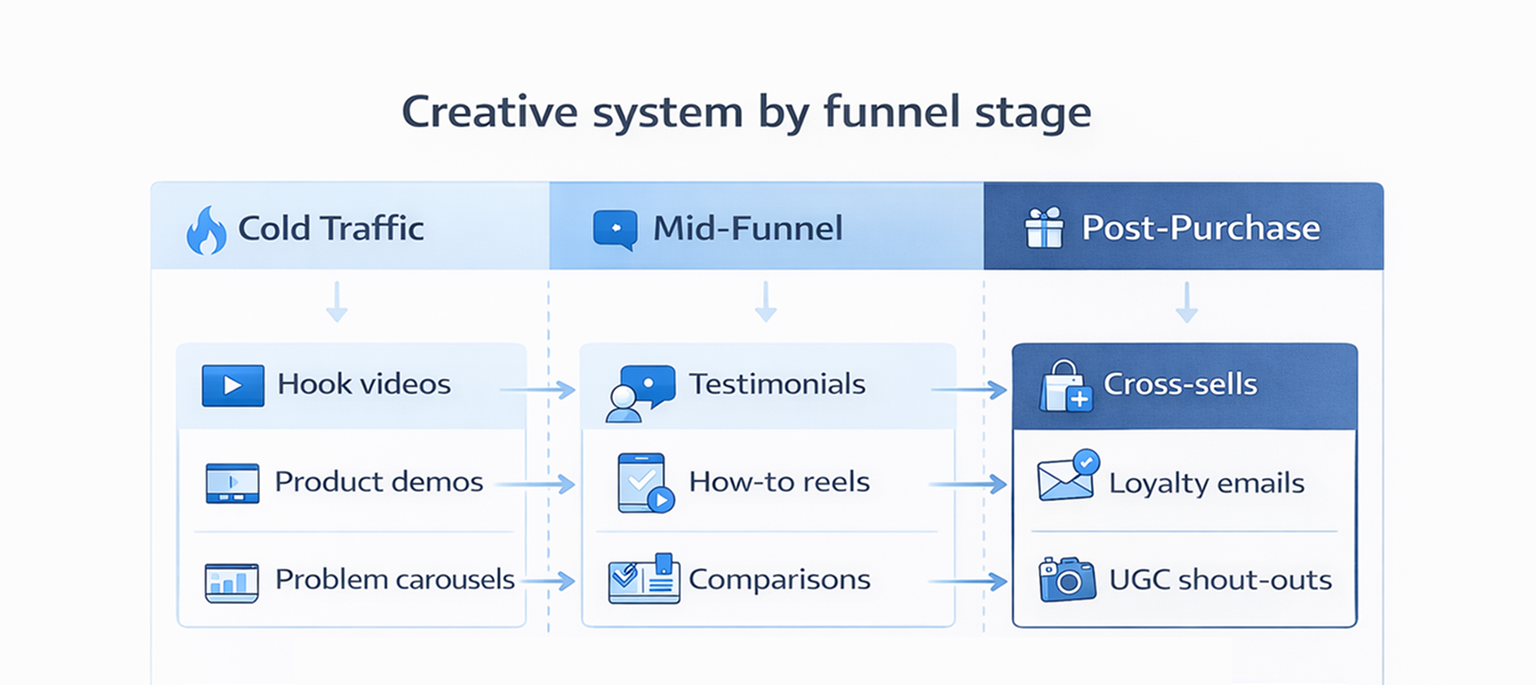
Funnel-stage creative example:
Cold traffic:
-
Hook-based videos (“Most skin products are too harsh — this one fixes that in 3 steps”);
-
Bold product demo reels;
-
Benefit carousels that explain problems and outcomes.
Mid-funnel:
-
User testimonials with quotes;
-
How-to reels showing the product in use;
-
Comparisons vs competitors.
Post-purchase:
-
Loyalty content (“Welcome to the routine — here’s what to expect”);
-
Cross-sell or bundle offers;
-
Customer shout-outs and UGC.
Rotate these weekly, especially at the cold stage. Audit them monthly. Creative decay is real — and preventable.
Step 4: fix your attribution blind spots
You may be making decisions with incomplete data. Meta only tracks what it can see — and that's not always the full picture.
What to add:
-
UTM tracking for cross-channel performance (e.g., if someone clicks from Facebook, browses, then converts through email);
-
Meta’s Conversions API to capture server-side events (more accurate than pixel-only setups);
-
Compare 1-day, 7-day, and 28-day windows to understand buying delays.
Don’t judge a campaign too early. If you're selling a $200 product, people won’t always buy on the first click.
Step 5: build second and third funnels
Getting the first purchase is just the beginning.
You need to think about what happens next. That’s where profit lives.
What a second funnel might include:
-
Welcome email flows that match your Facebook ads;
-
Post-purchase retargeting (“How to get the most from your product”);
-
Winback ads after 30+ days of no purchase;
-
Loyalty sequences with surprise bonuses or insider offers.
Example: If someone buys skincare from you, don’t wait 6 months. Retarget them with tips for how to use it. Then offer a matching product 2–3 weeks later. Then invite them into a VIP bundle.
Each step increases LTV and reduces CAC pressure.
Final tip: measure beyond the ad platform
Success doesn’t live in Ads Manager alone.
You need to track the full journey — click to conversion, repeat purchase, and referrals. That means syncing your CRM, email tool, ad account, and analytics platform.
Set up cohort tracking. Monitor payback periods. Run tests, but track what happens over time, not just in the first 48 hours.
Final thoughts
The real problem with most digital advertising strategies isn’t bad creative or bad targeting. It’s short-term thinking.
If you only focus on the first funnel, you’ll always be rebuilding.
Build a system that includes:
-
Smarter audience targeting;
-
Layered creative strategies;
-
Segmented retargeting;
-
Stronger attribution;
-
Post-purchase structure.
This is what allows your campaigns to not just survive — but compound.