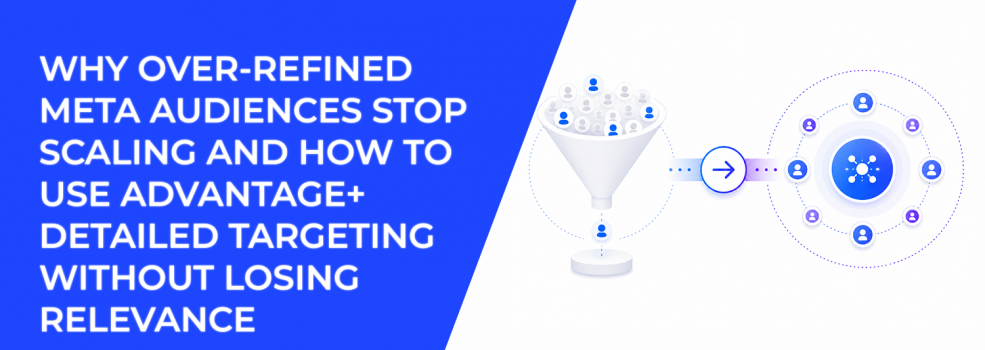
A narrow Meta audience can look like the safer choice. You add more controls. You limit who can enter the audience. You try to keep Meta close to your ideal buyer. The setup looks clean and precise.
Then the campaign starts spending.
CPM comes in higher than expected. Conversions arrive slowly. When you raise the budget, CPA starts climbing instead of improving. The audience looked controlled, but Meta did not have enough space to find cheaper buyers.
That is the main problem with over-refined targeting. It gives you more control, but it can also stop Meta from learning properly.
Why Over-Controlled Meta Audiences Get Expensive
Meta needs enough people to compare.
When the audience is too restricted, Meta has fewer users to test across auctions. It may find a few good leads or purchases early. After that, it often runs out of easy opportunities.
Then it keeps bidding for the same small group of people. This can make the campaign more expensive, even when the audience looks relevant. You can usually spot the issue in Ads Manager:
- CPM starts high because the ad set has fewer available auctions.
- Frequency rises too soon because Meta keeps reaching the same people.
- CPA jumps after the first few conversions because the easiest buyers are gone.
- Spend becomes unstable because Meta cannot find enough qualified users.
This often happens when advertisers try to fix weak results by adding more controls. The campaign becomes tighter, but not always stronger.
If delivery already looks weak, it is worth checking how to troubleshoot a limited Facebook Ads audience before rebuilding the campaign.
Why Audience Control Is Not The Same As Buyer Quality
A restricted audience does not automatically mean a better audience.
Meta can only optimize from the signals it receives. If the campaign has weak conversion data, unclear creative, poor landing page behavior, or low-quality lead events, stricter audience controls will not fix the real problem.
They may just make the learning pool smaller.
For example, a campaign can reach a very specific group and still bring poor leads. The people may match the advertiser’s idea of the buyer, but they may not be ready to book a call, request pricing, or complete a purchase.
That is why audience quality should be judged by behavior, not by how precise the setup looks.
Meta needs signals that show who takes valuable actions. Those signals can come from purchases, qualified leads, booked appointments, strong page engagement, or other actions that connect to revenue. If Meta does not have enough of that data, narrowing the audience will often make CPA worse.
The campaign becomes controlled, but not smarter.
How Over-Refined Targeting Hurts Scaling
The first few conversions can make a restricted audience look better than it is.
At low spend, Meta may find the most obvious buyers quickly. The campaign looks promising. But when you increase the budget, performance starts to weaken because Meta has already used the easiest part of the audience.
This is when scaling becomes difficult. For lead generation, CPL may rise. Lead quality may also drop because Meta starts finding people who fit the audience limits, but not the real sales intent. For e-commerce, ROAS can fall because there are not enough new buyers left at a profitable cost.
A common example is a paid course campaign.
The advertiser starts with a narrow audience built around the course topic and ideal learner profile. Early leads look acceptable, so the team raises the budget. After a few days, CPL rises and sales calls get weaker. Meta is still reaching the “right” type of person, but the audience does not have enough depth to support more spend.
The campaign did not need more control. It needed better signals and more room to learn.
What Advantage+ Detailed Targeting Actually Does
Advantage+ Detailed Targeting gives Meta more room to find people outside your original audience setup when it expects better results.
This does not mean Meta ignores your direction. Your setup still helps Meta understand where to begin. But Meta can move beyond that starting point if it finds people who are more likely to convert.
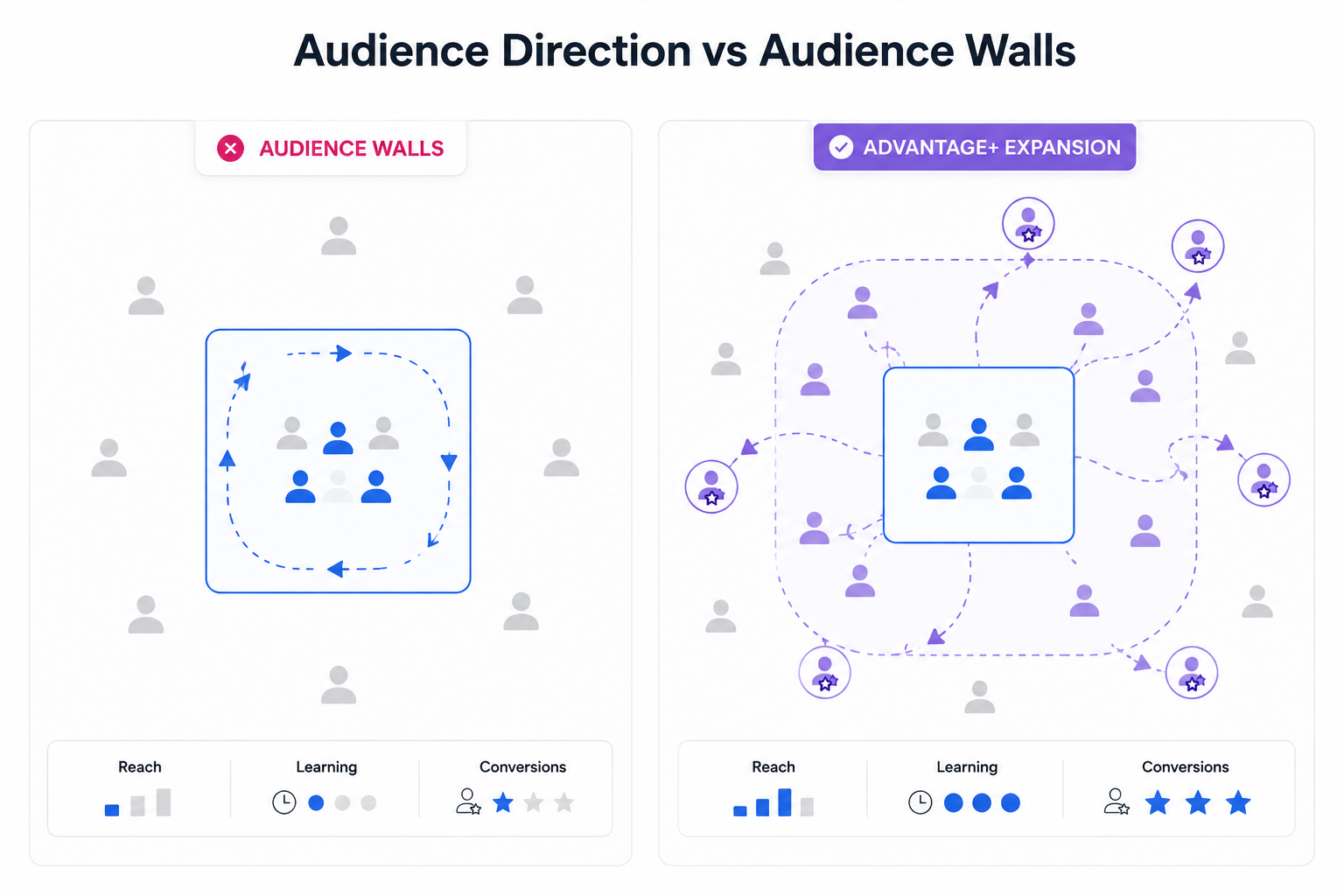
This is useful when your audience logic is directionally right, but too tight.
For example, a brand selling premium dog training programs may know that its best buyers are owners dealing with behavior issues, not casual pet owners. A strict audience setup may limit delivery too much. With Advantage+ Detailed Targeting, Meta can start from that direction and then look for similar conversion behavior outside the original pool.
The starting point still matters.
If you give Meta weak direction, expansion may also start from weak signals. If you give it a cleaner starting point, it has a better chance of finding useful buyers outside your manual setup.
That is why it helps to use Advantage+ Detailed Targeting more efficiently, instead of treating automation as a fix for poor campaign inputs.
How To Expand Without Losing Relevance
The best setup is usually simpler than advertisers expect.
Start with one clear audience idea. Do not add controls just because they make the audience look more precise. Choose the strongest signals that describe the buying situation, then let Meta test beyond them.
A cleaner setup can include:
- A clear audience direction based on who has the problem your offer solves.
- A location and age range large enough for stable delivery.
- Exclusions for recent buyers, bad leads, or poor-fit groups.
- A conversion event that reflects real business value.
The conversion event is especially important.
If you optimize for cheap leads, Meta will look for more cheap leads. If you optimize for qualified leads, purchases, booked calls, or stronger funnel actions, Meta gets a better signal to follow.
This is where LeadEnforce can help. Instead of relying only on Meta’s broad automation, advertisers can build more focused audiences from Facebook groups and Instagram pages where their market already gathers.
For example, a brand selling accounting software for freelancers could use Facebook groups for self-employed professionals or Instagram pages followed by solo business owners. That gives Meta a stronger starting pool than a fully broad setup with no market context.
Meta still gets room to optimize, but the first signal is closer to the real buyer.
That is the useful balance: better inputs, without choking delivery.
When Narrow Targeting Still Makes Sense
Broad expansion is not always the best answer.
Some campaigns need tighter control. Local services, regulated industries, high-ticket offers, and niche B2B products often cannot afford too much irrelevant reach.
The question is simple: does each restriction improve performance?
Location limits may be needed. Excluding customers can protect spend. Age limits can make sense when the offer clearly fits a certain life stage. Some audience limits can also protect sales teams from low-fit leads.
But every restriction should earn its place.
If a control makes the audience smaller but does not improve CPA, lead quality, or purchase rate, it is probably not helping. It only gives Meta less room to work.
A good test is to run one controlled audience and one expanded version. Keep the creative, offer, placement setup, and conversion event as similar as possible. Then compare cost per qualified lead or purchase, not just CPC.
That will show whether precision is helping or hurting.
How To Know If Your Audience Is Too Refined
Do not judge the audience only by estimated size. A large audience can still behave like a narrow one if it has too many limits. A smaller audience can still work if it has strong intent and enough conversion volume.
Look at delivery behavior instead.
If frequency rises quickly, Meta may be reaching the same people too often. If CPM is much higher than similar campaigns, the audience may be limiting auction access. If CPA jumps after a few early wins, the ad set may have run out of easy buyers.
Also check what happens after the click.
Low CPC with weak conversions usually means the audience is too loose or low intent. High CPM with low volume can mean the audience is too restricted. High CTR with poor sales often means people are curious, but not qualified.
Do not change everything at once.
If you edit creative, budget, audience, and objective together, you will not know what caused the result. Start by expanding one audience variable. Keep the rest stable long enough to see what changes.
Better Inputs Beat More Controls
Meta’s automation works better when the starting signals are clean.
That means good tracking, useful conversion events, clear creative, and audience sources that reflect real buyer behavior. If those inputs are weak, more audience controls will not fix the campaign.
A better setup starts with a clear buyer idea.
Then you add data from places where your audience already gathers, such as relevant Facebook groups or Instagram pages. After that, you give Meta enough room to find patterns instead of forcing it into a tiny audience box.
The goal is not to build the smallest possible audience. The goal is to give Meta enough useful signal to find more buyers at a cost your business can afford.
Final Takeaway
Over-refined Meta audiences often stop scaling because they restrict learning too early.
The campaign may look precise, but precision can raise CPM, slow delivery, and increase CPA when Meta has too little room. Advantage+ Detailed Targeting works best when it expands from a clean starting point.
Use audience controls as direction, not as hard walls. Use stronger audience sources, like relevant Facebook groups and Instagram pages, to improve signal quality. Then give Meta enough space to find cheaper conversions.