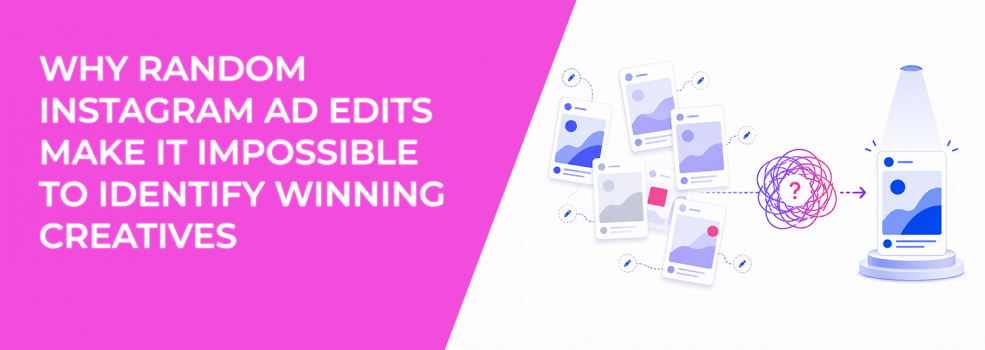
Random Instagram ad edits destroy testing clarity faster than most advertisers realize.
An ad underperforms for two days, so the advertiser changes the headline. Later the image changes. Then the CTA changes. Budget increases follow, audiences expand, and placements get adjusted before the campaign stabilizes.
A week later the account shows different metrics, but nobody knows what actually caused the improvement or decline.
This is one of the biggest reasons advertisers struggle to identify winning creatives consistently.
Why constant Instagram ad edits corrupt performance data
Instagram’s optimization system compares behavioral patterns across ads.
Meta evaluates:
- which creatives attract clicks,
- which hooks hold attention,
- which users convert,
- and which ads lose engagement quickly.
Frequent edits interrupt those comparisons. The platform stops evaluating one stable creative against another and starts evaluating a constantly changing system instead.
That creates noisy reporting patterns inside Ads Manager. A campaign may suddenly show:
- lower CPM,
- higher CTR,
- but weaker conversion quality.
Another may improve CPA temporarily before collapsing several days later. Since multiple changes happened simultaneously, attribution becomes unclear.
This is why experienced advertisers focus on editing ads without resetting learning instead of constantly rebuilding live campaigns.
The real problem with random optimization
Most advertisers think frequent edits mean active optimization. In reality, random changes often slow optimization because they prevent reliable learning.
Meta’s delivery system needs stable engagement patterns long enough to identify which users respond to a creative. Large edits interrupt those patterns before the system fully stabilizes.
This becomes especially damaging in smaller accounts with lower conversion volume.
A lead generation campaign producing 12–15 conversions per week may never stabilize if:
- creatives change every 48 hours,
- audiences rotate constantly,
- and budgets fluctuate aggressively.
The account stays trapped in unstable learning behavior.
This is similar to what happens when advertisers pause and restart campaigns too frequently instead of letting delivery stabilize naturally.
Why random edits hide winning creatives
Strong creatives often succeed because of one specific element.
It may be:
- the opening hook,
- the first-frame image,
- the emotional trigger,
- or the offer framing.
Random edits make those signals difficult to isolate.
An ecommerce advertiser may replace:
- the product image,
- the headline,
- and the CTA button simultaneously.
ROAS improves slightly, but CPC also rises.
Now the advertiser cannot determine whether:
- the visual improved scroll-stop rate,
- the copy improved purchase intent,
- or the CTA simply attracted more low-quality clicks.
This is how advertisers accidentally scale the wrong creative insights. Future campaigns get built around assumptions instead of evidence.
How to optimize Instagram ads without destroying test clarity
Strong advertisers separate optimization from emotional reaction.
Instead of changing everything immediately, they preserve stable comparison conditions.
That usually means:
- Testing one meaningful creative variable at a time.
This creates cleaner cause-and-effect relationships inside Ads Manager. - Leaving stable control ads active.
Removing every existing creative destroys historical comparison benchmarks. - Avoiding major edits during early learning periods.
Instagram campaigns often fluctuate before delivery stabilizes. - Documenting every meaningful change.
Without change tracking, performance interpretation becomes unreliable.
This creates cleaner optimization feedback loops. It also reduces wasted spend because scaling decisions become easier to trust.
Advertisers who constantly intervene often create the exact instability described in over-optimization hurts performance.
Why stable testing improves long-term campaign scaling
Instagram ads rarely scale successfully without reliable learning patterns. Winning creatives are not just high-performing ads. They are repeatable performance signals advertisers can trust across future campaigns.
Random editing destroys that reliability.
Stable testing creates:
- clearer optimization logic,
- more trustworthy reporting,
- and faster scaling decisions.
The advertisers who consistently identify strong Instagram creatives are usually not the ones making the most changes.
They are the ones protecting clean data long enough to understand what actually works.