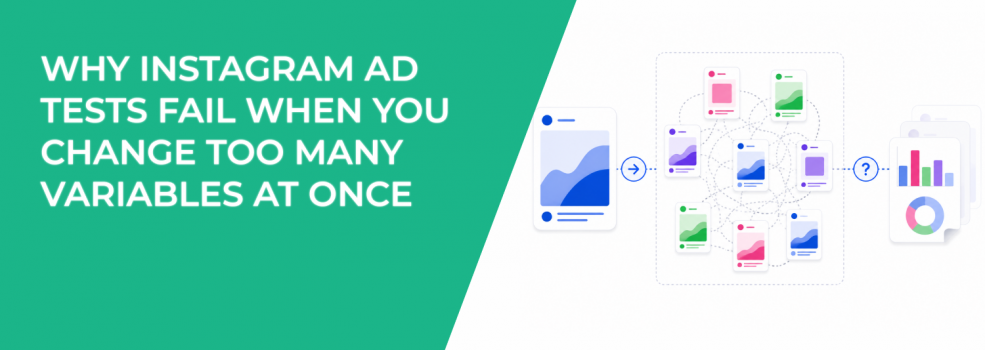
Instagram ad tests usually fail before advertisers even read the results.
The problem is not always weak creatives or bad targeting. In many cases, the real issue is overloaded testing. Advertisers change the creative, audience, offer, copy, and landing page at the same time, then try to interpret the outcome afterward.
The campaign produces movement, but not useful learning.
That makes scaling difficult because nobody can clearly explain what actually improved performance.
Why changing too many variables destroys test clarity
Meta’s delivery system already operates inside unstable auction conditions. Audience competition changes daily. Placement behavior shifts by device. Conversion timing fluctuates across different user groups.
When advertisers introduce multiple major changes simultaneously, performance signals become difficult to interpret accurately.
A campaign may suddenly show:
- higher CTR,
- lower CPM,
- but worse lead quality.
Another campaign may improve CPA temporarily while reducing purchase volume later. Which change caused the shift?
The answer becomes unclear because several systems changed together.
This is why experienced media buyers rely on structured frameworks like A/B testing strategies that deliver results instead of chaotic optimization cycles.
The hidden problem behind overloaded Instagram ad tests
Most advertisers think more testing creates faster optimization. In reality, too many simultaneous changes often create false conclusions.
A common ecommerce example looks like this. An advertiser changes:
- the product image,
- the audience,
- the discount offer,
- and the landing page layout.
ROAS improves slightly. The team assumes the new creative won.
But the actual improvement may have come from:
- stronger pricing,
- lower-friction landing pages,
- or higher-intent audience behavior.
Now future campaigns get built around the wrong insight. This creates long-term scaling problems because the advertiser never isolated the real performance driver.
That is exactly why experienced advertisers follow frameworks around running clean tests instead of changing everything at once.
Why Meta’s learning system reacts poorly to unstable tests
Instagram’s algorithm performs better when it receives consistent behavioral signals. Changing too many variables fragments those signals.
The system suddenly tries to evaluate:
- new engagement patterns,
- new audience behavior,
- new conversion behavior,
- and new post-click behavior simultaneously.
That slows optimization efficiency. This becomes especially damaging in:
- smaller ad accounts,
- niche B2B campaigns,
- and high-ticket offers with lower conversion volume.
A campaign generating only 10–15 conversions weekly cannot absorb large experimental instability efficiently. The account stays trapped in unreliable learning behavior.
Many advertisers interpret this as “algorithm randomness” when the real issue is poor experimental structure.
What advertisers should isolate first in Instagram tests
Strong testing frameworks prioritize the highest-impact variable first. Usually that means isolating one major layer before touching the next.
Examples include:
- Creative hook.
If users do not stop scrolling, deeper optimization barely matters. - Offer framing.
Weak positioning lowers purchase intent even when CTR looks healthy. - Audience quality.
Broad low-intent traffic often distorts creative interpretation. - Landing page continuity.
Message mismatch between ad and landing page quietly destroys conversion rate.
Trying to test all four together creates reporting chaos.
This is also why advertisers eventually need to learn how to avoid false positives in testing, especially when campaigns generate mixed performance signals.
Why cleaner tests produce better scaling decisions
The purpose of Instagram ad testing is not simply finding temporary winners. The real goal is building reliable optimization logic that survives future scaling.
Clean tests create:
- clearer cause-and-effect relationships,
- more trustworthy reporting,
- and safer budget allocation decisions.
That reduces wasted spend because advertisers stop optimizing assumptions. The advertisers who identify strong Instagram creatives consistently are usually not testing more variables.
They are removing more uncertainty from every test.