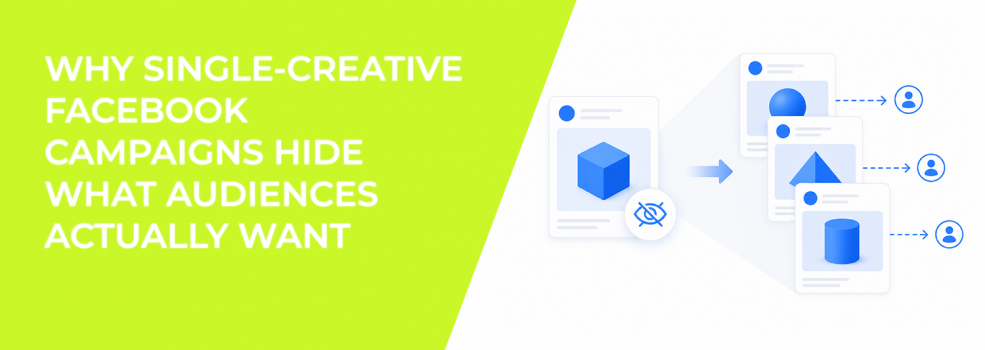
Some Facebook campaigns look stable while teaching the advertiser almost nothing useful.
The campaign gets clicks. Leads come in consistently. CPA stays within target range. From the outside, everything appears fine.
But underneath, the advertiser has no idea what actually caused the performance.
Was it the hook? The format? The headline? The visual style? The CTA? The audience simply never saw alternatives, so there is nothing to compare against.
This is one of the biggest limitations of single-creative campaigns. They generate performance data without generating audience insight.
That becomes a serious problem when advertisers try to scale, improve lead quality, or lower acquisition costs later.
Problem: Single-Creative Campaigns Prevent Real Audience Learning
Meta’s algorithm optimizes for outcomes, not for advertiser understanding.
If one creative performs “well enough,” the system keeps spending behind it. The campaign may continue generating acceptable results for weeks while hiding better opportunities underneath.
That creates a dangerous false conclusion:
“This is the best creative for this audience.”
In reality, it may simply be the only creative the audience ever saw.
This happens constantly in Facebook campaigns where advertisers launch:
- one founder video,
- one product image,
- one UGC ad,
- or one testimonial creative.
Once the campaign starts converting, no meaningful comparison exists anymore.
The advertiser cannot tell whether the audience prefers:
- emotional messaging or practical messaging,
- short-form videos or static visuals,
- direct offers or educational hooks,
- premium positioning or value-focused positioning.
That missing information becomes expensive later because optimization decisions start relying on assumptions instead of behavior patterns.
For example:
A lead generation campaign for a B2B software company may produce decent CPL using a polished demo video. The advertiser assumes the audience prefers professional-looking content.
But if no alternative creatives exist, there is no way to know whether the audience would respond far better to:
- a problem-focused static image,
- a carousel breakdown,
- a quick founder selfie video,
- or a customer workflow example.
The campaign keeps spending, but audience insight stays shallow.
This is one reason why creative testing without audience bias becomes extremely important once campaigns move beyond early validation.
Solution: Use Creative Comparison to Understand Audience Preferences
The best Facebook advertisers do not only test for performance. They test for audience behavior patterns.
Instead of asking: “Which ad wins?”, they ask: “What type of message and structure does this audience naturally respond to?”
That shift changes the entire purpose of creative testing.
The goal becomes identifying audience preference signals before scaling aggressively.
A useful creative comparison framework usually tests:
- different formats,
- different emotional tones,
- different information depth,
- and different buying motivations.
For example, one audience may respond strongly to clarity and simplicity. Another may need detail and explanation before clicking. Some audiences react best to authority-driven messaging while others respond better to native-looking low-production creatives.
Without creative comparison, those differences stay hidden.
This is why advertisers experimenting with different ad formats often uncover performance improvements that targeting changes alone could never reveal.
What Audience Preferences Usually Reveal First
Audience behavior becomes much easier to understand when several creatives compete inside the same campaign environment.
Certain patterns usually appear quickly.
For example:
- High CTR but weak conversion quality often means the hook attracts curiosity instead of buying intent.
- Low CTR with strong conversion rates may signal a more qualified audience response.
- Cheap video engagement combined with weak lead quality often means the creative is entertaining but commercially weak.
- Strong carousel engagement may indicate the audience needs more information before converting.
These patterns are difficult to detect in single-creative campaigns because there is no baseline comparison.
The advertiser only sees isolated results.
This becomes especially important for businesses with longer sales cycles. In B2B campaigns, the creative generating the cheapest leads is often not the creative producing the best pipeline quality later.
Without multiple creative comparisons, those differences remain invisible until sales feedback arrives weeks later.
Why Single-Creative Campaigns Make Scaling Harder
Scaling becomes much riskier when campaigns rely on one creative only.
The campaign has no creative flexibility.
If performance starts weakening, the advertiser has very few ways to respond besides:
- rebuilding audiences,
- increasing budgets,
- or replacing the creative entirely.
Campaigns with multiple proven creative types behave differently.
Meta can redistribute delivery across several engagement patterns instead of depending on one narrow response signal. That usually creates more stable CPMs and smoother scaling behavior.
This matters because audiences do not all react identically during expansion.
As campaigns scale, Meta gradually reaches users with different attention patterns, different buying awareness levels, and different trust thresholds. One creative rarely works equally well across all of them.
This is why advertisers focused on testing Facebook ad creative properly usually scale more efficiently than advertisers relying on one “hero ad.”
The Best Way to Compare Creative Types
Many advertisers accidentally create confusing test environments.
They test different creatives while simultaneously changing:
- audiences,
- campaign objectives,
- offers,
- placements,
- and landing pages.
That makes the results difficult to interpret.
A cleaner structure keeps most variables stable while comparing one major creative difference at a time.
For example:
Keep the same:
- audience,
- offer,
- campaign objective,
- and landing page.
Then compare:
- static image vs short-form video,
- direct-response copy vs educational copy,
- polished design vs native-looking design,
- founder messaging vs customer messaging.
This structure makes audience preferences easier to identify because fewer variables distort the results.
The goal is not producing endless creative variations.
The goal is understanding what type of communication creates the strongest audience response.
Why Some Audiences Respond Better to “Imperfect” Creatives
One of the most surprising things advertisers discover during creative comparison is that polished creatives often lose to simpler ones.
Highly designed ads can feel overly promotional inside Facebook and Instagram feeds. Meanwhile rougher creatives sometimes feel more trustworthy because they resemble native content more closely.
This becomes especially noticeable in:
- Reels,
- Stories,
- mobile Feed,
- and ecommerce prospecting campaigns.
Audiences scrolling quickly often react better to creatives that feel immediate and natural rather than heavily produced.
Without testing multiple creative types, advertisers often assume professional-looking creatives automatically perform better.
Many campaigns lose efficiency because that assumption never gets challenged.
Final Takeaway
Single-creative Facebook campaigns create shallow learning.
The campaign may generate conversions, but the advertiser never fully understands what the audience actually prefers, trusts, or responds to emotionally.
That missing insight limits optimization, weakens scaling decisions, and makes campaigns harder to stabilize over time.
Creative comparison solves this problem by revealing real audience behavior patterns. Instead of relying on assumptions, advertisers begin seeing which structures, tones, formats, and hooks genuinely influence performance.