Most advertisers believe their creative testing is systematic. In reality, many tests are compromised long before results come in. The root problem is audience bias: when different creatives are shown to different audience segments, performance differences often reflect audience quality rather than creative strength.
For example, one ad may be served disproportionately to warmer users, while another reaches colder or less qualified segments. The result looks like a “winning creative,” but what actually won was the audience composition.

Relative contribution of different advertising factors to effectiveness, highlighting creative’s impact
Industry data shows that up to 40–60% of observed performance variance in early-stage tests can be attributed to audience overlap and delivery skew rather than the creative itself. When those distorted signals are used for scaling decisions, costs rise quickly and learning slows down.
What Audience Bias Looks Like in Practice
Audience bias typically appears in three ways:
-
Uneven delivery – Platforms optimize delivery during the test, pushing one creative toward users more likely to convert.
-
Hidden audience quality differences – Small changes in interests or behaviors create large differences in intent.
-
False statistical confidence – Results look significant but collapse when moved to a new audience or scaled.
A recent meta-analysis of paid social experiments found that creatives declared “winners” in biased tests underperformed by an average of 25–35% when re-tested on neutral audiences.
The Principle of Creative-First Testing
To remove bias, creative tests must isolate creative variables while holding audience variables constant.
Creative-first testing follows three core principles:
-
One audience, multiple creatives – Every variation competes for the same pool of users.
-
Equal budget distribution – No creative is favored during the learning phase.
-
Delayed optimization – Performance is measured before algorithmic optimization reshapes delivery.
When these principles are applied, advertisers see much clearer signals. Internal benchmarks from large-scale ad accounts show that creative-first testing improves prediction accuracy of scaled performance by ~30% compared to traditional audience-split tests.
Metrics That Matter (and Those That Don’t)
Early creative testing should focus on metrics that reflect user reaction, not downstream conversion noise.
High-signal early metrics:
-
Thumb-stop rate / hook engagement
-
3-second and 50% video retention
-
Cost per landing page view
-
Click-through rate normalized by placement
Low-signal early metrics:
-
Cost per purchase (during learning)
-
ROAS in small sample sizes
-
Frequency-adjusted conversion rates
Data from multi-creative test frameworks shows that creatives ranking in the top 20% by early engagement metrics are 2.1× more likely to remain top performers after scaling.
Structuring a Bias-Free Creative Test
A practical bias-free test setup looks like this:
-
Select one stable, sufficiently large audience.
-
Launch 3–6 creative variations simultaneously.
-
Lock budgets and placements during the initial test window.
-
Collect data until each creative reaches a minimum engagement threshold.
-
Rank creatives by consistent early indicators, not single metrics.
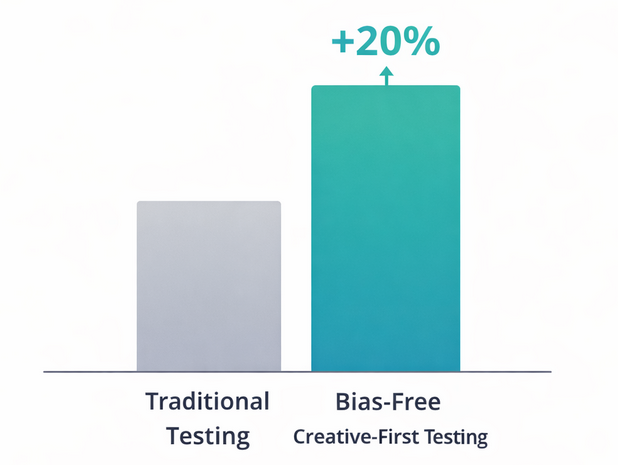
Conversion performance comparison: bias-free creative testing vs traditional audience-split tests
Tests run this way typically reach usable conclusions 20–30% faster while producing fewer false positives.
Scaling Without Reintroducing Bias
Even after a clean test, bias can reappear during scaling if creatives are moved into different audiences without validation.
Best practice is a two-step scale:
-
Validation phase: Re-test top creatives on a second neutral audience.
-
Expansion phase: Introduce creatives to broader or new segments only after performance consistency is confirmed.
Advertisers following this approach report 15–25% lower creative fatigue and more stable CPA curves over time.
Final Thoughts
Creative testing only works when creatives compete on equal ground. Removing audience bias doesn’t just improve accuracy—it accelerates learning, protects budget, and makes scaling decisions far more reliable.
When creative performance is measured cleanly, the best ideas surface faster—and they stay winners when it actually counts.
Recommended Reading
To go deeper into advanced testing and targeting strategies, explore these related articles: