One of the biggest Facebook advertising mistakes is forcing every campaign into static creative.
Some offers work perfectly with a single image. Others become difficult to understand without motion. When advertisers ignore that difference, campaigns often struggle with low CTR, weak conversion rates, and rising CPA.
The problem is not that static ads are “bad.” The problem is that certain products and services require visual explanation before users understand the value.
If the audience cannot quickly understand:
- how the product works,
- what problem it solves,
- or what changes after using it,
the ad loses attention before the click ever happens.
That becomes a performance issue, not just a creative issue.
Why Static Creative Sometimes Hurts Facebook Ad Performance
Static ads succeed when the value is immediately obvious.
A clothing brand can show the product instantly. A restaurant can display the finished meal. A local event can communicate the offer in seconds.
But many advertisers run products that involve process, transformation, interaction, or workflow changes. Those offers create friction inside a static frame.
This happens frequently with:
- SaaS products,
- AI tools,
- financial services,
- fitness systems,
- B2B lead generation offers.
A single image often forces users to mentally “guess” how the product works.
Most users will not do that.
Instead, they scroll.
When enough users ignore the ad, Meta receives weak engagement signals. Delivery quality drops. CPM rises. CTR falls. Eventually, CPA becomes harder to control.
Motion Solves the “I Don’t Get It” Problem
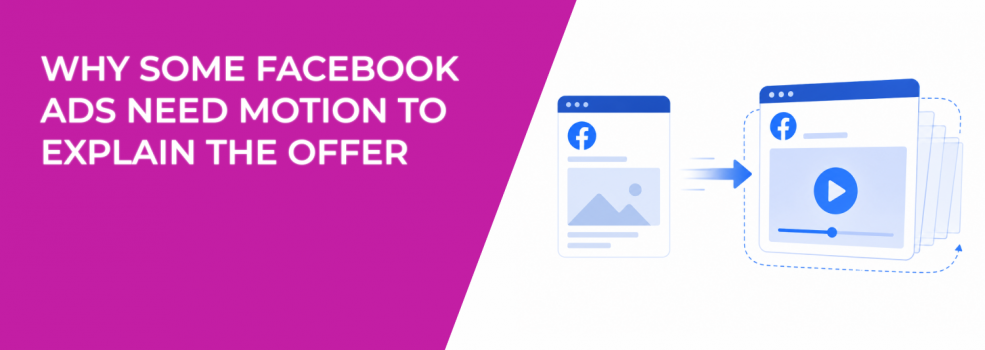
The main advantage of video is not entertainment. It is clarity.
Motion allows advertisers to explain the offer step by step instead of compressing everything into one frame.
For example, a short Facebook video ad can:
- show the problem;
- demonstrate the friction;
- reveal the solution;
- display the outcome.
That structure reduces cognitive load. Users no longer need to imagine how the product works because they can see it immediately.
This is especially important in cold traffic campaigns where the audience has never heard of the brand before.
Motion also improves behavioral signals Meta uses for optimization:
- watch time;
- hold rate;
- pauses;
- engagement quality;
- click intent.
Stronger engagement signals usually create better delivery efficiency over time.
That is why understanding how to hook attention before users scroll away matters so much in modern Facebook advertising.
Some Offers Cannot Be Explained Properly With a Single Image
Many B2B advertisers experience this problem without realizing it.
They launch static ads with clean design and strong copy, but performance stays weak because the mechanism behind the offer is unclear.
Imagine promoting a lead generation platform with a dashboard screenshot and the headline “Improve audience targeting.”
That does not explain:
- where the audience comes from;
- how targeting improves;
- why lead quality changes;
- or how wasted spend gets reduced.
Motion fixes that gap.
A lightweight walkthrough, animated workflow, or short screen recording can explain the system in seconds.
For LeadEnforce, motion can visually demonstrate how advertisers build high-intent audiences using Facebook groups, Instagram followers, and engagement signals. That makes the targeting process easier to understand than a static graphic alone.
In many cases, that clarity improves conversion quality because users understand the value before clicking.
Why Facebook and Instagram Feeds Make Motion More Important
Facebook’s feed environment has changed dramatically.
Users constantly scroll through:
- Reels;
- Stories;
- creator content;
- UGC videos;
- animated posts.
A fully static ad placed between moving content often loses visual contrast immediately.
This does not mean every advertiser needs expensive production. It means the creative needs enough movement to interrupt scrolling behavior.
Even simple motion can improve attention:
- animated headlines;
- product movement;
- zoom effects;
- cursor motion;
- before-and-after transitions.
The goal is not cinematic production quality.
The goal is faster communication.
Advertisers should also think carefully about choosing the right Facebook ad format for each funnel stage. Video often performs best when the audience still needs education before converting.
The Wrong Type of Video Can Still Kill Performance
Many Facebook video ads fail because advertisers focus on visuals instead of explanation.
A flashy video with weak structure often performs worse than a simple product demonstration.
Common mistakes include:
- long intros;
- irrelevant stock footage;
- slow pacing;
- excessive transitions;
- branding before value communication.
These ads may attract views but fail to generate qualified clicks.
That creates misleading performance data. CTR may increase while conversion rates decline because the video creates curiosity instead of buying intent.
The solution is simpler, clearer communication.
In many cases, advertisers improve results simply by using motion graphics to improve Facebook ad engagement. Small visual improvements can make the offer easier to understand without increasing production costs.
When Facebook Video Ads Usually Perform Better
Video is usually the better format when the product needs explanation before the click.
That includes situations where:
- the workflow is unfamiliar;
- the transformation is visual;
- the offer feels abstract;
- trust must be built quickly;
- the buying cycle is longer.
Static creative still works extremely well for visually obvious products, simple offers, and strong promotional campaigns.
The mistake is assuming one format should dominate every campaign.
Creative format should match the complexity of the offer.
Final Takeaway
Some Facebook ads underperform because static creative cannot explain the offer fast enough.
When users feel confused, they scroll. That weakens engagement signals, hurts delivery quality, and increases CPA over time.
Motion solves that problem by making the product easier to understand before the click happens.
The best Facebook video ads are not necessarily expensive. They are simply clearer.
When advertisers use motion to explain transformations, workflows, or mechanisms, campaigns usually generate:
- stronger engagement;
- higher conversion rates;
- better-quality clicks;
- more stable scaling performance.
Video is not automatically the best format.
But when the offer needs explanation, motion often becomes necessary for performance.