In paid media, sudden jumps in impressions, clicks, or conversions often trigger optimism. Campaigns appear to be working, budgets get increased quickly, and expectations rise. Yet just as often, these spikes fade, performance drops, and costs rise.
Sustainable growth rarely comes from dramatic fluctuations. Instead, stable performance creates compounding advantages: stronger algorithm learning, more accurate forecasting, and healthier unit economics. Understanding why stability matters is essential for anyone managing paid acquisition at scale.
The Hidden Cost of Performance Spikes
Performance spikes are usually driven by short-lived factors: novelty, aggressive bidding, or narrow audience saturation. While these tactics can inflate metrics temporarily, they often damage long-term efficiency.
Several industry benchmarks highlight this pattern:
-
After an initial surge, average click-through rates tend to decline by 50–70% within the first 2–4 weeks as creative fatigue sets in.
-
Cost per acquisition can increase by 30–60% after sudden budget increases, especially when campaigns exit learning phases repeatedly.
-
Over-targeted audiences may reach saturation after 5–7 exposures, reducing conversion likelihood by up to 40%.
Average ad click-through rates have declined significantly over decades, showing the need for consistent performance optimization rather than chase short-term spikes
Spikes also distort decision-making. When optimization is based on peak moments rather than normalized performance, teams often overestimate true campaign potential.
Why Platforms Reward Stability
Ad platforms are designed to optimize for consistency. Their delivery algorithms rely on predictable signals to identify high-probability users and efficient placements.
Stable campaigns provide:
-
Continuous data flow, improving conversion modeling accuracy
-
Fewer learning resets caused by abrupt budget or structure changes
-
More reliable pacing across auctions and placements
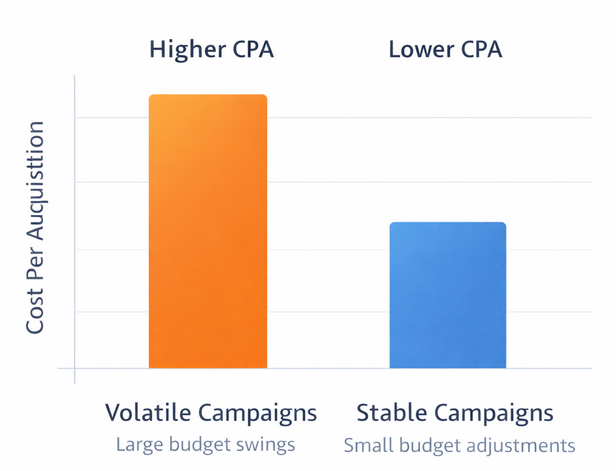
Paid media campaigns with smaller daily budget adjustments often show lower cost per acquisition compared to volatile spend patterns
Research across major ad ecosystems shows that campaigns with daily budget changes under 20% achieve up to 25% lower acquisition costs than campaigns with frequent large swings. Consistency allows algorithms to refine delivery instead of constantly recalibrating.
Forecasting and Scaling Become Easier
One of the biggest advantages of stability is predictability. When performance fluctuates wildly, forecasting becomes unreliable, making it harder to plan spend, inventory, or revenue targets.
Stable paid media performance enables:
-
More accurate CAC and ROAS projections
-
Controlled, incremental scaling without efficiency collapse
-
Faster identification of real performance changes versus noise
Teams that scale budgets gradually—typically 10–15% per adjustment—maintain efficiency far more effectively than those that double or triple spend overnight.
Long-Term Efficiency Compounds
Small, consistent gains compound over time. A 5% improvement in conversion rate maintained over several months often delivers more total value than a brief 40% spike followed by decline.
Stability also supports better creative testing. When baseline performance is steady, it becomes easier to isolate the true impact of new creatives, audiences, or bidding strategies. In contrast, volatile performance makes it difficult to distinguish real wins from temporary fluctuations.
When Spikes Do Make Sense
Not all spikes are bad. Short-term increases can be useful during:
-
Product launches or limited-time promotions
-
Seasonal demand peaks
-
Controlled experiments with clearly defined exit criteria
The key difference is intent. Spikes should be planned, measured, and temporary—not mistaken for a new normal.
Outcome: Build for Consistency
Paid media success is rarely about chasing the highest peak. It is about building a stable acquisition engine that performs reliably day after day.
By prioritizing consistency over volatility, advertisers gain better algorithm alignment, clearer insights, and sustainable growth. Over time, stability does not just protect performance—it amplifies it.