
Performance often declines after changes because ad systems need time to re-learn. When multiple variables shift at once, historical signals weaken, delivery becomes inconsistent, and short-term volatility increases.
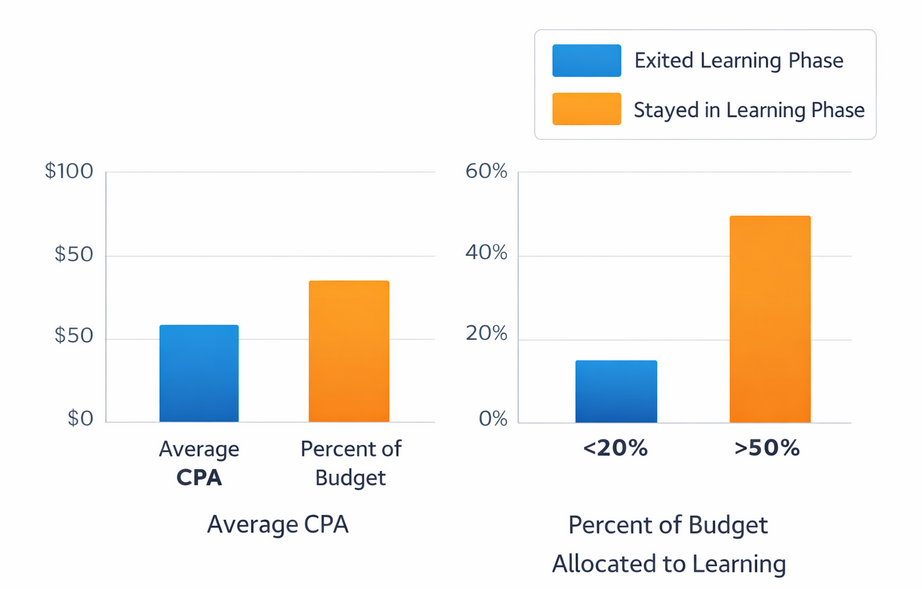
Advertisers that exit the learning phase achieve up to 19% lower CPA and perform more efficiently when less of their budget remains in learning-limited status
Industry data shows that campaigns undergoing significant structural changes can experience temporary efficiency losses of 15–30% during the first 7–14 days as algorithms recalibrate. In highly competitive auctions, even small disruptions can amplify cost volatility.
Separate Learning Risk from Business Risk
One of the most effective protections is isolating learning periods from core revenue campaigns.
Best practices include:
-
Testing changes in parallel campaigns rather than editing proven setups
-
Allocating 10–20% of total budget to experimentation instead of full-scale rollouts
-
Preserving original campaigns until the new version reaches stable performance
This approach ensures that experimentation does not directly endanger predictable revenue streams.
Limit the Number of Simultaneous Changes
Each adjustment—creative, audience, bid strategy, or budget—adds uncertainty. Stacking multiple changes multiplies risk and extends the learning phase.
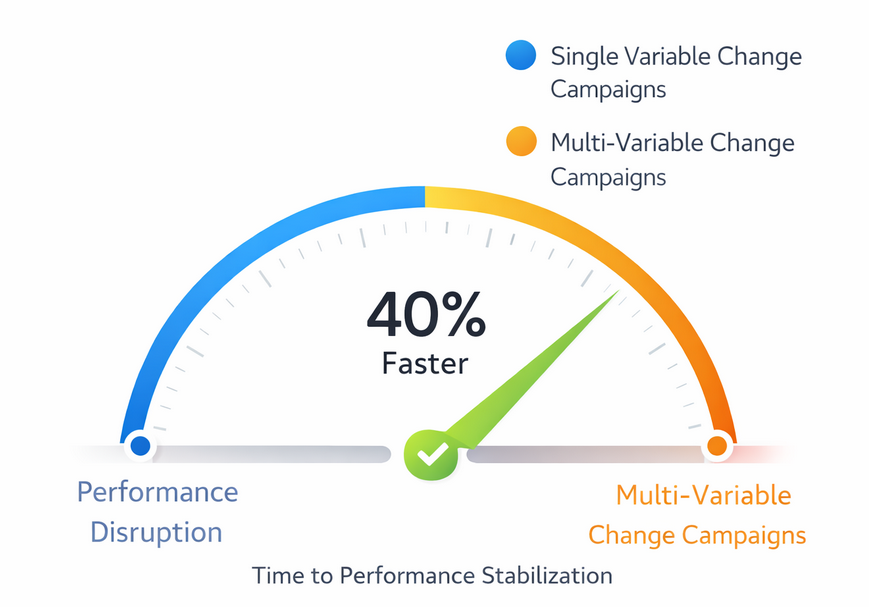
Campaigns that change one variable at a time recover performance up to 40% faster than those with multiple simultaneous edits
Data from performance marketing benchmarks indicates that campaigns with one variable changed at a time recover performance up to 40% faster than those with multiple simultaneous modifications.
A controlled change sequence makes it easier to diagnose what worked and what caused declines.
Stabilize Budgets During Transition Periods
Budget volatility is one of the fastest ways to destabilize performance. Sharp increases or cuts reset optimization signals and inflate costs.
Recommended safeguards:
-
Keep daily budget changes within ±20% during optimization phases
-
Allow 3–5 days between budget adjustments
-
Avoid scaling until key metrics (CPA, ROAS, CTR) stabilize
Gradual budget movement allows systems to adapt without overcorrecting.
Monitor Leading Indicators, Not Just Outcomes
Waiting for conversions alone delays intervention. Early signals often reveal issues before revenue impact becomes severe.
Key leading indicators to track:
-
CTR changes within the first 48 hours
-
CPM fluctuations relative to historical averages
-
Frequency growth signaling early audience fatigue
For example, a CTR drop of more than 20% within two days often precedes a deeper conversion decline if left unaddressed.
Use Rollbacks as a Performance Safety Net
A rollback plan is a critical but often overlooked protection mechanism.
Before making changes:
-
Document baseline metrics
-
Define acceptable performance deviation thresholds
-
Set clear rollback timelines (e.g., revert if CPA increases by 25% within 72 hours)
Teams that implement structured rollback criteria reduce prolonged underperformance by up to 35%, according to internal optimization audits across large ad accounts.
Protect Performance by Preserving Signal Quality
Signal dilution occurs when data becomes too fragmented. Excessive segmentation, over-filtering, or constant resets weaken optimization.
To preserve signal quality:
-
Maintain sufficient audience size during tests
-
Avoid frequent campaign duplication without budget support
-
Let changes accumulate enough data before judging results
Stronger signals accelerate recovery and improve long-term efficiency.
Final Thoughts
Change is unavoidable in performance marketing, but performance loss does not have to be. By isolating risk, sequencing adjustments, stabilizing budgets, and monitoring early indicators, teams can evolve their strategies while protecting results.
The most successful advertisers treat change as a controlled process—not a sudden leap.