You run one ad across Facebook, Instagram, Messenger, and Audience Network. Same creative, same targeting, same budget — but completely different results.
Why?
Because each Meta platform works differently. The way people scroll, click, and engage changes from one to the next.
If you want better results, you need to treat each platform as its own space, not just another place to put your ad.
It’s Not Just Where the Ad Shows — It’s How People Use It
Meta placements aren’t just boxes on a screen. They’re different experiences, and people behave differently on each one.
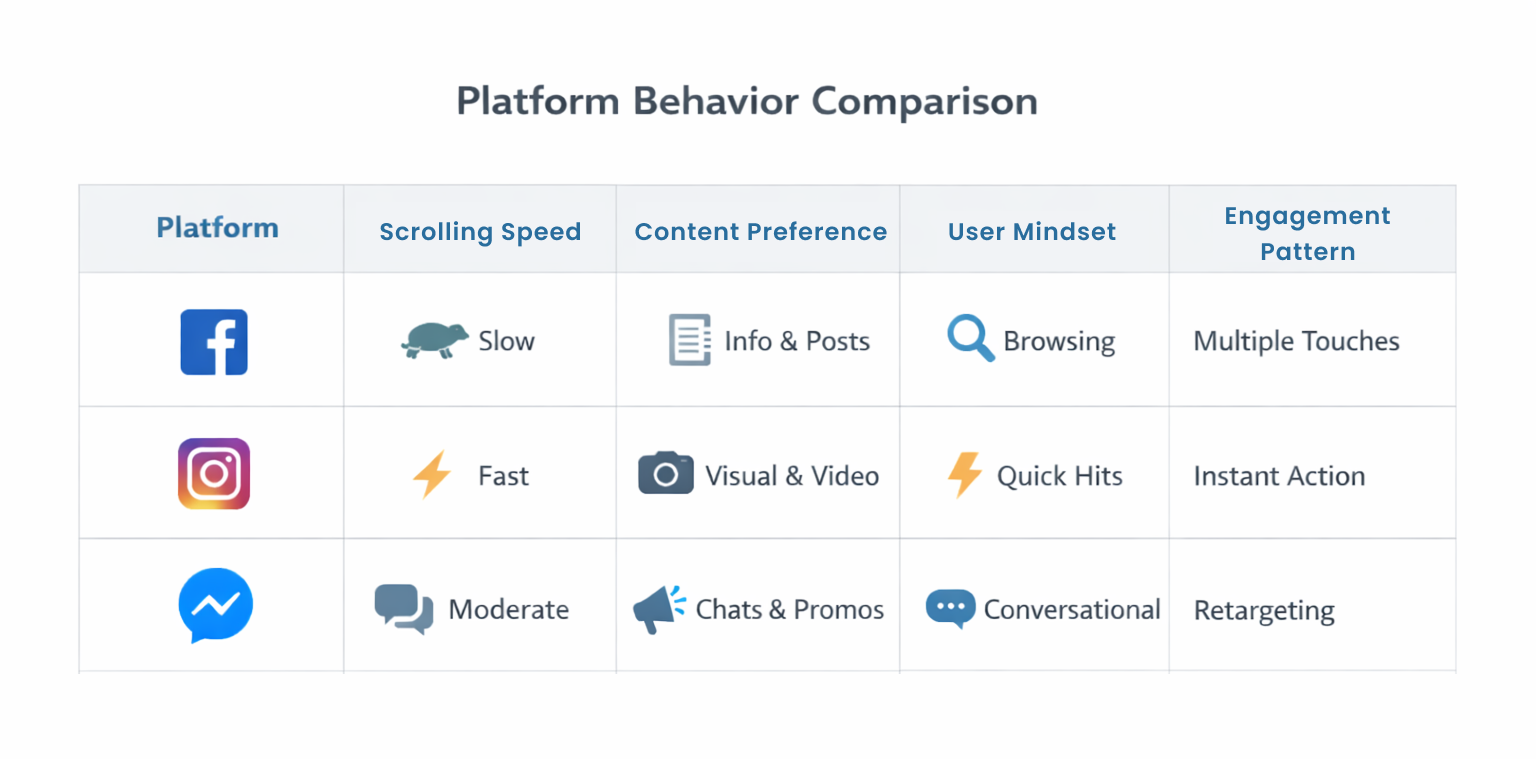
On Facebook, people scroll more slowly and take time to read. Longer posts and info-driven ads tend to perform better, and conversions often happen after more than one interaction. Users are usually in a browsing or research mindset.
On Instagram, behavior shifts. The platform is fast, visual, and scroll-heavy. If an image or video doesn’t stand out immediately, users keep moving. Attention is short, and decisions happen quickly — or not at all. To better understand these user intent differences, see Facebook Ads vs Instagram Ads: How User Intent Differs.
In Messenger and the Audience Network, ads feel more interruptive. Users are focused on conversations or other apps, not discovery. As a result:
-
Cold traffic usually struggles;
-
Retargeting performs more reliably;
-
Purchase intent is generally lower.
When you understand how people behave in each environment, it becomes much easier to design ads that fit instead of forcing the same approach everywhere.
Different Platforms = Different Signals
Meta decides who sees your ad based on engagement, but engagement is not universal across platforms.
On Facebook, delivery is influenced by signals such as:
-
Link clicks, especially to external pages;
-
Comments and reactions that show active interest;
-
Shares that include personal commentary.
On Instagram, the system values different behaviors:
-
Saves, which often signal future intent;
-
Story shares and fast tap-throughs;
-
Visual attention, even when no click happens.
This is why an ad can look strong on Facebook but underperform on Instagram. The creative might be fine, but it’s optimized for the wrong type of engagement. If you want to evaluate results beyond surface metrics, check out How to Analyze Facebook Ad Performance Beyond CTR and CPC.
Small UX Differences Have a Big Impact on CTAs
Your call-to-action does not behave the same way on every platform, even when the wording stays the same.
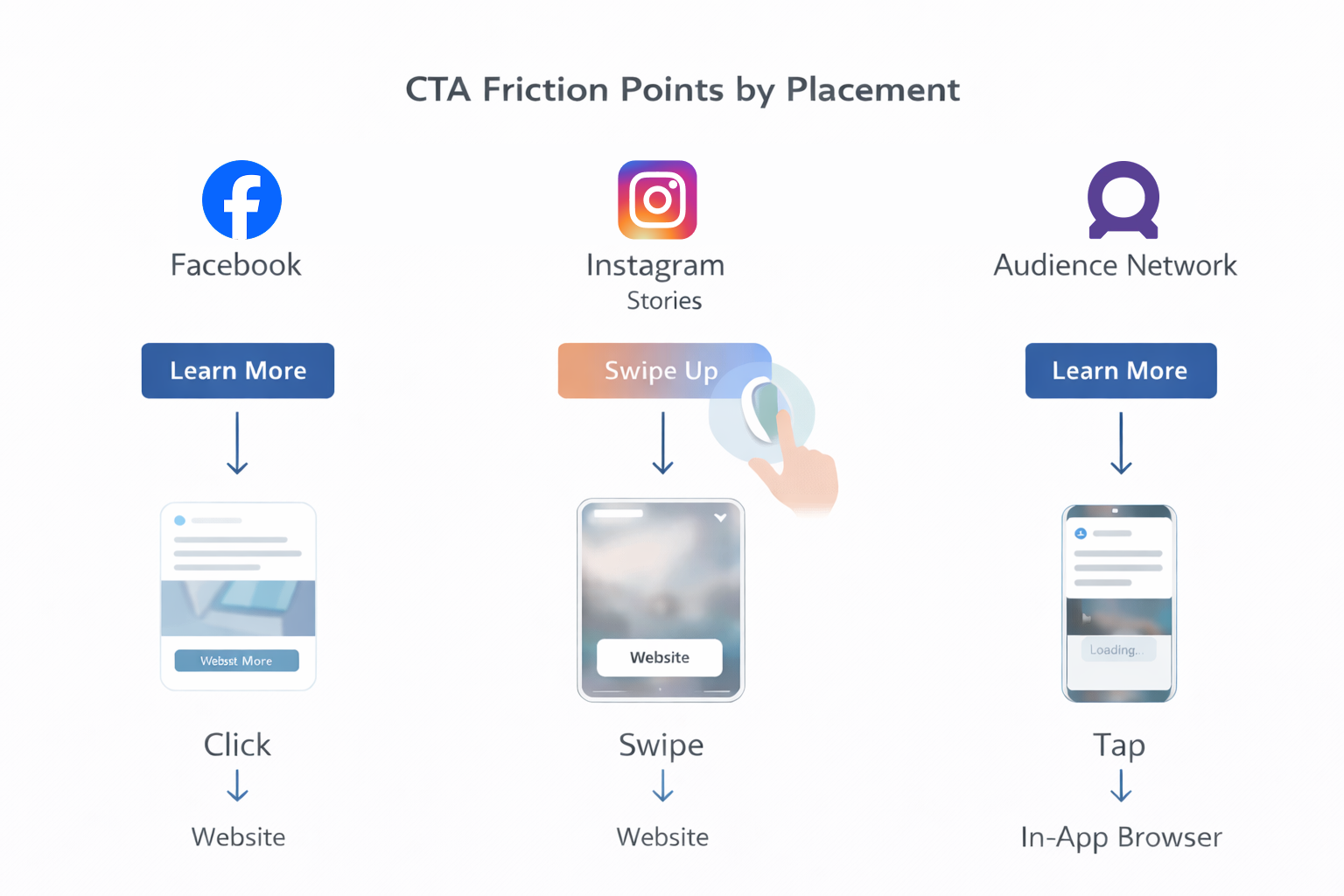
On Facebook, the CTA button is clear and familiar. Users expect to click and land on a site without friction, and longer captions often help set expectations.
On Instagram, especially in Stories, the CTA may appear later or require a specific swipe or tap. If the next step is not immediately obvious, users simply won’t take it.
In the Audience Network, clicks open in an in-app browser. That adds friction through slower load times and a less trusted experience. In many cases, conversions drop not because of the offer, but because of the path to it. Here’s how to use Facebook Audience Network effectively without wasting budget.
When performance dips, the issue is often how the CTA appears, not what it says.
Creative Fatigue Hits at Different Speeds
Every ad wears out eventually, but not at the same pace everywhere.
On Instagram, fatigue shows up quickly because users scroll fast and see the same visuals often. Performance usually drops within days unless creatives are refreshed. Even small changes help, such as:
-
New crops or formats;
-
Updated colors or motion;
-
Slight visual variations.
On Facebook, creatives last longer. Users engage more deeply, and social proof adds momentum. Performance can often be extended by:
-
Tweaking the headline or primary text;
-
Updating the thumbnail or first frame;
-
Reordering copy without changing the message.
If you want to detect early signs of ad burnout and keep performance high, see How to Avoid Ad Fatigue and Keep Optimal Ads Conversion Rate.
Rotation should follow platform behavior, not a fixed schedule.
Same Person, Different Platform, Different Behavior
You might target the same user across Facebook, Instagram, and Messenger, but their behavior changes with context.
Think about intent:
-
Facebook is often used for longer browsing or research;
-
Instagram is quick, visual, and distraction-heavy;
-
Messenger is task-focused, where ads interrupt conversations.
Device usage reinforces this difference. Instagram is almost entirely mobile, while Facebook still sees strong desktop usage. A slow or poorly optimized mobile site will hurt Instagram performance first, even if Facebook results look fine.
Targeting alone doesn’t explain results. Context does.
What to Do Instead of Copy-Pasting Ads Everywhere
Running the same ad across all placements may feel efficient, but it usually caps performance. A few targeted adjustments make a measurable difference.
Start with these steps:
-
Adapt creative to each platform.
Use vertical formats for Instagram Stories, bold visuals for Instagram Feed, and more context-rich captions on Facebook. -
Analyze results by placement.
Look beyond campaign averages. Identify which platforms drive real outcomes and which only spend budget. -
Match optimization goals to behavior.
Instagram often works better with click or engagement goals first, followed by retargeting. Facebook can handle conversion goals earlier. -
Retarget based on the first touchpoint.
Visual reminders work better for Instagram users. Deeper offers and explanations often work better for Facebook traffic.
These are not big structural changes. They’re small adjustments that respect how each platform actually works.
Final Thought
Meta platforms are connected, but they are not interchangeable. Each one has its own rhythm, user expectations, and engagement logic.
If you treat Facebook, Instagram, Messenger, and Audience Network as the same channel, results will stay inconsistent.
If you adapt your ads to the environment they appear in, performance becomes far more predictable and scalable.