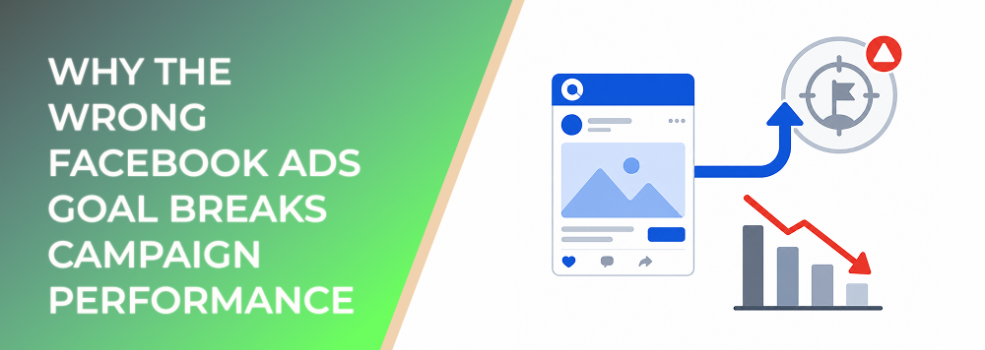
The wrong Facebook Ads goal can make a campaign look active while quietly damaging performance.
This is one of the most frustrating problems in paid social. The campaign spends. The dashboard updates. Clicks, impressions, reactions, messages, or leads appear. But the business result does not improve.
For performance marketers, agencies, SMB owners, growth teams, and B2B lead-generation teams, this creates a reporting trap. The campaign looks like it is doing something, but it is not doing the thing the business needs.
That is why goal choice matters so much.
The Problem
The problem is choosing a Facebook Ads goal that does not match the real business objective.
A campaign goal is not just a label. It tells Meta what kind of user behavior to prioritize.
If you choose traffic, the campaign is pushed toward users likely to click.
If you choose engagement, it is pushed toward users likely to react, comment, share, or interact.
If you choose leads, it is pushed toward users likely to submit information.
If you choose sales, it is pushed toward users more likely to complete purchase-related actions.
The issue starts when the advertiser expects one result but selects a goal that trains the campaign toward another.
This is how a business can ask for sales but buy clicks. It is how a B2B team can ask for pipeline but buy form fills. It is how a local business can ask for booked appointments but buy messages from people who are not ready to act.
Why This Problem Hurts Performance
A wrong goal breaks performance because it distorts optimization, reporting, and decision-making at the same time.
The optimization problem is direct. Meta tries to find people likely to complete the selected action. If the action is too shallow, the campaign may find cheap activity instead of valuable intent.
The reporting problem is more subtle. Ads Manager may show a low CPC, strong CTR, or low CPL. Those numbers can look efficient, especially in the first few days. But if the campaign is optimizing for the wrong behavior, those metrics do not prove commercial value.
The decision-making problem is the most expensive. Teams start fixing the wrong part of the campaign.
They rewrite copy when the objective is wrong.
They change creative when the funnel is wrong.
They increase budget when the result quality is poor.
They blame the audience when the campaign is buying the wrong action.
A wrong goal can make every later optimization decision less reliable.
Common Scenarios Where This Happens
A SaaS company wants demo requests but launches a traffic campaign to a landing page. CPC looks efficient, but demo bookings remain flat.
An ecommerce brand wants purchases but chooses a traffic goal because the sales setup feels more expensive. Product page views increase, but purchase ROAS stays below target.
A local service business wants appointment requests but optimizes for engagement on a promotional post. The post gets reactions, but the calendar does not fill.
An agency inherits an account where old campaigns were built around outdated objective logic. The dashboard has years of data, but the campaign structure no longer matches the client’s current goals.
A startup wants early validation and selects engagement because it wants signs of interest. The campaign generates comments, but the team cannot tell whether people would actually pay.
A B2B lead-gen team optimizes for low CPL without checking sales acceptance. The campaign produces leads, but sales rejects most of them.
Why the Problem Happens
The wrong goal usually gets chosen for practical reasons.
The first reason is speed. Page-created ads and simplified campaign workflows make it easy to launch quickly. Quick setup is helpful, but it can turn goal selection into an administrative click instead of a strategy decision.
The second reason is metric bias. Marketers often prefer the goal that creates the cheapest visible result. Traffic can produce cheaper clicks than lead or sales campaigns. Engagement can create fast reactions. Lead forms can produce volume.
But cheaper is not always better.
A low-cost action that does not predict revenue can increase the real cost of acquisition.
The third reason is unclear business intent. Teams say they want “more traffic,” “more awareness,” or “more leads” without defining what those results should do for the business. When the business objective is vague, the campaign goal becomes vague.
The fourth reason is funnel mismatch. Cold users, warm users, and high-intent users are not ready for the same action. A hard sales goal may be too aggressive for a completely cold audience. An engagement goal may be too shallow for retargeting users who already visited a pricing page.
The Solution
The solution is to choose the Facebook Ads goal based on the behavior you actually need Meta to find.
Start by separating platform activity from business value.
A click is platform activity. A qualified visit may create business value.
A form fill is platform activity. A sales-accepted lead may create business value.
A purchase is platform activity. A profitable order creates business value.
A message is platform activity. A qualified appointment request may create business value.
Once that distinction is clear, choose the goal that is closest to the valuable action and realistic for the campaign’s data volume.
Use a business-outcome filter
Before choosing the goal, answer four questions:
What business result do we need?
What user action best indicates that result?
Can Meta optimize for that action reliably?
How will we verify quality outside Ads Manager?
If you cannot answer those questions, the campaign is not ready to launch.
Match the goal to funnel intent
Use awareness or engagement when the campaign’s job is to build recognition, social proof, or retargeting pools.
Use traffic when the destination has a clear next step and you are measuring post-click quality.
Use leads when the offer, form, and follow-up process can qualify intent.
Use sales when the campaign needs purchases, trials, subscriptions, or revenue-linked actions.
Do not ask a top-of-funnel goal to deliver bottom-of-funnel economics.
Judge performance by downstream quality
Do not evaluate a campaign only by the metric Meta was asked to produce.
If the goal is traffic, check landing page behavior and conversion rate.
If the goal is leads, check qualified lead rate, contact rate, booked calls, and sales feedback.
If the goal is sales, check CPA, ROAS, margin, AOV, and repeat-purchase potential.
If the goal is awareness, check relevant reach, frequency, brand recall proxies, and retargeting audience growth.
The real test is whether the platform result supports the business result.
Risks and Considerations
Do not assume the deepest goal is always the right goal.
A sales campaign may struggle if the account has too little purchase data, the offer is unfamiliar, or the audience is too cold. A lead campaign may produce poor results if the form is too easy or the offer attracts low-intent users.
Also avoid switching goals too frequently. Constant campaign rebuilding can make it harder to interpret performance. If the goal is wrong, fix it decisively. But do not change goals every time one metric moves.
Remember that goal alignment does not replace creative quality, landing page relevance, offer strength, tracking reliability, or sales follow-up.
Prerequisites and Dependencies
To choose the right goal, you need a clear business objective, funnel stage, audience hypothesis, offer, CTA, and primary KPI.
You also need a quality metric. For lead generation, that may be sales acceptance or booked-call rate. For ecommerce, it may be ROAS or margin-adjusted CPA. For local services, it may be appointment rate or cost per booked job.
If deeper conversion volume is too low, you may need to optimize for a higher-funnel event temporarily. But that event should still predict the final outcome.
Practical Recommendations
Do not pick a Facebook Ads goal because it looks cheaper.
Pick the goal that gives Meta the clearest instruction for the result you actually need.
If you need revenue, do not judge the campaign by clicks alone. If you need pipeline, do not judge it by raw lead volume alone. If you need qualified appointments, do not judge it by message count alone.
Review goal alignment before editing creative, changing audiences, or increasing budget.
When performance looks confusing, ask this first: “Is the campaign buying the action we actually need?”
Final Takeaway
The wrong Facebook Ads goal breaks performance because it trains Meta to optimize toward the wrong behavior.
A campaign can generate activity and still fail commercially. The fix is to define the business outcome first, choose the goal second, and measure success by downstream quality instead of surface-level results.
Related LeadEnforce Articles
- How to Tell If Facebook Ads Are Optimizing for the Wrong Goal — Helps diagnose campaigns that appear active but fail to produce meaningful outcomes.
- How to Catch Facebook Ad Objective Mismatch Before Launch — Useful for preventing goal mismatch before spend begins.
- What Meta’s Updated Ad Objectives Mean for Campaign Setup and Performance — Explains how objective categories affect delivery and reporting.
- Facebook Ads Goals: How to Connect Campaign Setup to Revenue and Pipeline — Connects ad goals to business economics, pipeline, and revenue quality.