A Facebook ads goal should come from the business model, not from the campaign setup screen.
Many advertisers choose a goal because it sounds close enough. Traffic for visibility. Leads for growth. Sales for revenue. Engagement for interest.
That logic is too loose.
The real question is: what result would make this campaign worth the spend? For one business, that may be qualified sales calls. For another, it may be first purchases above a margin target. For a local service business, it may be booked appointments in a specific service area.
If the goal does not connect to a real business result, Ads Manager can look active while the campaign fails to create value.
Problem: Facebook Ads Goals Often Start From Platform Metrics Instead of Business Economics
A platform metric can look useful without proving business progress.
Clicks, impressions, leads, landing page views, and purchases all matter in the right context. The problem starts when advertisers choose one before defining the economics behind the campaign.
An e-commerce brand may say the goal is “more sales.” But if the product has thin margins, the goal needs to be profitable orders, not just purchases.
A B2B company may say the goal is “more leads.” But if sales only accepts companies with a certain budget, raw lead count is not the real result.
The business result should define the ad goal. Without that link, the campaign may chase volume that does not support cash flow, pipeline, or profit.
Why Business Economics Should Shape the Campaign Goal
A campaign goal should answer a financial question.
Can the business afford this CPA? Can the sales team convert this lead type? Can the average order value support the media cost? Can the campaign create enough margin to scale?
These questions change what the campaign should aim for.
A brand selling a $30 product cannot judge performance like a brand selling a $900 product. A SaaS company with a six-month sales cycle cannot treat every form submission as equal. A local service business with limited staff may need fewer leads but better booking quality.
A cheap result is not useful if the business cannot profit from it.
This is why it helps to align advertising strategy with business goals before choosing the campaign structure.
How the Wrong Business Goal Shows Up in Performance Data
A poor goal usually creates a split between Ads Manager and business reporting.
Spend is moving. Results are coming in. The issue appears when those results fail to match the economics of the business.
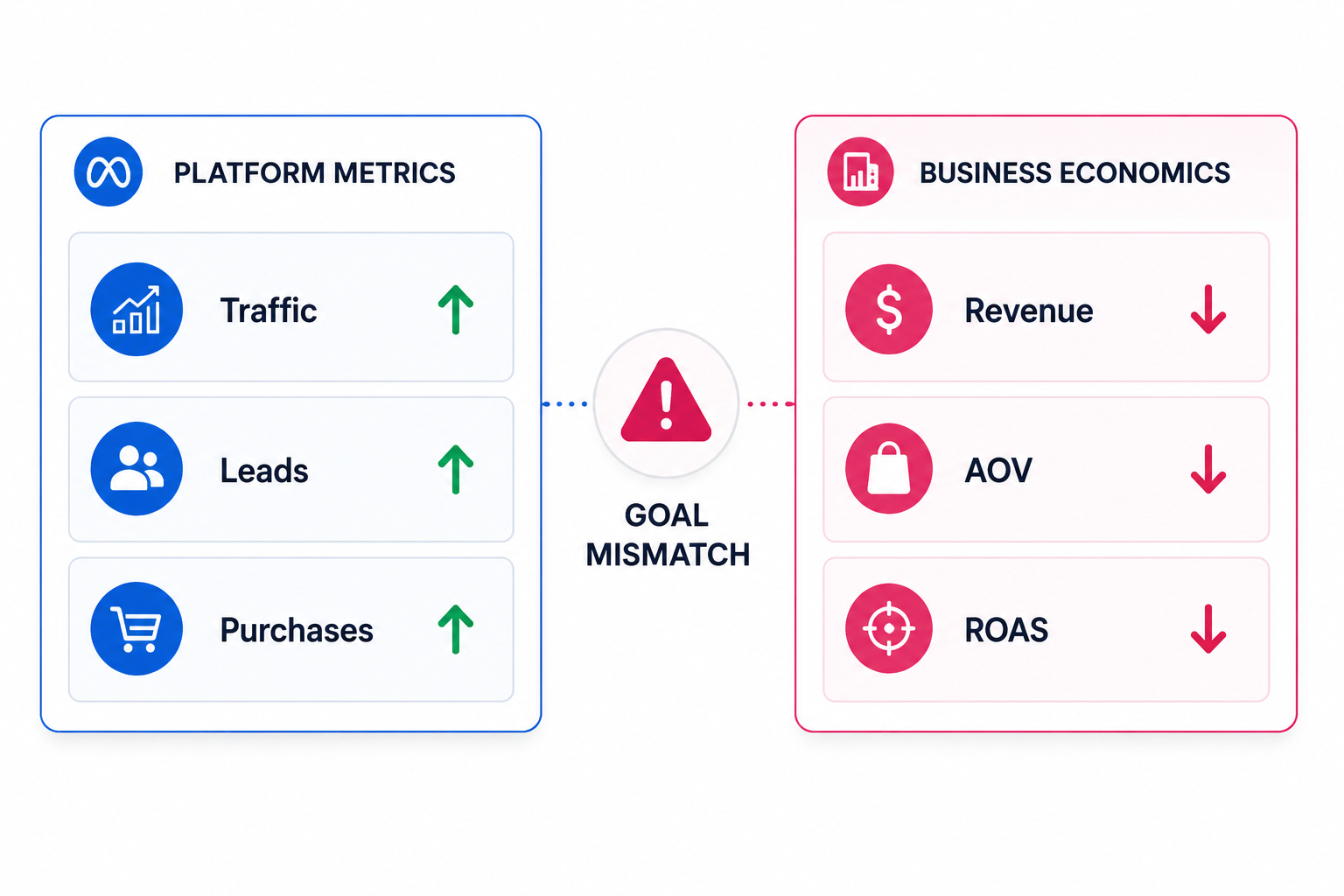
You may see traffic growth without enough revenue per visitor. You may see lead growth without enough qualified calls. You may see purchases, but the average order value is too low to protect ROAS.
The campaign may not be delivering badly. It may be measuring the wrong version of success.
A DTC brand with a 40% gross margin should not judge a campaign only by purchase count. A high-ticket agency should not judge lead campaigns only by CPL. A subscription business should not ignore retention when the first purchase is barely profitable.
Solution: Build a Business-Result Goal Map Before Launch
The solution is to build a business-result goal map before creating the campaign.
This planning step connects the business target, campaign goal, KPI, and quality check before budget is spent.
Use four questions:
- What business result are we trying to create? Define the result as revenue, booked calls, qualified pipeline, profitable orders, subscriptions, trials, or repeat purchases.
- What campaign goal supports that result? Choose the Meta goal only after the business result is clear.
- What KPI proves the result is working? Use CPA, CAC, ROAS, cost per qualified lead, AOV, booking rate, or pipeline value.
- Where will we verify quality? Check CRM data, sales feedback, checkout revenue, booking data, margin, or repeat purchase behavior.
This prevents the campaign from being judged by a metric that looks good but does not support the business.
Set the Revenue Constraint Before Choosing the Goal
Revenue campaigns need a cost limit before launch.
If you do not know the break-even CPA or ROAS, the campaign goal is incomplete. Meta may generate purchases, but you will not know whether those purchases are profitable.
Start with unit economics.
A product with a $120 AOV and a 50% gross margin has less room for acquisition cost than a product with strong repeat purchase potential. If the break-even CPA is $35, purchases at $60 are not successful just because volume increased.
The goal is not “get purchases.” The goal is get purchases within the margin structure the business can afford.
Set the Lead Quality Standard Before Choosing a Lead Goal
Lead campaigns need a quality definition before launch.
A campaign that generates 300 leads is not automatically better than one that generates 80. If the smaller campaign produces more qualified calls, it may be the stronger business performer.
Lead quality should be defined before setup.
For SaaS, that may mean job title, company size, budget, use case, or urgency. For local services, it may mean service area, project type, appointment availability, or purchase timeline.
Instead of “generate leads,” the goal becomes “generate leads that meet sales criteria at a sustainable cost.”
That is where advertising KPIs that connect spend to results matter. The KPI should connect ad spend to the next useful business step, not just the form fill.
Set the Funnel Role Before Choosing Awareness or Traffic Goals
Awareness and traffic goals are not wrong by default.
They become weak when the campaign has no clear role in the funnel.
A traffic campaign may be useful when it sends users to a comparison page, launch page, content hub, or offer page that feeds retargeting. An awareness campaign may help when the business needs market familiarity before direct response works.
But the next step must be clear.
If traffic is the goal, what should visitors do after they land? If awareness is the goal, what audience will be built or measured later? If engagement is the goal, how will that engagement support retargeting, demand, or sales?
If the next step is missing, the goal is not ready.
Match Campaign Success to the Decision You Need to Make
Some campaigns exist to answer a business question.
A company may need to know whether a new offer deserves more budget. An e-commerce brand may need to know whether a bundle attracts higher-value buyers. A B2B team may need to know whether a webinar or demo offer creates better pipeline.
The campaign goal should make that decision easier.
If the decision is about offer quality, CTR is not enough. If the decision is about sales potential, raw CPL is not enough. If the decision is about profit, purchase count is not enough.
Use the campaign to collect evidence that supports the decision. This is why teams should measure what actually moves revenue, not only what looks active in the dashboard.
How to Check Whether a Facebook Ads Goal Matches the Business Result
Before launch, ask one question:
Can this campaign result be tied to revenue, margin, qualified pipeline, booked demand, or customer value?
If the answer is no, the goal is still too loose.
“Increase traffic” becomes stronger when tied to landing page conversion rate or retargeting quality. “Generate leads” becomes stronger when tied to sales acceptance or booked-call rate. “Drive sales” becomes stronger when tied to ROAS, AOV, and margin.
Final Takeaway: The Best Facebook Ads Goal Starts Outside Ads Manager
Facebook ads goals should start with the business result, not the objective menu.
Revenue, pipeline, margin, lead quality, booking rate, and customer value should shape the campaign before budget is spent.
A better question is not “Which Meta goal should I choose?” It is: what business result must this campaign prove?