You open Ads Manager and see a 3.8% CTR. That number looks impressive. Then you check conversions, and almost nothing moved.
This scenario happens often in Meta campaigns. Clicks grow, but revenue stalls. The problem is rarely the platform itself.
What High CTR Actually Means
CTR shows how many people clicked after seeing your ad. It measures attention and initial curiosity. It does not measure purchase intent.
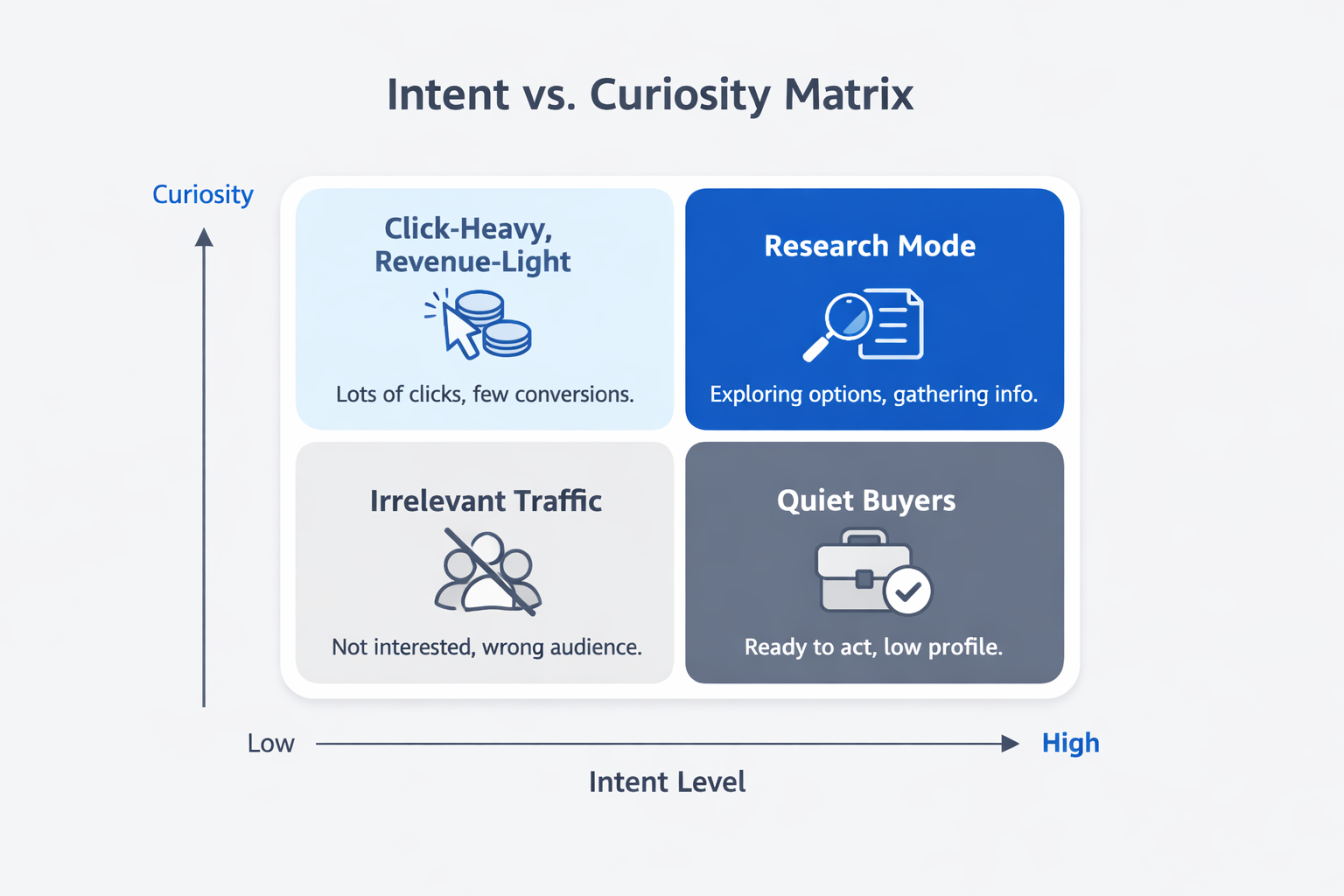
An ad can trigger a fast reaction without driving serious consideration. Curiosity is cheap. Commitment is not.
If you want a deeper breakdown of how click metrics can mislead advertisers, see Why Click-Through Rate Can Be Misleading.
Example: The Attractive Hook Trap
Imagine you run ads for a B2B analytics tool. Your headline says, “Stop Wasting 40% of Your Ad Budget.”
The statement is bold and emotional. Many marketers click to see what they are missing. Most of them are not ready to buy software.
They want validation or tips. They are not looking for a demo.
The Real Reasons High CTR Ads Fail to Convert
High CTR usually signals a structural misalignment. Something attracts attention. Something else blocks the sale.
1. The Hook Filters Poorly
A strong hook should attract qualified users. Many hooks attract everyone.
For example, a SaaS company promotes, “Free Marketing Toolkit.” CTR jumps quickly. Traffic comes from freelancers, students, and early-stage founders.
The product, however, is built for enterprise teams. The funnel fills with people who will never buy.
Common filtering mistakes include:
-
Using broad benefit claims; anyone can relate to them.
-
Avoiding industry-specific language; wrong users feel included.
-
Emphasizing “free” over relevance; price-sensitive clicks dominate.
If this pattern feels familiar, compare it with the principles in How to Attract the Right Customers on Facebook (Not Just Clicks).
The ad wins the click. The business loses the sale.
2. Message and Landing Page Disconnect
Users click because of one promise. They land on a page that pushes another.
Consider an eCommerce brand running an ad for “50% Off Winter Jackets.” The landing page shows the entire catalog, not just discounted jackets.
The user now has to search. That friction kills momentum.
In B2B, this problem appears differently. An ad offers a free checklist. The landing page immediately pushes a sales call. The user expected value first, not a pitch.
This breakdown often relates to weak post-click flow. For practical fixes, review From Click to Conversion: Where Funnels Usually Break .
3. Campaign Objective Attracts Clickers, Not Buyers
If you optimize for traffic, Meta looks for people who click often. These users are active and responsive. They also convert less frequently.
Suppose you run a webinar campaign with a traffic objective. CTR looks strong. Landing page sessions increase.
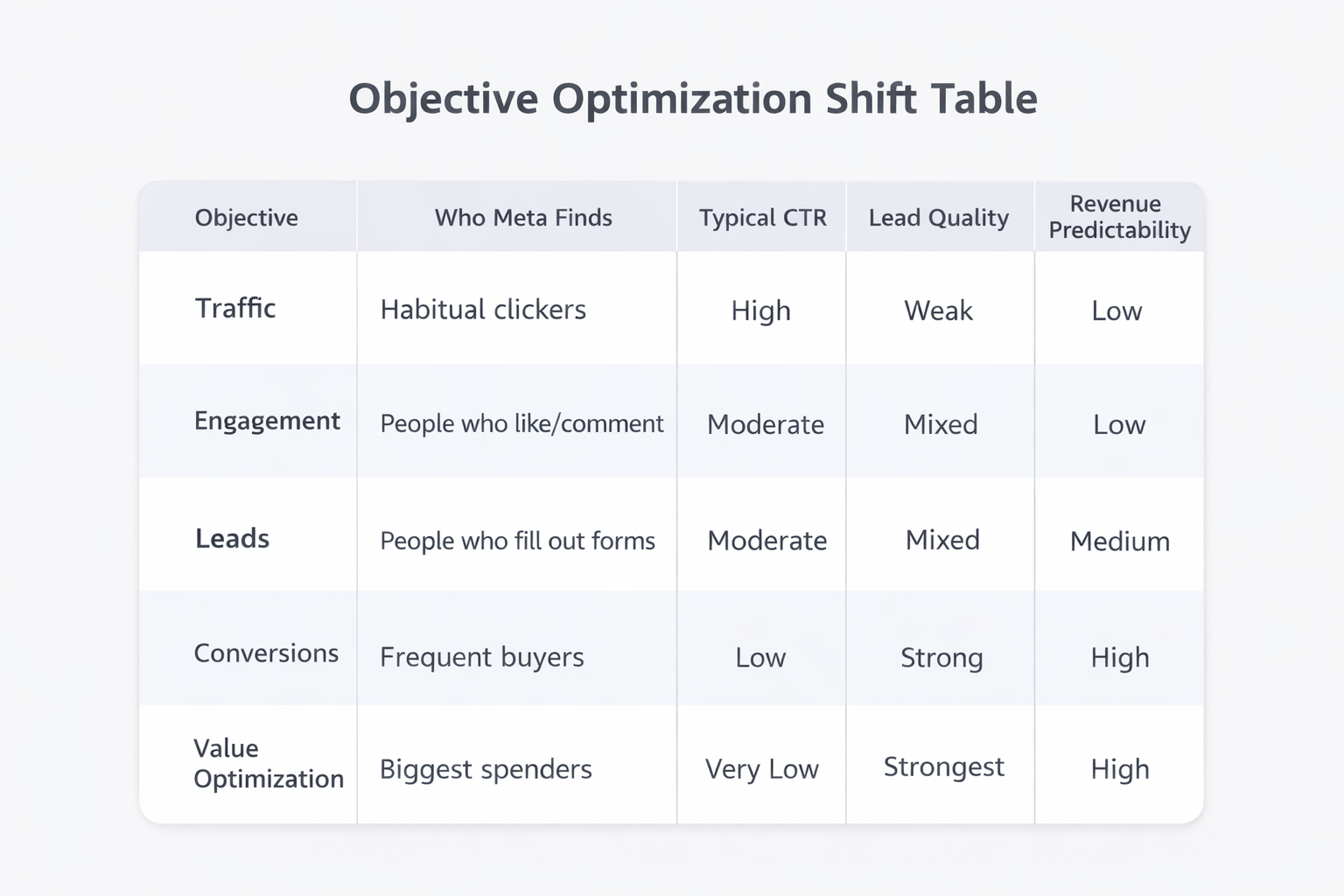
Registration rate stays low because habitual clickers love exploring content. They rarely commit to a form.
Switching to conversion optimization changes delivery. CTR may drop from 3% to 1.5%. Registration rate improves significantly.
For a broader comparison of click-focused vs result-focused metrics, read CTR vs Conversions: Why High CTR Doesn’t Always Mean More Sales.
Lower CTR can signal better audience quality.
4. Curiosity Creatives vs Buying Creatives
Some creatives spark interest. Others drive decisions. They are not the same.
For example, a fitness app runs a dramatic before-and-after transformation video. Engagement explodes. Comments flood in.
Users debate whether the transformation is real. Many click to inspect.
Few subscribe because the ad focuses on shock value, not program structure or pricing clarity.
Compare that with a direct ad showing:
-
A clear weekly workout plan.
-
A transparent subscription price.
-
A limited-time bonus for joining today.
CTR may be lower. Conversion rate improves because the creative pre-qualifies the user.
5. Broad Audience Expansion Inflates Click Volume
Audience expansion often increases reach. It also lowers average intent.
Imagine a brand using a 1% lookalike of past buyers. Conversion rate is stable. Then the team expands to 5%.
CTR increases because the broader group includes lighter, more reactive users. Conversion rate drops because similarity to buyers declines.
You may see:
-
More impressions.
-
More clicks.
-
More sessions.
Yet cost per acquisition rises because intent density shrinks.
This dynamic is explored in Why Audience Expansion Sometimes Lowers Facebook Ads ROI.
How to Diagnose the Real Problem
Surface metrics hide structural issues. You need to connect clicks to downstream behavior.
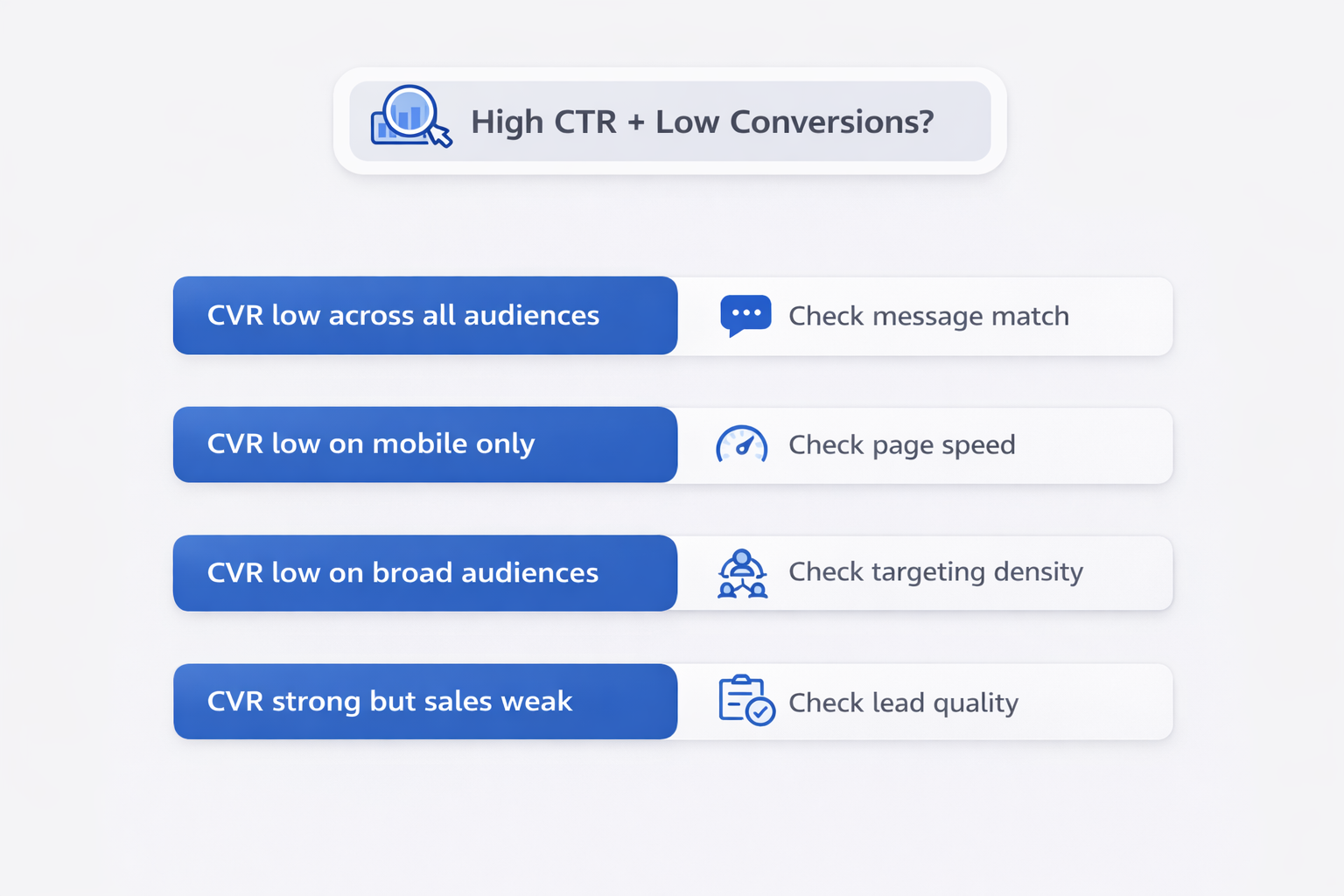
Start with these checks:
-
Compare CTR and conversion rate by audience; identify segments with inflated curiosity.
-
Break down results by placement; some placements drive cheap clicks but weak purchases.
-
Analyze scroll depth; high bounce and low depth indicate message mismatch.
-
Review form completion rate; sharp drop-offs suggest friction or weak intent.
Patterns usually reveal themselves quickly.
Use Case: Lead Generation for a B2B Service
A consulting firm runs ads offering a “Free Growth Audit.” CTR reaches 2.9%. Lead quality is poor.
When they segment by creative, they notice:
-
Ads emphasizing “free” produce most clicks and lowest close rate.
-
Ads highlighting “for SaaS companies above $1M ARR” have lower CTR but triple the deal size.
The solution is not better landing design. It is sharper qualification in the ad itself.
Aligning CTR With Revenue
CTR becomes meaningful when it aligns with business outcomes. That requires intentional filtering.
Qualify Early
Add specificity to reduce unqualified traffic.
Instead of “Improve Your Ads,” say “Improve B2B Lead Quality for SaaS Teams.”
Specificity reduces clicks from irrelevant segments. It increases buyer density.
Match Promise and Page
Your landing page headline should mirror the ad angle. The first screen should confirm the user’s expectation.
If the ad offers a free checklist, the page should deliver that asset clearly. Secondary offers can follow.
Continuity supports trust.
Optimize for the Right Event
If revenue is the goal, optimize for purchases or qualified leads. Accept that CTR may decline.
A campaign with 1.2% CTR and strong ROI outperforms a 3% CTR campaign that generates noise.
Final Thoughts
CTR measures the first micro-commitment. It does not measure buying intent.
If your Facebook ads generate clicks but not conversions, examine targeting depth, message continuity, and optimization strategy. When intent flows through the entire funnel, CTR becomes a supporting metric instead of a misleading one.