Facebook video ads often get skipped before the offer appears.
The campaign may have enough budget. The audience may be relevant. The product may also be strong. But if the first seconds do not create interest, users scroll past the ad before Meta has a chance to collect useful engagement signals.
This is not only a creative issue. It becomes a performance issue.
When people skip early, CTR can fall, CPC can rise, and CPA becomes harder to control. Over time, weak attention signals can also make ROAS look worse, even when the campaign setup is not the main problem.
Problem: The Opening Seconds Do Not Create Immediate Relevance
Most skipped video ads lose attention because the viewer does not understand why the ad matters fast enough.
The opening may show a logo, product shot, office scene, or brand statement. None of these are automatically wrong. The issue is that they often ask the user to wait before giving them a reason to care.
That does not match how people scroll through Facebook.
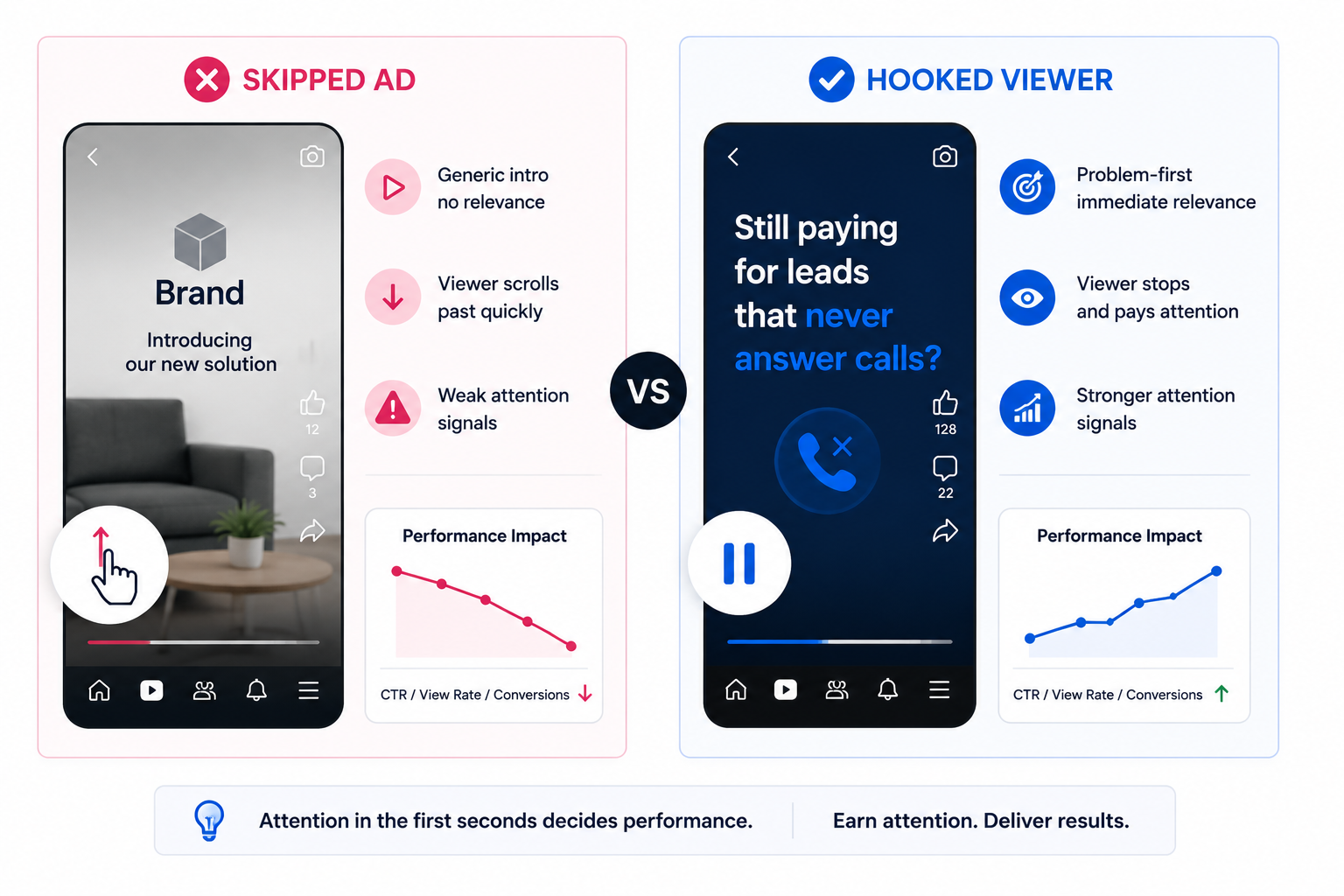
Users are not watching ads in a focused environment. They are moving between posts, comments, Reels, messages, and recommendations. If the ad does not connect to a recognizable problem or outcome immediately, it blends into the feed and disappears.
For example, an opening like “Meet our new platform” is easy to ignore. It talks about the advertiser before it talks about the viewer.
A stronger opening would be: “Still paying for leads that never answer sales calls?” This works because it names a painful campaign outcome right away.
The difference is not wording style. It is relevance speed.
Why Skipped Video Ads Hurt Campaign Performance
When users skip a video quickly, the campaign loses more than a view.
Meta receives weaker signals about the creative. The ad has fewer chances to earn clicks, landing page views, and conversions. That can make delivery less efficient because the system has less positive engagement data to learn from.
For paid social advertisers, this often shows up as misleading campaign data.
The ad may still get impressions. It may even get some video views. But if the right users are not staying long enough to understand the offer, those metrics do not translate into pipeline, purchases, or qualified leads.
This is why a campaign can look active but still feel expensive.
The ad is spending, but the opening is not creating enough qualified attention to support better CPC, CPA, or ROAS.
Solution: Open With the Buyer’s Problem Before Showing the Product
The fastest way to improve a skipped video ad is to rebuild the first seconds around the buyer’s problem.
Do not start with the brand. Start with the situation the viewer already recognizes.
A useful opening can focus on:
- A painful cost, such as rising CPL or wasted spend.
- A frustrating outcome, such as leads that do not convert.
- A clear desire, such as getting more booked calls from the same budget.
- A visible demonstration, such as showing the result before explaining the tool.
The goal is to make the viewer think, “That is exactly what I am dealing with.”
Once that happens, the product has permission to enter the ad.
This is where scripting short-form Facebook video ads becomes important. A short-form script needs to earn attention first, then explain the offer.
How to Make the First Three Seconds Stronger
The first three seconds should carry one clear message.
Not five benefits. Not a full brand story. Not a slow setup. One message.
For a B2B lead generation campaign, that message might be poor lead quality. For an e-commerce campaign, it might be product confusion or abandoned carts. For a local service business, it might be missed appointments or wasted ad spend.
The message should also work without sound.
Many users watch muted, especially in-feed. On-screen text, clear framing, and obvious visual context help the viewer understand the ad even if the audio never plays.
A strong opening usually combines three things:
- A specific problem.
- A visual cue that supports the problem.
- A reason to keep watching.
This is why advertisers should study how to earn attention in the first three seconds. The opening decides whether the rest of the ad gets seen.
Why Expensive Production Does Not Fix a Weak Opening
A polished video can still get skipped.
High production quality may improve trust after the viewer is already interested. But it does not automatically create interest in the first place.
If the opening is vague, slow, or brand-heavy, better lighting and editing will not solve the core problem.
In many campaigns, simple videos perform better because they feel easier to process in the feed. A phone-shot demo, founder clip, or customer-style explanation can work well when the first line is specific.
That is why high-production videos can underperform when the message arrives too late.
The creative does not need to look cheap. It needs to communicate quickly.
Final Takeaway
Facebook video ads get skipped when the opening seconds fail to create immediate relevance.
Before changing the campaign structure or increasing production spend, review the first frame, hook, and on-screen message. The viewer should understand the problem quickly and feel a reason to keep watching.
A stronger opening gives Meta better engagement signals, brings more qualified users into the funnel, and can improve CPC, CPA, and ROAS without a larger production budget.