You build your ideal customer profile (ICP). You launch a Facebook or Instagram ad campaign. But something doesn’t add up.
Your clicks come from the wrong age group. Your leads look nothing like your best customers. Your sales don’t reflect the ad spend.
You’re not alone. Many advertisers see this exact mismatch. It doesn’t mean your offer is bad or your audience is wrong. It means your ICP needs to evolve — and work with how Meta’s system really functions.
This article will help you understand why that gap happens, and how to fix it using real data, simple tools, and smarter creative.
Why your ideal customer profile doesn’t always match ad results
Your ICP may look perfect on a slide deck — but Facebook and Instagram don’t work off theory. They optimize based on behavior.
Most ICPs are built the wrong way
Usually, ICPs come from internal data, not ad performance. You might use:
-
CRM and sales data: Past customers, repeat buyers, referral sources.
-
Surveys or interviews: Direct feedback from happy customers.
-
Founder's vision: Who you think your product is for.
This is a solid starting point. But Facebook doesn’t care about who you like. It cares about who clicks and converts — and that can be a completely different group.
If you’re unsure about what actually makes a strong target audience in Facebook ads, read How to Define a Target Audience for Marketing: a Step-by-Step Guide.
What Meta’s algorithm really does
Meta doesn’t lock into your targeting and call it a day. It experiments, learns, and constantly shifts delivery toward the most responsive pockets.
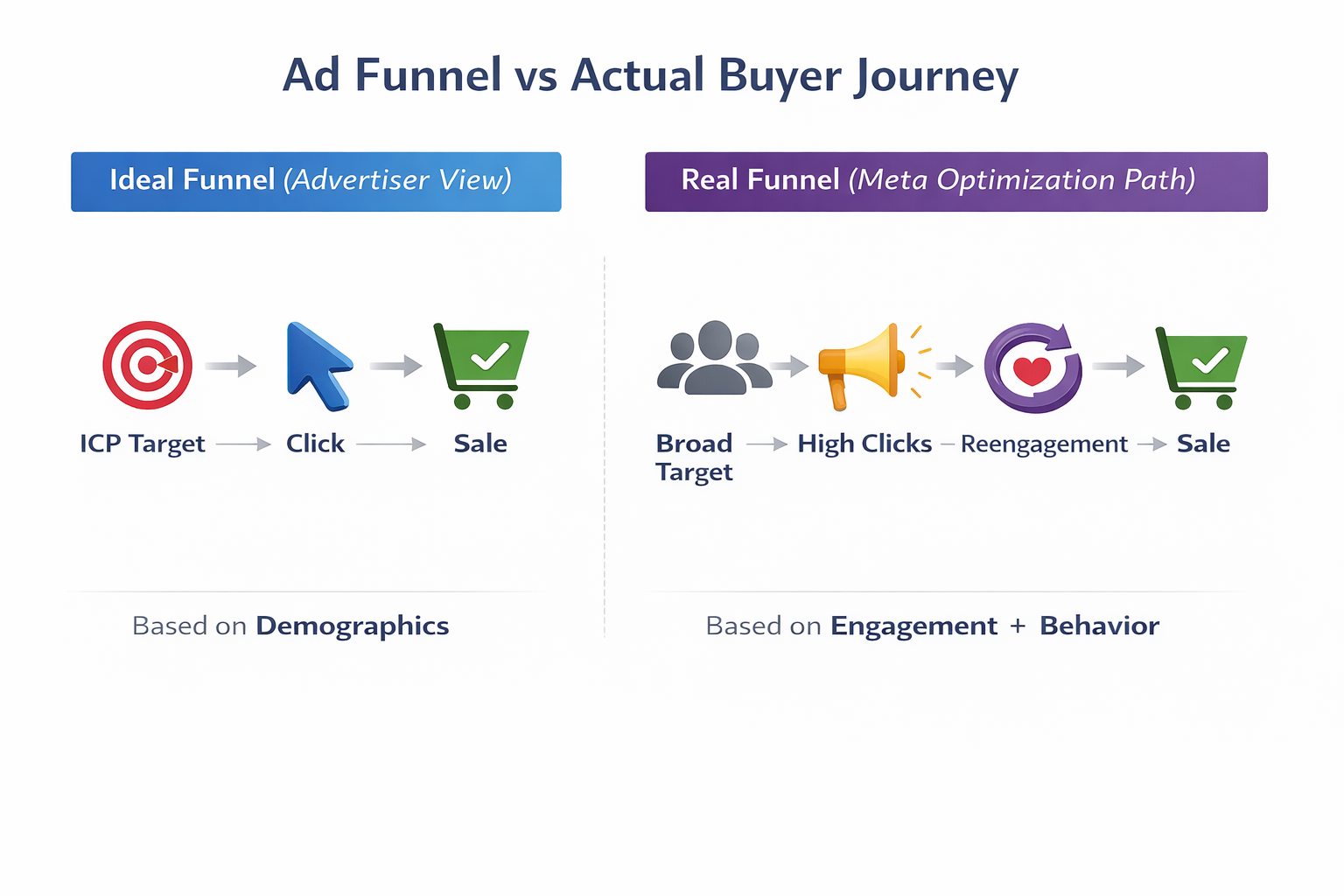
Here’s how it actually works:
-
You set your targeting — like women 35–55, interests in skincare, etc.
-
Meta tests delivery across different segments inside that group.
-
It reallocates budget to where it sees early signals (clicks, views, scrolls).
-
It keeps optimizing, often in directions you didn’t expect.
Even if you target a specific persona, Meta might shift spend to:
-
Younger users with faster click behavior;
-
Low-cost regions with higher engagement;
-
Audiences that click but never buy.
This is why results often drift from your intended ICP — and why so many advertisers feel like they’ve “lost control.”
Learn more about this dynamic in Why Your Ads Get Clicks But No Sales: Fixing the Audience Misalignment.
Signs your ad results don’t match your ICP
It’s not always obvious. But there are clear red flags to watch for.
1. You’re getting leads, but they don’t convert
Let’s say you run a lead-gen campaign. Cost per lead is low, but your sales team says the leads are junk.
Why this happens: You’re optimizing for form completions, not qualified leads. Meta is doing its job — but with the wrong success metric.
What to try instead:
-
Track offline conversions (real sales) and import them into Meta;
-
Use lead scoring to rate quality, and build custom audiences from top-tier leads;
-
Optimize for deeper funnel events like “booked demo” or “purchase,” not just “submit form.”
You’ll find more help in Why Facebook Ads Aren’t Generating Leads and How to Fix It.
2. Your top buyers don’t fit your ICP
You discover that your most profitable users are men 30–40, even though your ads targeted women 45–60.
Why this happens: The real buyers aren’t who you expected. Meta found new buyers based on what’s working, not your assumptions.
To uncover these patterns, try the tactics in Facebook Ad Targeting 101: How to Reach the Right Audience.
3. Your broad audiences perform better than narrow ones
You use detailed interest-based targeting — but broad or lookalike audiences win every time.
Why this happens: Your detailed targeting may be too tight, and it blocks Meta from finding the best subgroups.
What to try instead:
-
Test a broad audience with no filters — and strong creative instead;
-
Use lookalikes from your top 10% of buyers;
-
Layer in engaged Instagram followers using LeadEnforce.
Your creative might be attracting the wrong audience
Even if you get targeting right, your creative can still steer the wrong people to your funnel.
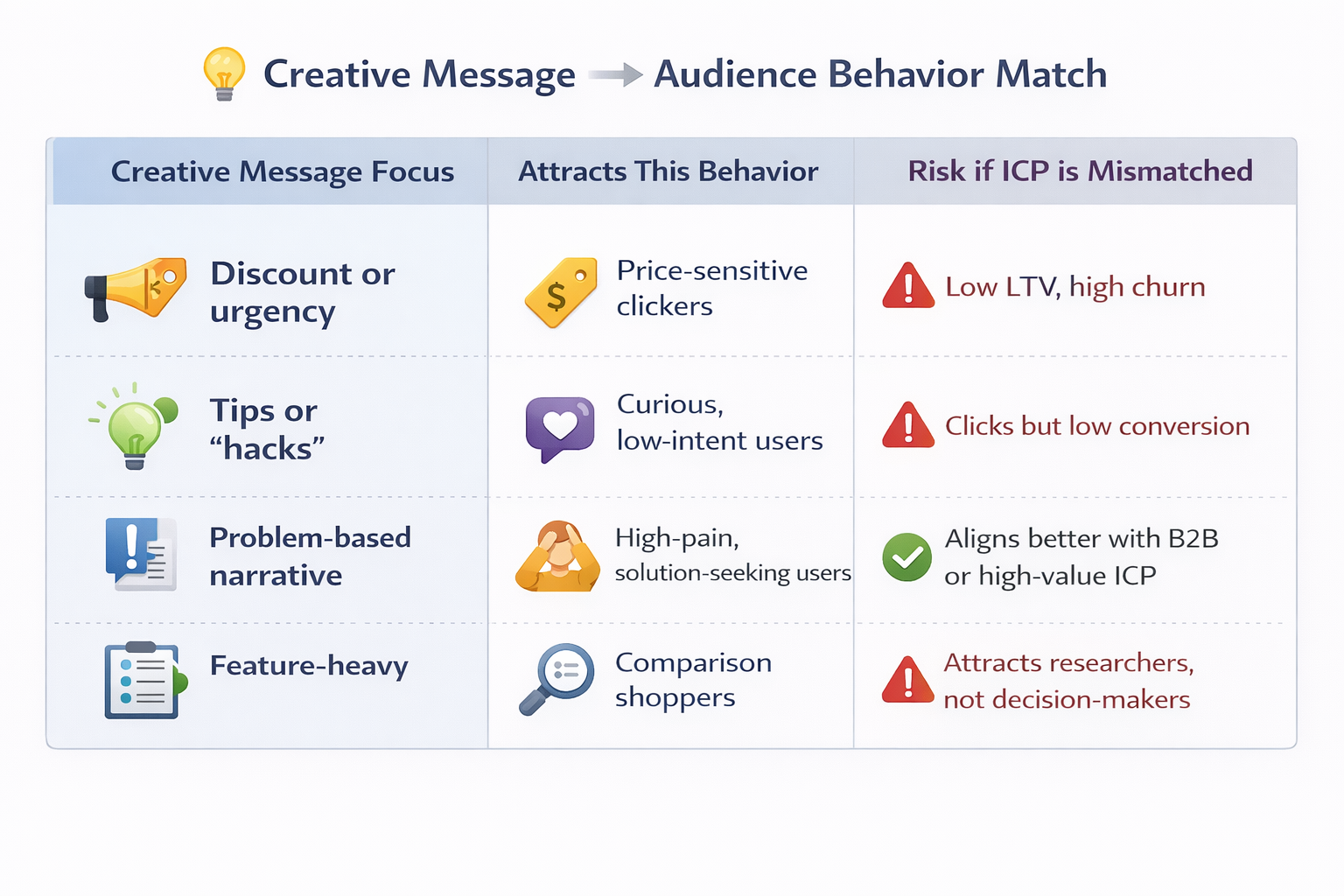
Examples:
-
Ads that highlight discounts bring in price-sensitive shoppers.
-
Ads with trendy language attract curious clickers, not committed buyers.
-
Ads that push features rather than outcomes attract browsers, not decision-makers.
Learn to craft better hooks in How to Structure a High-Converting Facebook Ad: Hook, Body, CTA.
How to realign your ICP with actual ad performance
Instead of throwing out your ICP, evolve it with platform data.
Track more than just clicks
Add tracking for:
-
Time on site;
-
Scroll depth and engagement;
-
Button clicks (e.g. "see pricing").
This helps you see who’s really interested — not just curious.
Build better audiences
Move beyond website visitors. Use:
-
People who watch your Reels or Stories;
-
Users who engage with competitors (via LeadEnforce);
-
Commenters and sharers on Meta platforms.
Use creative that speaks to buyers, not just clickers
Refocus your messaging around:
-
The problem your ICP wants to solve;
-
The outcome they care about;
-
Proof they trust (like social proof from similar people).
Final thoughts: performance reshapes your ideal customer
Your ideal customer isn’t just a guess — it’s a hypothesis you get to test.
Meta ads let you see what actually works. When results don’t match your expectations, don’t panic. Let your data reshape your ICP, not your confidence.