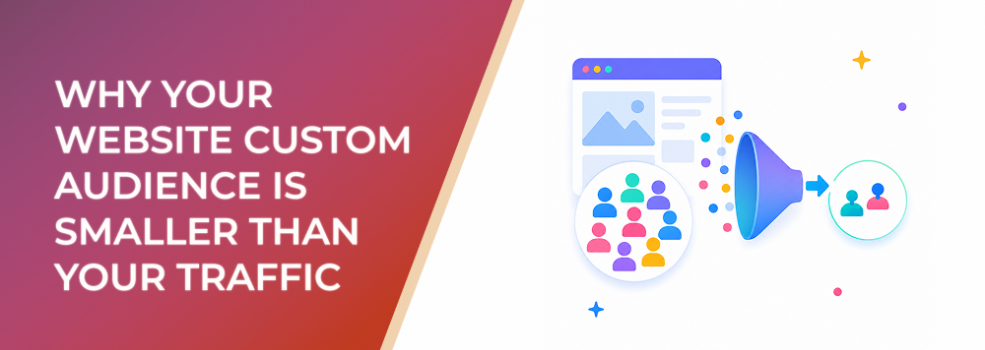
Few things frustrate advertisers more than seeing thousands of website visits but a much smaller website custom audience in Meta.
The immediate reaction is usually panic: “Is tracking broken?” Sometimes there is a setup issue. But in many cases, the audience size difference is expected. Website visits, pixel fires, and audience size are not the same thing.
For performance marketers, the real question is not only why the audience is smaller. It is how to keep campaign performance stable when your retargeting pool is limited.
Why audience size can differ from website traffic
A website custom audience does not necessarily include every visit your analytics platform records.
Meta needs to connect website activity to eligible users who can be included in an audience. Some visits may not match. Some users may not be available for advertising audiences. Some events may fall outside the retention window. Some visits may be repeated by the same person. Some may come from users who opted out, use privacy restrictions, or cannot be matched reliably.
That means a website with high traffic can still produce a smaller usable audience than expected.
This is especially common for advertisers with low-volume websites, niche B2B traffic, long sales cycles, landing pages with one-time visitors, or campaigns sending broad traffic that does not return.
Business impact on CPA, CAC, delivery, and wasted spend
A small website custom audience can affect campaign performance in several ways.
First, delivery may be limited. If the audience is too small, Meta may struggle to spend budget efficiently. That can lead to underdelivery or unstable results.
Second, frequency can rise quickly. A small retargeting pool may see the same ads repeatedly, causing fatigue, lower CTR, and higher CPA.
Third, optimization can become misleading. If your audience includes only a small slice of site visitors, campaign results may not represent the full funnel.
Fourth, advertisers may overreact. Increasing budget, widening retargeting windows, or merging all visitors into one audience can create more scale but lower relevance.
The challenge is to increase usable signal without turning retargeting into low-intent traffic recycling.
Typical scenarios where this applies
Traffic is high, but the audience looks small
This often happens when analytics counts sessions, while Meta’s audience size reflects matched people.
Pixel fires are visible, but audiences do not grow as expected
The event may fire, but that does not guarantee every event becomes an audience member.
Retargeting campaigns underdeliver
Small audiences can restrict delivery, especially when combined with narrow exclusions, short windows, or strict campaign settings.
B2B sites with low visitor volume
B2B advertisers may receive fewer but more valuable visitors. A small audience is common, but it requires careful campaign structure.
New websites or recent tracking changes
Audience pools take time and consistent data to build. Recent domain, page, funnel, or event changes can temporarily reduce audience usefulness.
Risks and considerations
The biggest risk is solving an audience-size problem by adding low-quality traffic.
For example, widening from pricing-page visitors to all website visitors may increase audience size, but it can also include low-intent blog readers, accidental clicks, or people outside your market.
Another risk is assuming the problem is always technical. Sometimes the audience is small because the website does not have enough qualified traffic.
Advertisers should also avoid constantly changing retargeting setup. Frequent changes can make performance harder to diagnose and may interrupt a stable test.
Finally, privacy and consent requirements should be respected. Do not try to force audience growth through questionable data practices.
Prerequisites and dependencies
Before troubleshooting, confirm the basics:
- Your website events are active and connected to the right ad account.
- The audience uses the correct event, URL rule, or behavior definition.
- The retention window matches your buying cycle.
- Exclusions are not accidentally removing most of the audience.
- The audience has had enough time and traffic to populate.
- Campaign budget is realistic for the audience size.
- Creative is refreshed enough to avoid fatigue.
For marketers, the goal is not only to “make the audience bigger.” The goal is to make the audience useful.
How LeadEnforce helps
LeadEnforce helps when website retargeting alone is too small, too slow, or too dependent on broad traffic.
If your website custom audience is limited, you need more qualified people entering the funnel. LeadEnforce helps advertisers build high-intent audiences from Facebook groups, Instagram profiles, followers, engagers, LinkedIn professional data, and custom social-profile sources.
That can reduce reliance on weak broad targeting. Instead of sending random traffic to your site and hoping enough of it becomes retargetable, you can start with people who already show relevance through communities, professional traits, competitor ecosystems, or social engagement.
LeadEnforce can also support testing when website retargeting pools are too small to carry the whole campaign. You can use social-intent audiences for prospecting, then let website custom audiences capture the users who show deeper on-site behavior.
Practical recommendations
Check audience logic before changing budget
Make sure the audience rule, retention window, and exclusions are correct before increasing spend.
Separate high-intent visitors from low-intent visitors
Pricing-page visitors, product viewers, and repeat visitors usually deserve priority over all-site traffic.
Do not overextend retention windows blindly
Longer windows add volume but may weaken intent. Match the window to your buying cycle.
Use frequency as an early warning sign
If frequency rises and CTR falls, the audience may be saturated. Refresh creative or rethink audience size before scaling.
Build more qualified traffic upstream
If your website audience is too small, improve prospecting quality. More relevant traffic creates better retargeting pools.
Use complementary audience sources
Combine website custom audiences with LeadEnforce-built social-profile audiences when website traffic alone is not enough for stable testing.
Final takeaway
A website custom audience can be smaller than website traffic for normal reasons, including matchability, retention windows, repeat visits, privacy settings, and audience eligibility.
The strategic response is not to chase size at any cost. It is to protect intent quality, improve upstream traffic, and build retargeting audiences that support CPA, CAC, and conversion performance.
To supplement small website retargeting pools with more relevant audience sources, join the free 7-day LeadEnforce trial period.
Related LeadEnforce Articles
- Why Your Retargeting Campaign Isn’t Delivering — Directly relevant for diagnosing small, saturated, or low-quality retargeting audiences.
- How to Retarget Website Visitors Who Didn’t Convert on Facebook — Helps structure website visitor audiences by intent and funnel stage.
- How to Convert Website Visitors into Paying Customers with Facebook Ads — Useful for building a stronger visitor-to-customer retargeting framework.
- Should You Retarget Website Visitors or Add-to-Cart Users First? — Helps prioritize limited retargeting audiences when budget or audience size is constrained.
- What Is Facebook Ad Audience Targeting and Why It Matters — Provides broader context on how audience quality affects campaign performance.