Why Smarter Targeting Matters
Digital advertising has reached a point where scale alone no longer guarantees success. As platforms mature and competition increases, reaching the right people has become more important than reaching more people. Smarter targeting focuses on relevance, intent, and data-driven segmentation rather than broad exposure.
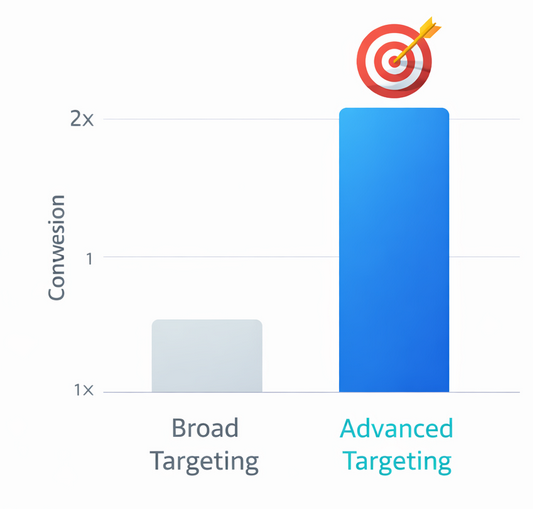
Conversion rates are up to 2× higher when advanced audience segmentation is used versus broad targeting
According to industry research, advertisers using advanced audience segmentation see up to 2× higher conversion rates compared to broad or interest-only targeting. At the same time, irrelevant impressions can account for 30–40% of total ad spend in poorly segmented campaigns, directly impacting profitability.
Smarter targeting is not about limiting growth—it is about building efficiency first, then scaling what works.
The Cost of Broad Targeting
Broad targeting may seem attractive for rapid reach, but it often comes with hidden inefficiencies:
-
Rising cost per click due to increased competition
-
Lower engagement from users with weak purchase intent
-
Longer optimization periods before campaigns stabilize
Recent benchmarks show that campaigns relying on generic interest targeting experience 20–35% higher cost per acquisition than campaigns built on high-intent or data-driven audiences. This gap widens further in competitive industries such as e‑commerce, SaaS, and lead generation.
Data-Driven Audiences Deliver Better Results
When targeting is built on real behavioral and performance data, campaigns become more predictable and scalable. Advertisers who prioritize data-backed audience creation consistently outperform those who rely on assumptions.
Key performance improvements observed across data-driven campaigns include:
-
Up to 70% higher conversion rates when using lookalike-style or performance-based audiences
-
25–40% lower acquisition costs compared to broad targeting
-
Faster learning phases due to clearer audience signals
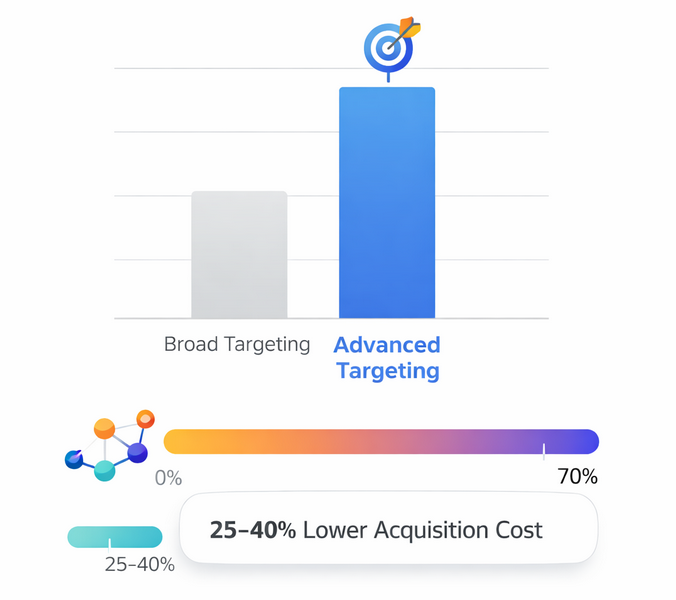
Data-driven audiences can achieve up to 70% higher conversion rates compared with broad targeting
These gains are not the result of higher budgets, but of better audience quality.
Precision Enables Smarter Scaling
One of the biggest misconceptions in advertising is that scaling requires broader reach. In reality, the most successful growth strategies start with precision.
By focusing spend on high-performing audience segments, advertisers can:
-
Identify scalable patterns faster
-
Allocate budget based on proven performance
-
Reduce volatility during scaling phases
Studies show that campaigns scaled from a strong, well-defined audience foundation maintain up to 30% more stable performance during budget increases compared to broadly targeted campaigns.
Practical Targeting Principles That Work
Smarter targeting does not require complex setups—it requires discipline and consistency. High-performing advertisers tend to follow these principles:
-
Start with quality signals: Build audiences from converters, high-value users, or engaged leads rather than clicks or impressions.
-
Segment by intent and value: Separate audiences by behavior, funnel stage, or purchase likelihood.
-
Continuously refine: Regularly exclude low-performing segments and refresh audiences to maintain accuracy.
Advertisers who actively refresh and optimize audiences report 15–25% performance lifts over static targeting approaches.
Measuring Impact Beyond Clicks
Smarter targeting shifts success metrics away from vanity numbers and toward real business outcomes. Instead of optimizing solely for clicks or reach, high-impact campaigns focus on:
-
Conversion quality
-
Cost per qualified lead or sale
-
Lifetime value trends
Data shows that campaigns optimized for downstream metrics generate up to 40% higher return on ad spend over time compared to campaigns optimized only for top-of-funnel actions.
Related Reading
For deeper insights into advanced targeting and campaign optimization, explore these related articles:
Final Thoughts
Smarter targeting is no longer optional—it is the foundation of sustainable advertising success. As costs rise and attention becomes more fragmented, precision, relevance, and data-backed decisions define which campaigns scale and which stall.
By focusing on the right audiences, advertisers unlock bigger impact—not by spending more, but by spending smarter.