Most advertisers test ads in isolation: a few creatives, a couple of audiences, and limited budgets. This approach may produce short-term wins, but it rarely generates repeatable results.
Scalable ad testing frameworks solve three core problems:
-
They reduce false positives by ensuring statistical relevance
-
They make learnings transferable across campaigns and channels
-
They allow teams to test continuously without increasing complexity
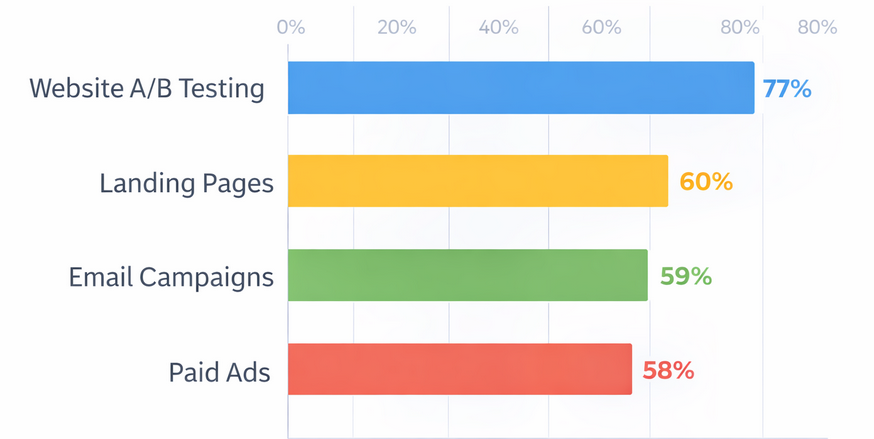
Percentage of companies using A/B testing across key marketing areas
According to Meta internal benchmarks, ads that exit the learning phase with at least 50 conversion events per week are up to 30–40% more stable in cost per result over time. This highlights why structure and volume matter as much as creativity.
The Core Principles of Scalable Ad Testing
1. Isolate Variables
A scalable framework tests one variable at a time. Mixing creative, audience, and offer changes in the same test makes results unusable.
Common isolated variables include:
-
Creative format (image vs. video)
-
Messaging angle (problem-aware vs. solution-aware)
-
Hook or opening line
-
Audience source or size
By isolating variables, winning elements can be reused systematically across campaigns.
2. Standardize Budgets and Timelines
Inconsistent budgets create misleading results. A scalable framework assigns:
-
A fixed daily budget per test cell
-
A minimum test duration (usually 3–5 days)
-
A defined exit rule (for example, pause after 2× target CPA)
Industry data shows that tests run for fewer than 72 hours misidentify winners up to 25% of the time due to delivery volatility.
3. Build Modular Creative Systems
Instead of testing full ads, scalable teams test creative components. For example:
-
Headline A vs. Headline B
-
Visual concept A vs. Visual concept B
-
Call-to-action variations
This modular approach allows one winning element to be combined with others, accelerating iteration without starting from zero.
Three Proven Ad Testing Frameworks
Framework 1: The Creative Matrix
The creative matrix tests multiple hooks against a single offer and audience. Each row represents a hook, and each column represents a format or visual style.
Why it scales:
-
Easy to expand without redesigning the entire test
-
Quickly identifies top-performing hooks
Brands using creative matrices often see 20–35% higher creative efficiency compared to one-off ad tests.
Framework 2: Audience Expansion Ladder
This framework starts with high-intent audiences and gradually expands:
-
Retargeting
-
High-quality seed lookalikes
-
Broad or interest-based audiences
Each level uses the same creative until performance drops beyond a predefined threshold. This ensures that audience learnings are not confused with creative performance.
Advertisers who expand audiences systematically report up to 28% lower CPA during scaling phases compared to abrupt budget increases.
Framework 3: Budget-Based Validation
Instead of declaring winners early, this framework validates ads at increasing budget tiers:
-
Validation at low spend
-
Confirmation at medium spend
-
Scaling at high spend
Ads that survive all three stages are significantly more likely to remain profitable under scale. Internal performance analyses across e-commerce accounts show that only 15–20% of ads pass full validation, but those that do drive the majority of revenue.
How to Know When a Test Is Valid
Scalable testing frameworks rely on clear validation rules:
-
Minimum conversion volume (usually 30–50 events)
-
Cost per result stability across multiple days
-
Consistent performance across placements
Without these criteria, teams risk scaling ads that perform well by chance rather than by design.
Common Scaling Mistakes to Avoid
-
Testing too many variables at once
-
Declaring winners too early
-
Increasing budgets before validating performance
-
Failing to document learnings
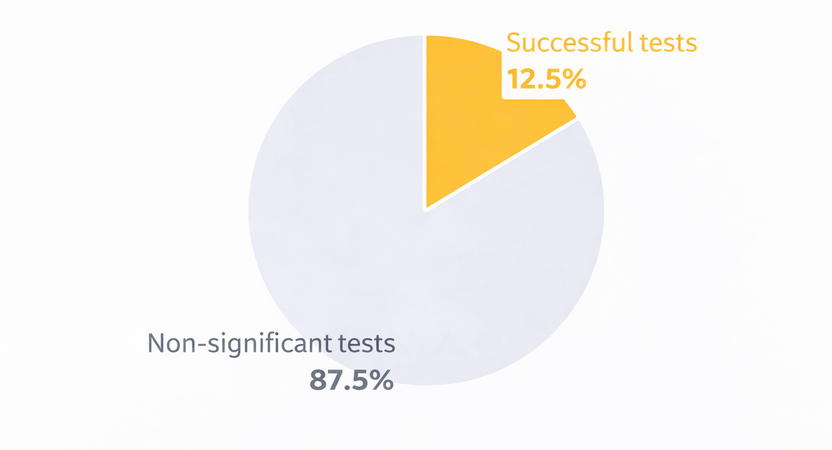
Success rate of A/B tests that produce statistically significant results
Advertisers who document and reuse testing insights are 2× more likely to maintain performance after scaling, according to cross-account campaign audits.
Turning Testing Into a Growth Engine
The goal of scalable ad testing is not finding a single winning ad. It is building a system that consistently produces insights, reduces risk, and compounds performance over time.
When testing frameworks are structured, documented, and repeatable, scaling becomes a controlled process rather than a gamble.