
Digital advertising platforms reward scale, but performance depends on relevance. When audiences are too broad, costs rise and conversion rates drop. When audiences are too narrow, delivery slows, frequency spikes, and growth stalls.
The goal is not choosing one over the other, but designing audience structures that expand intelligently while preserving intent signals.
Industry benchmarks consistently show that:
-
Overly narrow audiences often see CPMs increase by 20–40% due to limited inventory.
-
Broad audiences without behavioral signals can reduce conversion rates by 30–50% compared to segmented targeting.
Balancing volume and precision requires layering, sequencing, and continuous qualification of data sources.
Why Precision Alone Doesn’t Scale
Highly precise audiences—such as small custom lists or tightly defined interest stacks—perform well initially. However, they come with natural ceilings:
-
Limited reach restricts algorithmic learning
-
High frequency leads to creative fatigue
-
Costs rise as platforms exhaust available impressions
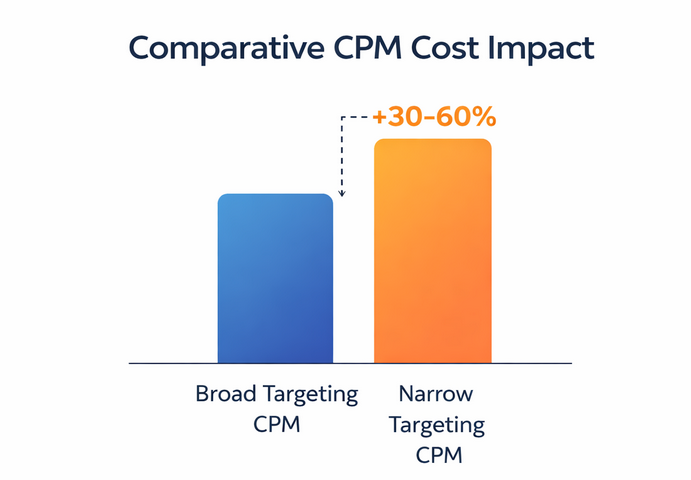
Comparative CPM cost impact of broad vs narrow audience targeting
Performance data across paid social campaigns shows that once frequency exceeds 2.5–3.0, click-through rates typically decline by 15–25%, even when relevance remains high.
Precision should be treated as a foundation, not the final state.
Why Volume Without Control Fails
Expanding too aggressively introduces noise. Large audiences without qualification signals force algorithms to test across low-intent users, which delays optimization and increases acquisition costs.
Studies across paid acquisition campaigns show that:
-
Broad prospecting audiences take 40–60% longer to exit learning phases
-
Cost per lead can be up to 70% higher when no first-party or behavioral signals are present
Volume only works when the platform receives enough structured feedback to identify patterns.
The Balance Strategy: Expand With Signals
The most stable growth happens when volume is increased gradually, while precision is maintained through signal quality.
Key principles include:
1. Start Narrow, Then Expand
Launch with high-intent audiences to generate clean conversion data. Once performance stabilizes, use that data to support expansion.
2. Use Lookalike Expansion Intentionally
Instead of jumping directly to large lookalike percentages, scale incrementally. For example:
-
1% lookalikes prioritize precision
-
3–5% lookalikes introduce controlled volume
-
8–10% lookalikes maximize reach but require stronger creative testing
Across multiple ad accounts, 5% lookalikes often deliver 20–30% more volume with only a 10–15% increase in acquisition cost compared to 1% audiences.
3. Layer Behavioral Qualification
Broad audiences perform significantly better when layered with behavioral or engagement signals. Examples include:
-
Recent content engagement
-
Video view thresholds
-
Prior website interaction windows
Campaigns using layered behavioral signals frequently see conversion rates improve by 25–40% versus purely demographic targeting.
Audience Structuring for Sustainable Scale
A balanced account structure typically includes:
-
Core precision audiences for consistent performance
-
Mid-scale expansion audiences fed by high-quality data
-
Broad testing audiences with strict performance monitoring
This structure allows budgets to shift dynamically based on efficiency, without forcing abrupt scaling decisions.
Measurement: Knowing When Balance Is Lost
Watch for early warning signs that indicate imbalance:
-
Rising CPMs paired with flat conversion rates (over-precision)
-
Falling CTRs and long learning phases (over-expansion)
-
Frequency growth without corresponding revenue lift
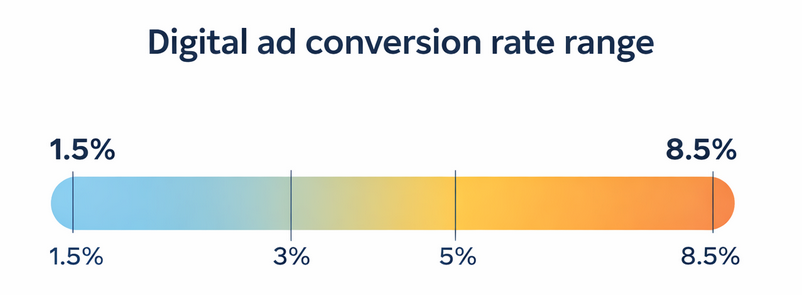
Typical conversion rate range for paid digital advertising campaigns (industry benchmarks)
Regular audience refresh cycles and exclusion hygiene help maintain equilibrium.
Final Thoughts
Volume and precision are not opposing forces—they are complementary levers. Precision generates the data. Volume unlocks growth. Sustainable performance comes from designing systems where both evolve together, guided by signal quality and disciplined expansion.