Most campaigns don’t fall apart when you increase budget because something “mysteriously changed.”
They fall apart because the system you were relying on at $100/day doesn’t behave the same way at $1,000/day.
Scaling changes auction access, audience composition, and how the model interprets conversion signals. If you don’t control those shifts, performance drops almost by default.
Why Scaling Budget Changes Performance
You’ll usually notice it quickly.
You increase budget, and within a day or two:
-
CPM rises,
-
conversion rate drops,
-
CPA follows.
Same setup, different outcome.
What changed is the type of delivery your campaign is getting.
The shift most advertisers miss
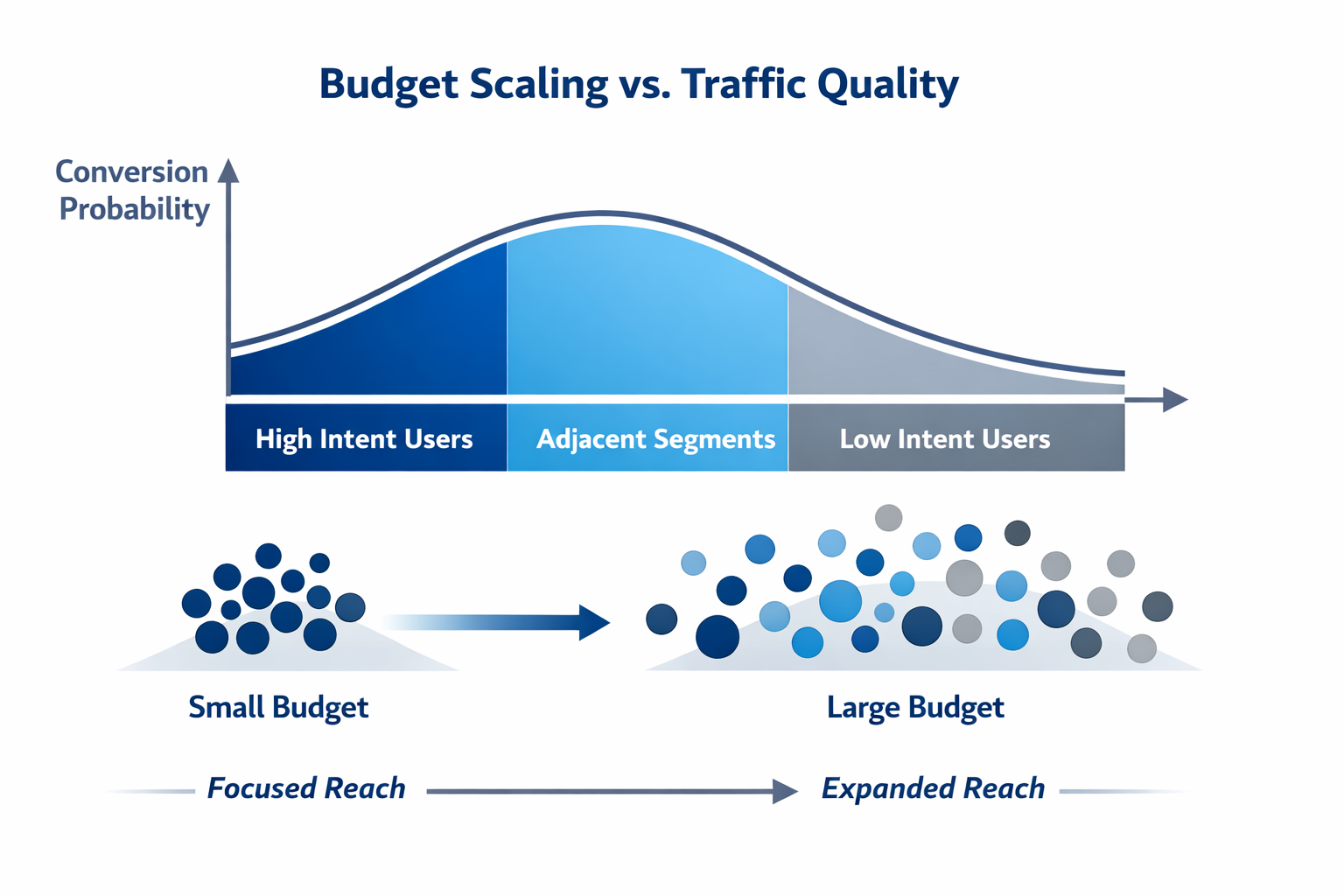
When you raise budget, Meta needs more inventory. To spend it, the system starts:
-
entering auctions it previously avoided,
-
reaching users outside your core high-conversion segment,
-
accepting higher CPM impressions just to maintain spend.
That’s why CTR can stay stable while conversion rate declines. The clicks are still there, but the intent behind them is weaker.
If you want to understand how this competition actually works, read Facebook Ad Auction: Do Ad Sets Compete Against Each Other?
The Learning System Breakpoint
Scaling doesn’t just expand reach. It disrupts how Meta learns.
The system builds short-term models based on recent conversions. When you scale too quickly, you change the data distribution faster than the model can adapt.
What actually breaks
When budgets jump:
-
The campaign reaches new users the model hasn’t validated yet.
-
Conversion feedback lags behind impression growth.
-
Prediction accuracy drops, which leads to worse bidding decisions.
From the outside, this looks like volatility. In reality, the system is trying to relearn under unstable conditions.
If you’ve seen campaigns reset or struggle after scaling, this is closely tied to learning behavior: How to Finish the Facebook Learning Phase Quickly.
Audience Saturation Comes Faster Than You Think
Even broad audiences have limits.
When performance is strong, Meta concentrates delivery around a relatively small cluster of high-converting users. Scaling forces expansion beyond that cluster.
What saturation looks like in practice
You’ll typically see:
-
Frequency rising above ~2.5 quickly,
-
CTR slowly declining,
-
CPM increasing at the same time,
-
Conversion rate dropping before full spend is reached.
That pattern matters.
It means the system has already exhausted the best segment and is now moving into weaker ones. At that point, increasing budget alone won’t fix performance.
How to Scale Without Breaking Performance
Scaling works when you expand capacity before increasing pressure.
Most advertisers do the opposite.
1. Increase budget gradually
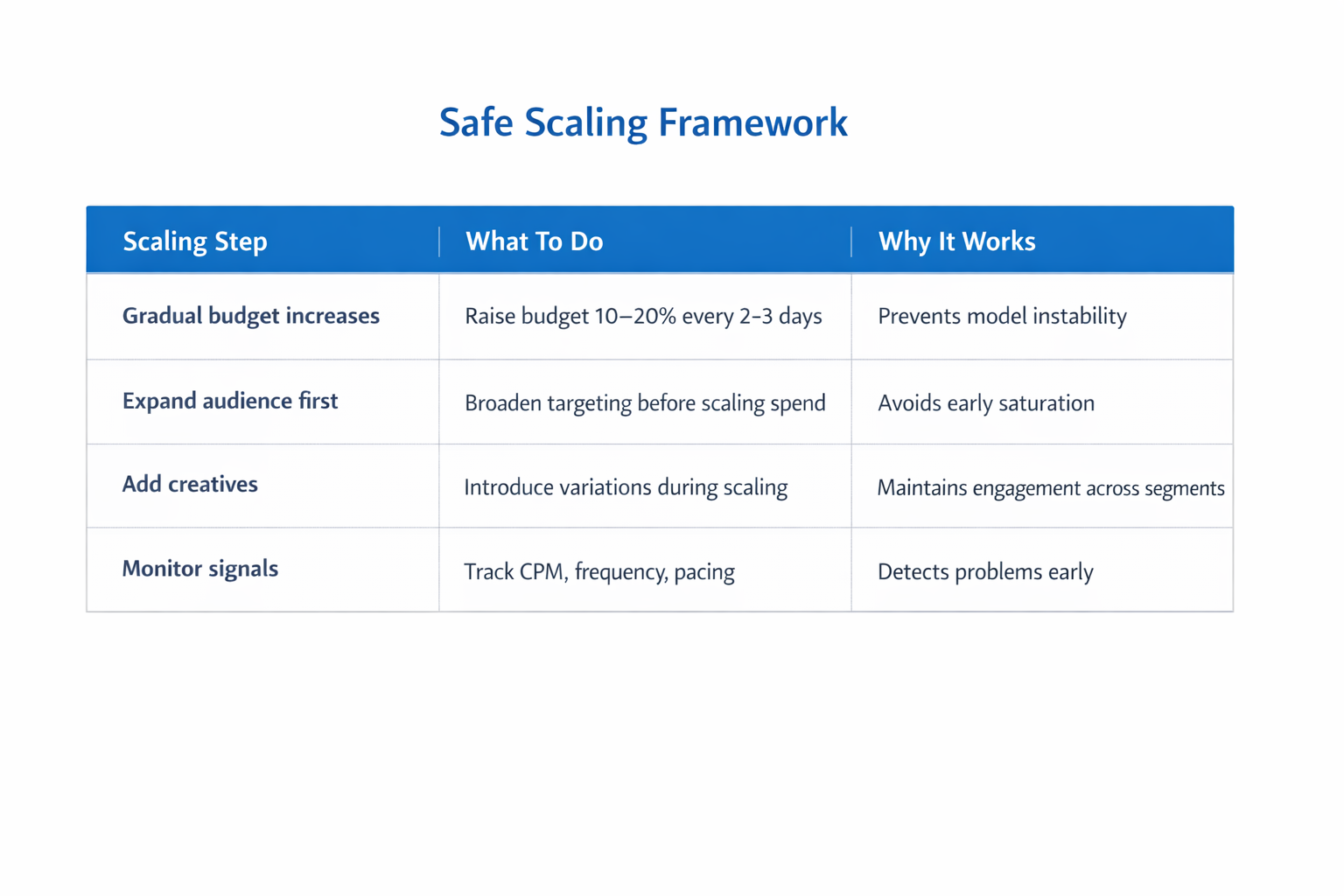
Large jumps introduce instability faster than the system can adapt.
A more stable approach:
-
Increase budgets by 10–20% at a time,
-
wait 48–72 hours between changes,
-
monitor early signals before scaling again.
If performance drifts, that’s not random. It’s the system telling you it hasn’t stabilized yet.
2. Expand the audience before scaling spend
If you scale budget without expanding targeting, you’ll hit saturation faster.
Instead:
-
Gradually widen lookalike ranges,
-
add behaviorally related interests,
-
give expansion features more input diversity.
If you’re working with interest targeting, this becomes especially relevant: Facebook Interest Targeting Expansion.
3. Add new creatives as you scale
Creative fatigue accelerates under higher spend.
The same ad shown more often, to less ideal users, loses effectiveness quickly.
To support scaling:
-
Introduce new hooks and angles,
-
adjust messaging for colder audiences,
-
refresh creatives before performance drops.
If engagement is already declining, fatigue is likely the issue: How to Avoid Ad Fatigue and Keep Optimal Ads Costs.
4. Monitor leading indicators, not just CPA
CPA tells you what already happened.
Scaling decisions depend on earlier signals:
-
CPM trends — rising costs signal weaker auction positioning,
-
frequency growth rate — fast increases indicate saturation,
-
spend pacing — uneven delivery suggests strain,
-
conversion delay — longer delays point to lower intent traffic.
These indicators help you react before performance fully declines.
Horizontal vs Vertical Scaling
Most advertisers default to vertical scaling.
That works — until it doesn’t.
Vertical scaling
Increasing budget inside one ad set works when:
-
the audience still has room,
-
frequency remains stable,
-
CPM doesn’t spike after small increases.
The downside is concentration. If it breaks, everything breaks.
Horizontal scaling
This spreads risk across multiple ad sets.
Use it when:
-
performance drops after budget increases,
-
you want to test adjacent audiences,
-
you need more stable delivery at scale.
Instead of forcing one system to adapt, you distribute the load.
A Scaling Sequence That Actually Holds
Start by stabilizing performance at your current budget.
Then expand your audience inputs so the system has room to grow. Add new creatives to support broader delivery.
Only after that should you increase budget — gradually. If vertical scaling starts to degrade performance, shift part of the budget into new ad sets.
This sequence aligns with how Meta actually adapts.
Key Takeaway
Scaling Meta ads isn’t just increasing spend.
You’re changing how the system finds users, how it competes in auctions, and how it interprets signals.
If those changes happen too fast or without enough support, performance drops.
When you expand capacity first — audience, creatives, structure — scaling becomes much more predictable.