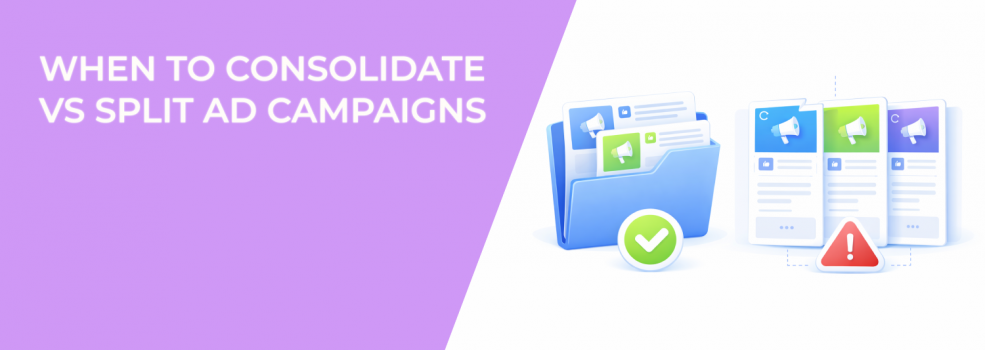
Most Meta Ads problems don’t start with the ad itself. They start with structure.
You can have a good offer, a solid creative, and a reasonable budget, yet still get unstable CPA, uneven spend, or poor scaling because the account is built in a way the algorithm can’t handle well. The choice between consolidation and segmentation is really a choice about signal quality. If each part of the account has too little data, Meta struggles to learn. If everything is packed together, useful differences get buried.
That’s why this decision matters more than many advertisers think.
Why Structure Changes Performance
Meta does not learn from your account in one big pool. It learns from the way campaigns and ad sets are separated, and then allocates spend according to the data each part produces.
If you split too aggressively, each ad set generates too little conversion data to stabilize. If you combine too much, the system starts blending audiences, placements, and behaviors that should be read separately. This is where structure stops being an organizational choice and starts affecting results directly.
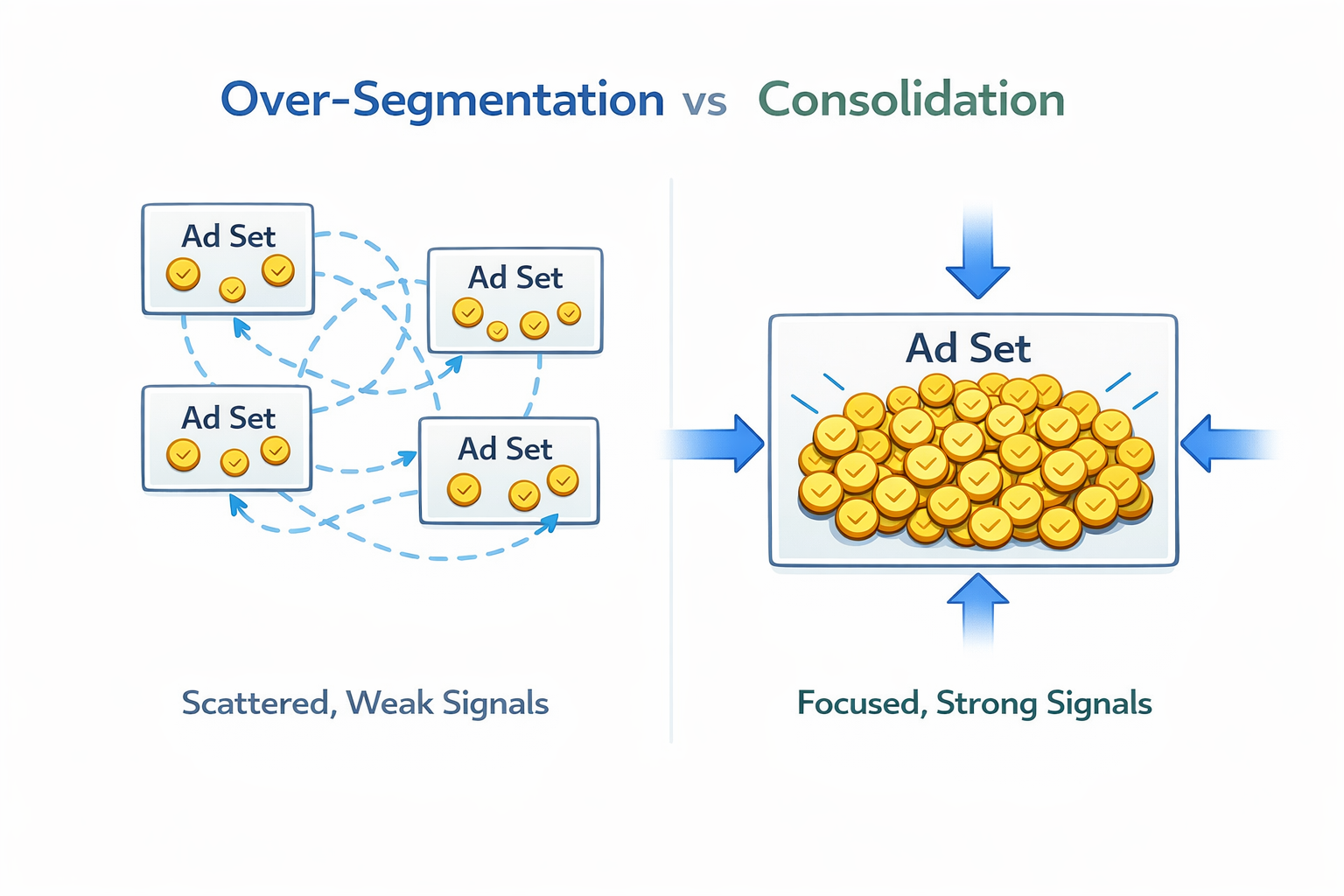
A lot of advertisers try to solve this by making more edits, but the issue is often upstream. The account is either too fragmented to learn or too blended to diagnose clearly.
When You Should Consolidate Campaigns
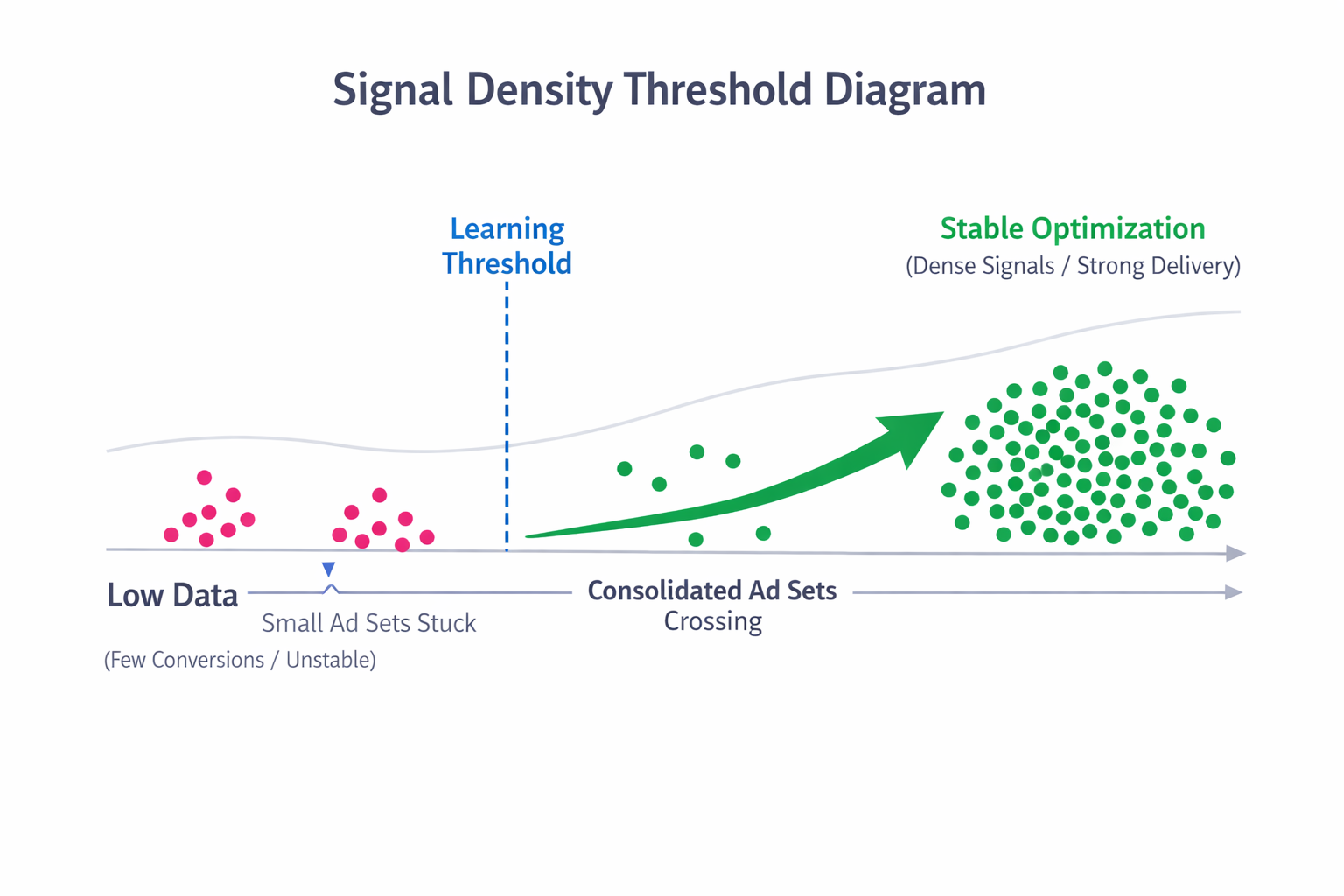
Consolidation usually makes sense when performance is noisy and each ad set is starving for data.
You’ll often see this in smaller accounts or in accounts where someone created separate ad sets for every small targeting idea. On paper it looks controlled. In practice it creates weak learning conditions.
Signs consolidation is the better move
These are the patterns that usually point to over-segmentation:
-
Each ad set produces very little conversion volume.
If an ad set is only generating a handful of conversions per week, Meta has very little to work with. The result is unstable delivery and delayed learning. -
Audiences overlap more than expected.
Slightly different interests or lookalikes often still compete for the same people. That can quietly raise CPM and reduce efficiency. If you want to go deeper on that problem, see Why Audience Overlap Is Killing Your Facebook Ad Performance. -
Spend clusters into one ad set anyway.
This is a common signal. You create five ad sets, but one gets most of the money while the others barely move. That usually means the structure is too thin, and Meta is trying to consolidate behavior on its own. -
Learning resets keep happening after small changes.
When data volume is low, even modest edits can create more disruption than expected. This is closely related to the learning issues covered in How to Structure Facebook Ad Campaigns for Faster Learning.
When these patterns show up together, consolidation usually helps because it gives Meta a denser signal pool.
What consolidation actually fixes
Consolidation is not magic. It does not turn a weak offer into a strong campaign. What it does is remove structural friction.
When you merge low-volume ad sets, more conversions feed the same learning path. Budget has more room to flow toward stronger opportunities. Internal auction competition often drops too. In many accounts, that alone is enough to make CPA stop swinging so hard day to day.
When You Should Split Campaigns
Splitting makes sense later, once the account is already producing enough volume to support separation.
This is where many teams get the timing wrong. They split early because they want more control, but control without data usually creates worse performance. Splitting works best when the account is already showing meaningful differences between segments and you need clearer isolation.
Signs splitting is the better move
You usually split because the data is already telling you that one structure is hiding too much.
-
Audience segments behave differently.
If one group consistently drives lower CPA or better downstream quality, blending it with everything else makes it harder to scale intelligently. -
Creatives perform differently by segment.
Sometimes one creative works with warm audiences and falls flat with prospecting traffic. If those behaviors are blended, you lose clarity. -
Budget keeps flooding one part of the campaign.
In that case, separation may be necessary to force exploration and protect promising segments. This becomes even more important if you are dealing with spend imbalance, which is covered well in How to Fix Uneven Spend Distribution Across Facebook Ad Sets. -
Scaling starts to break performance.
When increased spend pushes delivery into weaker users or lower-quality inventory, splitting can give you cleaner control over where expansion happens.
A simple example is separating cold traffic from retargeting. If they stay inside one blended setup for too long, you lose visibility into which layer is actually carrying the result.
The Risk of Going Too Far Either Way
This is where the decision gets more practical.
If you split too much, you create thin data, shaky learning, and erratic delivery. If you consolidate too much, you get cleaner volume but worse visibility. One problem creates chaos. The other creates blur.
Many advertisers assume more segmentation means more sophistication. Often it just means more noise. That tradeoff is at the center of Over-Segmentation in Facebook Ads: Why Too Many Campaigns Kill Efficiency.
The goal is not to make the account simpler or more detailed. The goal is to make it legible to Meta and legible to you at the same time.
A Practical Way to Decide
If most ad sets are producing weak conversion volume, consolidate first. If individual segments already generate enough data and clearly behave differently, split selectively.
That selective part matters. You do not need to break apart everything. Usually the best move is to separate only where the performance gap is real and recurring. If the difference is minor or inconsistent, keeping the structure tighter is often the better call.
This is especially true in lead generation, where structure can either support learning or choke it. For a related framework, see The Best Facebook Ad Campaign Structures for Lead Generation.
Final Takeaway
Campaign structure should change as the account matures.
Early on, consolidation helps Meta gather enough signal to learn efficiently. Later, once volume is stable and performance differences are easier to trust, strategic splitting gives you more control. The mistake is doing either one too early or too aggressively.
If your account feels inconsistent, do not assume the issue is creative or targeting right away. Sometimes the real problem is that the structure no longer matches the amount of data the account is producing. The more accurately those two things match, the easier the account becomes to scale. Source for the selected internal links: