AI is already embedded in every major ad platform, but most B2B teams still treat it as a black box rather than a controllable system.
The gap doesn’t come from lack of access — it comes from lack of alignment.
If you’ve seen campaigns generate volume but fail to produce pipeline, you’ve already experienced what happens when AI optimizes toward the wrong signal.
AI Is Already Making Decisions — You’re Just Not Guiding Them
Every impression you buy is influenced by machine learning.
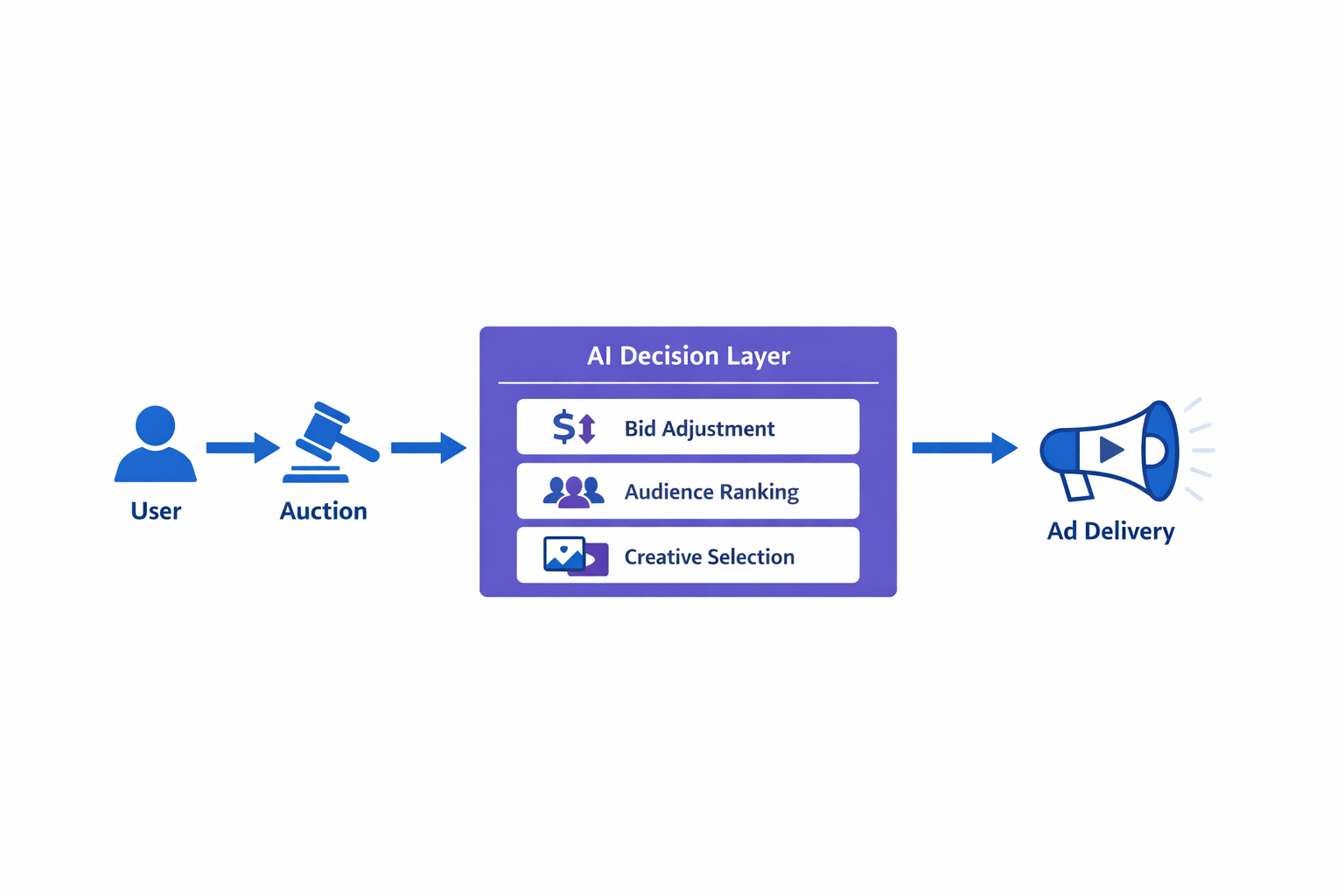
Platforms decide:
-
who enters the auction,
-
how much to bid,
-
which creative to show,
-
and when to deliver.
If you’ve ever noticed campaigns suddenly shifting spend distribution or favoring one ad set, that’s not random behavior. It’s AI reallocating budget based on predicted outcomes — the same mechanism explained in how Meta ads decide where to spend budget.
The key point is simple: AI doesn’t create performance. It amplifies the signals you provide.
Use Case 1: Lead Quality Optimization (Not Just Lead Volume)
A campaign producing cheap leads often looks efficient until sales reviews the pipeline.
This disconnect happens because the algorithm is trained on easy conversions, not valuable ones.
What the system actually learns
When optimizing for form submissions:
-
it clusters users who convert quickly,
-
prioritizes low-effort interactions,
-
and gradually excludes higher-intent but slower users.
You’ll often see:
-
decreasing CPL,
-
increasing lead volume,
-
declining lead quality.
This pattern closely mirrors what’s described in lead quality vs lead volume in Facebook campaigns.
How to use AI correctly
To shift performance:
-
Send qualified lead signals, not just submissions.
-
Integrate CRM outcomes (SQL, opportunity).
-
Accept short-term volatility while the system recalibrates.
Higher CPL is often the cost of better pipeline efficiency.
Use Case 2: Predictive Budget Allocation
Campaign budgets rarely distribute evenly — and they shouldn’t.
AI continuously evaluates where conversion probability is highest and reallocates spend accordingly.
What you’ll observe in Ads Manager
-
One ad set absorbing most of the budget.
-
Others stagnating despite similar setup.
-
Performance divergence within a few days.
This is the same predictive logic behind automated systems explained in the role of AI in Facebook ad budget allocation and scaling.
Where teams go wrong
Common reactions include:
-
forcing equal budget distribution,
-
duplicating ad sets to “restart” delivery,
-
manually overriding spend.
These actions interrupt learning.
Better approach
Instead:
-
structure campaigns clearly,
-
let AI optimize within defined boundaries,
-
analyze where spend concentrates.
Spend concentration is a signal.
Use Case 3: Creative Selection and Fatigue Detection
Creative is one of the strongest signals AI uses.
It determines which ads scale and which disappear.
What the system is doing
For each impression, the platform evaluates:
-
predicted engagement,
-
predicted conversion probability,
-
contextual relevance.
Over time:
-
top creatives dominate,
-
weaker ones stop spending.
The hidden issue: fatigue
As frequency increases, performance declines.
You’ll see:
-
rising frequency,
-
declining CTR,
-
stable or rising CPM.
This dynamic is covered in how to avoid ad fatigue and keep optimal performance.
How to work with AI here
-
Identify winning patterns.
-
Introduce controlled variations.
-
Refresh creatives before performance drops.
AI selects winners — you supply the next ones.
Use Case 4: Audience Expansion Beyond Manual Targeting
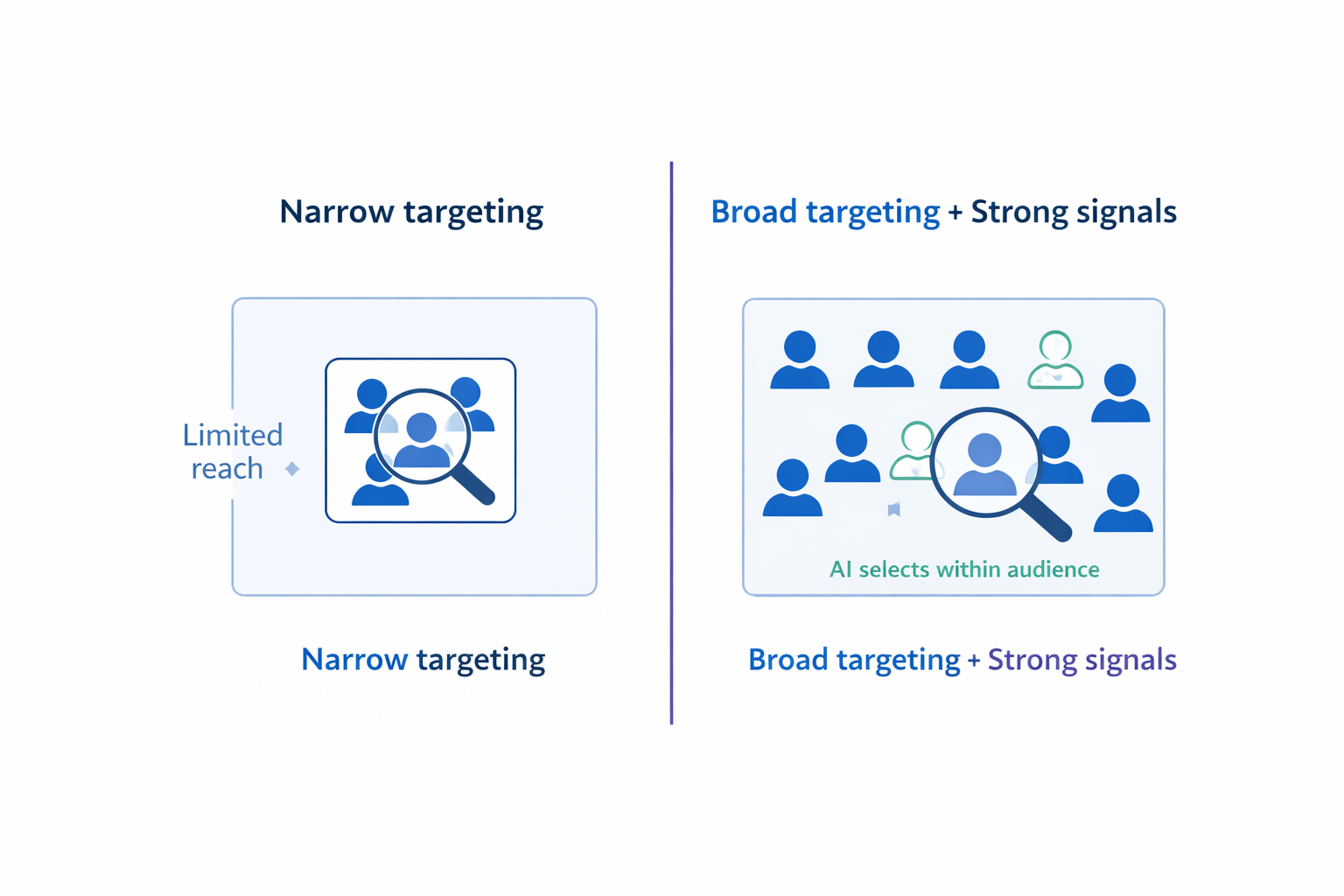
Manual targeting matters less than most advertisers assume.
What actually happens
Even with defined audiences, AI:
-
ranks users by predicted behavior,
-
expands reach where allowed,
-
learns from conversion feedback.
This shift is part of the broader move explained in how AI is changing digital marketing targeting.
Where campaigns break
Over-restriction leads to:
-
limited exploration,
-
slow learning,
-
unstable performance.
Better approach
-
Use broader inputs.
-
Feed high-quality signals.
-
Let the system find high-value segments.
Less control often leads to more scalable performance.
Use Case 5: Auction-Level Bid Optimization
Every impression is an auction.
AI determines how aggressively you compete.
What the system evaluates
-
user conversion likelihood,
-
competition,
-
historical outcomes.
Observable signals
-
fluctuating CPM,
-
unstable CPC,
-
delivery spikes.
How to use this
You don’t need manual bids — but you do need to read signals:
-
Rising CPM without better CVR → inefficient competition.
-
Stable CPM + lower CVR → weak signal or creative issue.
Use Case 6: Funnel Stage Prediction
AI infers where users are in the buying process.
What it detects
-
early-stage exploration,
-
mid-stage comparison,
-
late-stage intent.
How to apply this
Instead of rigid funnels:
-
run mixed-intent campaigns,
-
use varied messaging,
-
let AI match message to user.
Constraint
If all creatives push conversion, AI loses flexibility.
You need coverage across intent levels.
Where AI Fails (And Why It Gets Blamed)
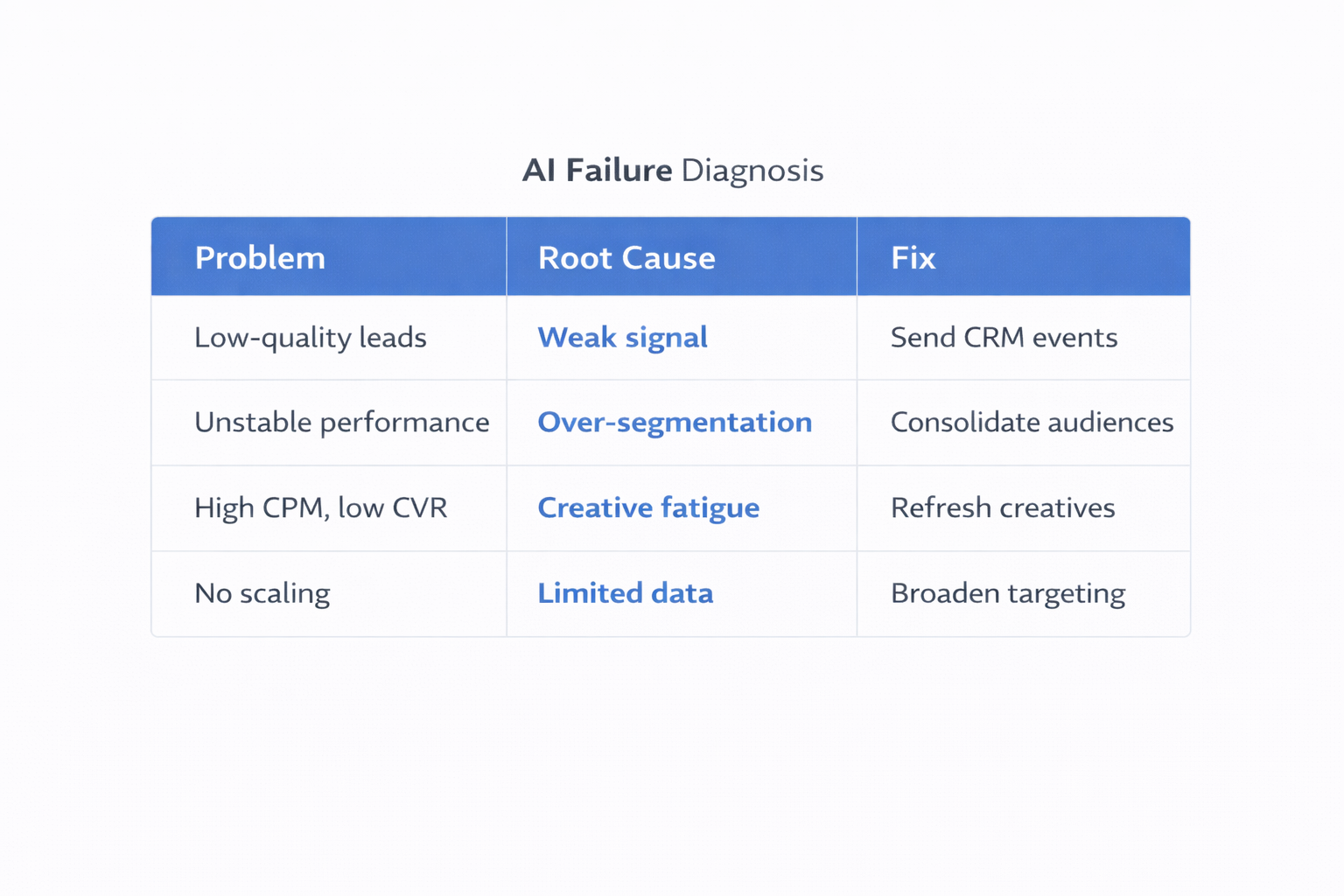
Failures usually come from inputs, not algorithms:
-
weak signals,
-
missing CRM feedback,
-
over-segmentation,
-
stale creatives.
AI follows the structure you give it.
Practical Takeaway
AI in B2B paid advertising is not something you “use.” It’s something you shape.
To make it work:
-
Feed downstream signals, not surface metrics.
-
Allow controlled exploration.
-
Focus on inputs, not overrides.
-
Refresh creatives and data continuously.
When aligned properly, AI shifts your role from campaign operator to system designer.