Most performance issues don’t come from targeting or creatives. They come from how the campaign is structured.
You can verify this directly in Ads Manager. Two campaigns with similar inputs can behave completely differently because one structure concentrates signals, while the other fragments them.
If performance feels unstable or inconsistent, structure is usually the constraint.
When Your Campaign Starts Competing With Itself
A common issue is internal competition between ad sets.
When multiple ad sets target overlapping audiences, they enter the same auctions and drive up costs. This is not theoretical — you can often trace it to rising CPM with no change in targeting.
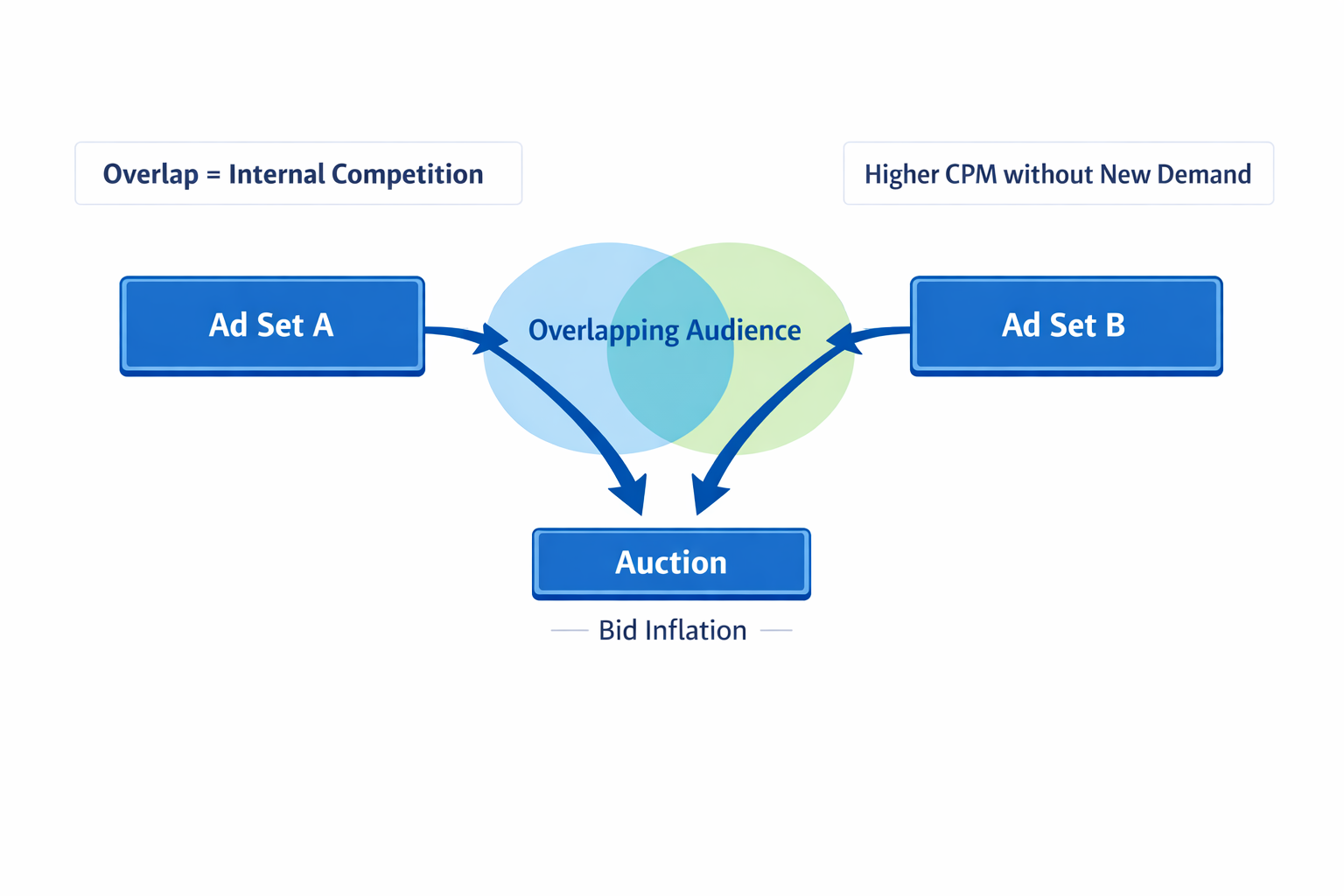
In practice, this usually shows up as a set of subtle but consistent signals inside Ads Manager:
-
Increasing CPM with stable audience size, because your ad sets are bidding against each other.
-
Uneven spend distribution, where one ad set absorbs most of the budget while others barely deliver.
-
Repeated learning resets, especially when budgets are split across similar segments.
This dynamic is explained in more detail in Facebook Ad Auction: Do Ad Sets Compete Against Each Other?
To fix this, the goal is not to add more structure, but to remove unnecessary duplication:
-
Merge similar audiences so conversion signals accumulate in one place.
-
Let the algorithm allocate delivery instead of forcing equal splits.
-
Expand targeting once stable signals exist.
You are not simplifying for convenience — you are removing internal friction.
Over-Segmentation Slows Down Learning
Breaking campaigns into many segments feels like control, but it often reduces performance.
When each ad set receives limited volume, the system cannot confidently identify patterns. The campaign may look active, but learning remains shallow.
You can usually recognize this problem by looking at how unstable results feel over time:
-
Low conversion counts per ad set despite decent total volume.
-
Long or never-ending learning phases.
-
CPA swings that don’t stabilize.
This issue is explored further in Over-Segmentation in Facebook Ads: Why Too Many Campaigns Kill Efficiency.
Instead of pre-defining too many segments, let performance guide structure:
-
Combine segments unless there is a clear performance gap.
-
Use broader audiences so the algorithm can detect patterns faster.
-
Split only when data shows consistent differences.
Segmentation should follow evidence — not assumptions.
Budget Distribution That Blocks Optimization
Budget is not just a resource. It directly affects how quickly the algorithm learns.
When budgets are spread across too many ad sets, none of them generate enough events to stabilize. The system remains in exploration mode.
This typically shows up as slow or inconsistent progress:
-
Ad sets stuck in learning with low daily spend.
-
High CPA variance from day to day.
-
Slow or stalled scaling.
A deeper breakdown is covered in Budget Optimization for Lead Generation Campaigns on Facebook.
The correction is usually straightforward but requires concentration:
-
Consolidate budget into fewer ad sets that can produce consistent events.
-
Avoid equal distribution unless performance is proven.
-
Shift spend toward segments that show stable results.
Budget concentration increases signal clarity — and improves optimization.
Creative Testing Without Control
Creative testing often fails because the structure does not support clean comparisons.
When too many variables are tested across multiple ad sets, results become inconsistent. It becomes unclear what actually drives performance.
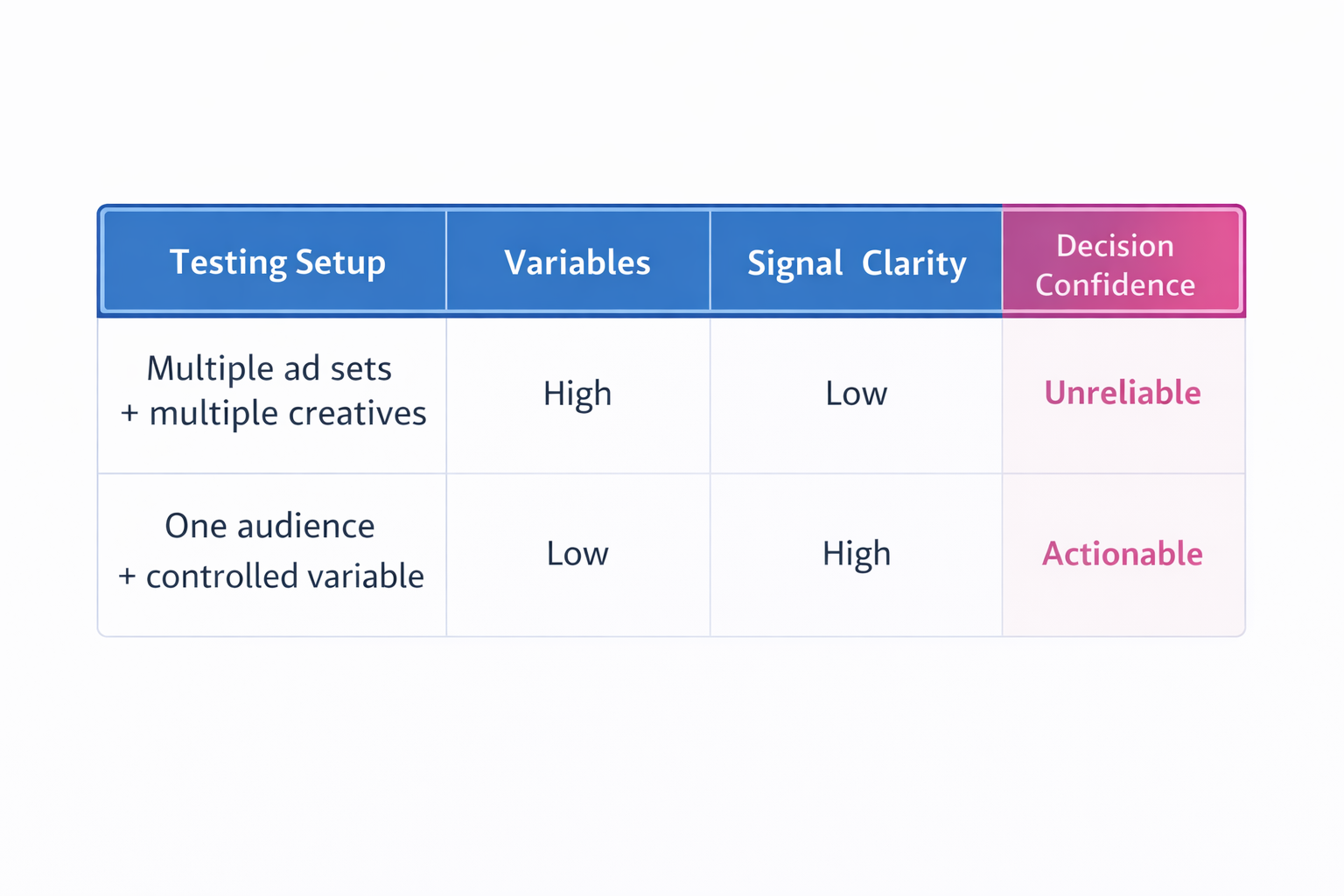
This usually leads to confusion:
-
No clear winner despite significant spend.
-
Results shifting depending on delivery distribution.
-
Duplicate creatives across segments.
A structured testing setup removes this ambiguity:
-
Test one variable at a time — angle, format, or message.
-
Use a consolidated audience for consistent delivery conditions.
-
Allocate enough budget to reach meaningful conclusions.
For a structured approach, see What Is A/B Test and How to Run Split Test on Facebook?
Testing only works when the environment is controlled.
Scaling a Weak Structure Makes It Worse
Scaling does not fix structural problems — it exposes them faster.
If signals are fragmented or inconsistent, increasing budget pushes delivery into less efficient inventory.
You can usually spot this quickly:
-
CPA rising after budget increases.
-
Conversion rate declining as reach expands.
-
Spend shifting toward lower-quality segments.
Before scaling:
-
Confirm stable performance across multiple days.
-
Check that conversion signals are consistent.
-
Ensure budget is concentrated in strong segments.
Scaling should extend a working system — not compensate for a broken one.
Practical Takeaway
Campaign structure determines how the algorithm learns, allocates budget, and enters auctions.
If performance is unstable, audit the structure first:
-
Are ad sets competing against each other?
-
Is data fragmented across too many segments?
-
Does each ad set have enough budget to stabilize?
-
Are objectives clearly separated?
Small structural fixes often outperform creative or targeting changes.
Once signal flow is clean, everything else starts working the way it should.