At some point, every advertiser asks the same question: can I retarget people who comment on Instagram posts?
It feels like high-intent behavior. Someone took the time to engage publicly. In theory, that should be one of the most valuable audiences you can build.
The reality is more nuanced. And if you misunderstand how Meta handles this type of engagement, you’ll end up optimizing for signals you can’t actually use.
The Short Answer
You cannot directly target people who comment on Instagram posts inside Meta Ads Manager.
There is no built-in audience type for “post commenters” the way there is for:
-
video viewers;
-
profile visitors;
-
people who engaged with your account;
-
people who sent messages.
However, this doesn’t mean comments are useless. They just need to be translated into trackable signals the system understands.
Why Comments Aren’t Directly Targetable
Meta’s ad system is built around structured, trackable events — not raw social interactions.
A comment is unstructured, varies heavily in meaning, and isn’t tied to a consistent intent signal. A detailed product question and a single emoji are treated the same way inside the system. That makes it difficult to standardize and use for optimization.
Because of that, the algorithm does not treat comments as a reliable input.
Instead, Meta prioritizes behaviors it can quantify consistently, such as:
-
video watch duration;
-
link clicks;
-
landing page events;
-
form submissions.
From a system perspective, a comment is engagement — but not a conversion-aligned signal.
What You Can Target Instead
While you can’t isolate commenters specifically, you can target engaged users at the account level.
Instagram Engagement Custom Audiences
Inside Ads Manager, you can build audiences of people who:
-
visited your Instagram profile;
-
engaged with any post or ad;
-
sent a message;
-
saved content;
-
clicked call-to-action buttons.
This is the closest proxy to “commenters.”
But there’s an important limitation.
Someone who liked a post once is grouped together with someone who commented multiple times. Intent levels are mixed, and the algorithm doesn’t differentiate depth of engagement.
So while this audience includes commenters, it is not filtered for them.
If you want to understand how these audiences behave in practice, it’s worth reviewing how Custom Audience – Why Should You Use It? fits into overall campaign performance and retargeting logic.
Why Commenters Feel High-Intent (But Often Aren’t)
In practice, comment quality varies more than most advertisers expect.
You’ll usually see a mix of quick reactions, casual questions, and occasionally more serious buying signals. Only a small portion of comments actually reflect real purchase intent, but all of them are grouped together inside Meta’s engagement data.
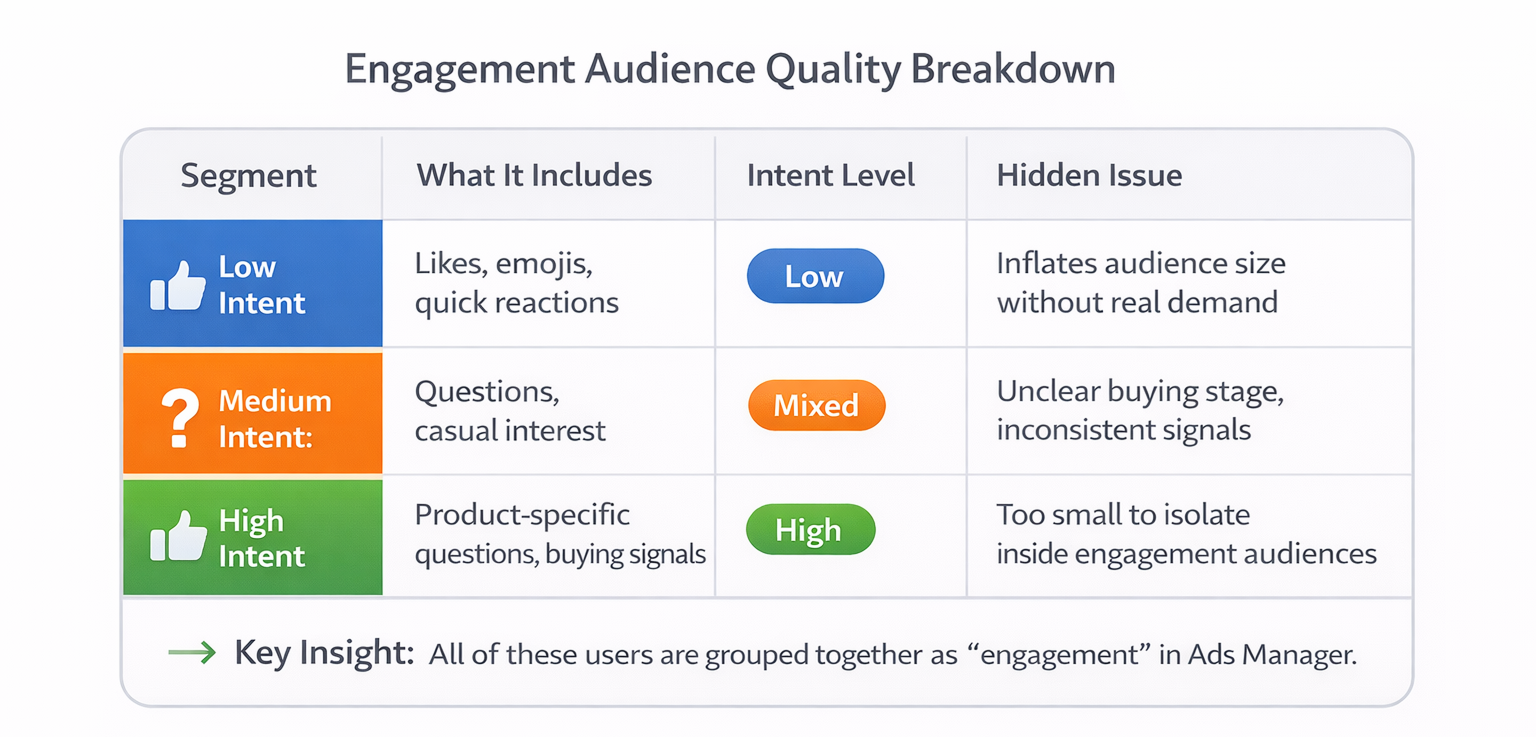
That’s where the disconnect happens.
If you treat all commenters as “warm,” you’re blending low-intent social interaction with genuine demand — and the system has no way to separate them for you.
Turning Comments Into Targetable Signals
The real strategy is not to target commenters directly — it’s to convert comment activity into measurable actions.
Here are the most effective ways to do that:
1. Drive Commenters Into DMs
When someone comments, prompt them to continue the conversation via direct message.
For example:
-
reply with a short answer plus a call-to-action;
-
invite them to “send a DM for details”;
-
use automated comment-to-DM tools if volume is high.
Why this works:
-
DM interactions are trackable;
-
you can build audiences of people who messaged your account;
-
these users show stronger intent than passive engagement.
2. Use Comment Triggers to Push Traffic
Instead of answering everything in the comments, redirect users:
-
share a link to a landing page;
-
guide them to a product page or offer;
-
encourage them to click through for full details.
This converts:
-
unstructured engagement → website visits;
-
website visits → pixel events.
Now the algorithm has something it can optimize around.
3. Capture Leads From Commenters
If your offer supports it, move commenters into a lead capture flow.
Once they submit, they become part of a structured dataset you can actually use for targeting and scaling. This is where strategies like How to Set Up Facebook Retargeting start to matter, because you’re no longer relying on surface engagement.
4. Build Retargeting Based on Engagement Depth
Instead of isolating commenters, structure your audiences by behavioral progression.
This creates a funnel where engagement turns into intent signals over time. If you’re unsure how to structure that progression, reviewing How Retargeting Works on Facebook: Best Facebook Retargeting Strategies can help clarify how each layer should work.
Where LeadEnforce Fits In
One of the limitations of Meta’s native system is that it doesn’t allow you to isolate users based on very specific Instagram behaviors — including who interacts with particular accounts.
This is where LeadEnforce takes a different approach.
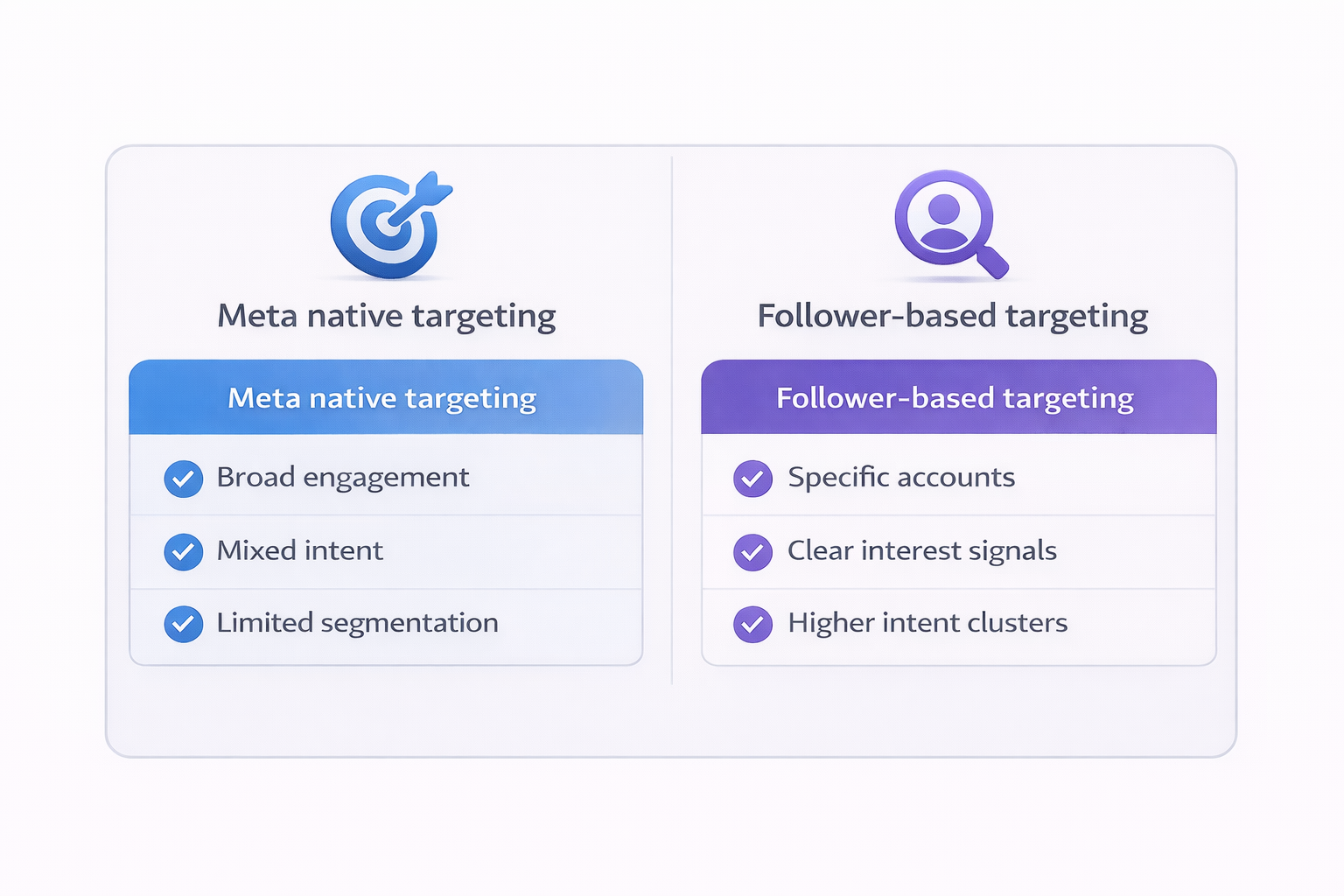
Instead of relying only on engagement signals, you can target users based on the Instagram accounts they follow. That means you can reach people who already follow competitors, niche creators, or industry-specific pages.
This is often a cleaner proxy for intent than comments.
If you want to understand how this works in practice, see how to target Instagram followers directly with Meta ads, which breaks down the mechanics behind this strategy.
You can also explore how Targeting Buyers Who Follow Your Competitors (Without Retargeting Them) works and why it often outperforms standard interest targeting.
A Common Mistake: Optimizing for Comments
Some advertisers intentionally optimize campaigns for engagement to generate more comments.
This usually backfires.
Here’s what happens inside the system:
-
the algorithm finds users who are likely to comment — not buy;
-
these users often engage cheaply but convert poorly;
-
cost per result looks good at the top of the funnel;
-
downstream metrics collapse (low lead quality, poor sales).
In Ads Manager, you’ll see signals like:
-
high CTR but low conversion rate;
-
cheap CPC with no revenue impact;
-
large engagement audiences that don’t scale profitably.
The system is doing its job — it’s just optimizing for the wrong objective.
A Better Way to Use Comments Strategically
Comments should be treated as entry points, not endpoints.
A practical approach looks like this:
-
use comments to identify interest;
-
respond quickly to maintain momentum;
-
redirect users into measurable actions (DM, click, form);
-
build audiences from those actions.
This aligns your social engagement with the algorithm’s optimization logic.
Key Takeaway
You can’t directly target people who comment on Instagram posts — and trying to force that strategy usually leads to poor results.
What works instead is translating that engagement into signals Meta can actually use. Messaging activity, website behavior, and conversion events give the algorithm something it can optimize around, which is what ultimately drives performance.