Retargeting has evolved from a blunt repetition tactic into a sophisticated, data-driven discipline. Yet many campaigns still treat all returning users as a single audience. This approach ignores a critical variable: intent.
Segmenting retargeting audiences by intent level allows marketers to tailor messaging, bidding strategies, and creatives based on how close a user is to conversion. The result is higher efficiency, better engagement, and measurable improvements in ROI.
Why Intent-Based Segmentation Matters
Not all visitors are equal. A user who briefly visited a homepage behaves very differently from someone who abandoned a checkout.
According to industry data:
-
Retargeted users are 70% more likely to convert compared to new visitors.
-
Personalized retargeting campaigns can increase conversion rates by up to 150%.
-
Around 97% of first-time visitors leave without converting, making segmentation essential for recovery strategies.
Without segmentation, campaigns risk overexposing low-intent users while under-serving high-intent ones.
Defining Intent Levels
To effectively segment audiences, it is important to categorize users based on behavioral signals.
1. Low Intent Users
These users show minimal engagement:
-
Visited a single page
-
Short session duration
-
No product interaction
Strategy:
Focus on awareness and value propositions. Use broad messaging and softer CTAs such as “Learn More” or “Discover Solutions.”
2. Medium Intent Users
These users demonstrate interest but not commitment:
-
Viewed multiple pages
-
Engaged with product categories
-
Spent meaningful time on site
Strategy:
Highlight differentiators, social proof, and benefits. Introduce case studies or comparisons to move them further down the funnel.
3. High Intent Users
These users are close to conversion:
-
Added items to cart
-
Initiated checkout
-
Revisited pricing or product pages
Strategy:
Use urgency and incentives. Limited-time offers, discounts, and strong CTAs like “Complete Your Purchase” are effective.
Behavioral Signals That Indicate Intent
Effective segmentation relies on accurate data. Key signals include:
-
Page depth and sequence
-
Time on site
-
Scroll depth
-
Cart and checkout interactions
-
Frequency of visits
Combining these signals creates a clearer picture of user readiness and enables precise audience grouping.
Building Intent-Based Segments
To operationalize intent segmentation, follow these steps:
-
Define Key Actions
Identify events that correlate with conversion (e.g., product views, demo requests). -
Assign Intent Scores
Allocate weights to user actions. For example, a pricing page visit may carry more weight than a blog view. -
Create Audience Buckets
Group users into low, medium, and high intent segments based on cumulative scores. -
Align Messaging and Creatives
Customize ads to reflect the user’s stage in the decision-making process. -
Optimize Frequency and Bidding
Allocate higher budgets and frequency caps to high-intent users while maintaining efficiency for lower-intent segments.
Creative Personalization by Intent Level
Segmentation is only effective when paired with relevant creative execution.
-
Low Intent: Educational content, brand storytelling, problem awareness
-
Medium Intent: Testimonials, product comparisons, feature highlights
-
High Intent: Promotions, urgency-driven messaging, direct CTAs
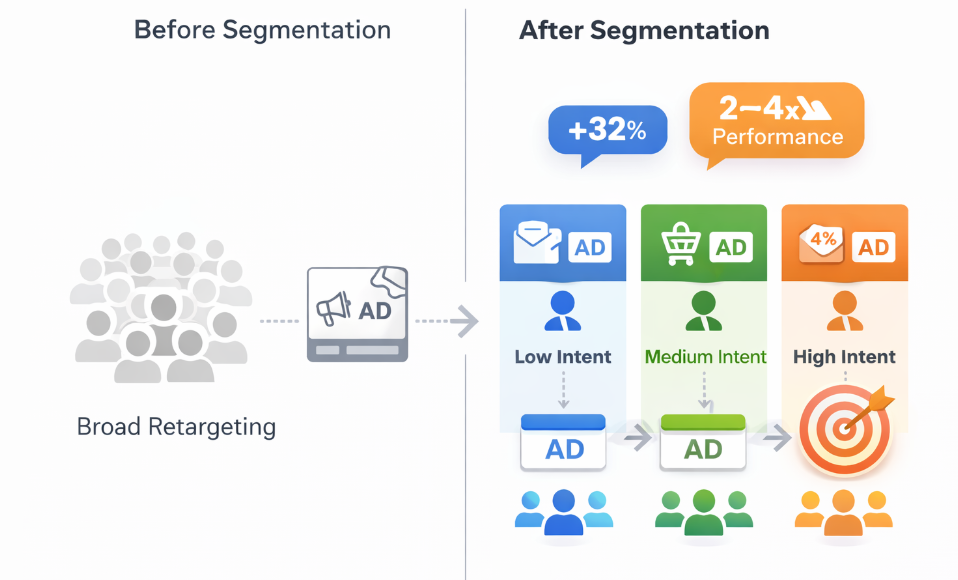
Segmented and personalized retargeting strategies significantly outperform broad, generic campaigns
Studies show that personalized ads can deliver 2–3x higher engagement rates compared to generic creatives.
Common Mistakes to Avoid
-
Treating all visitors as a single retargeting pool
-
Overexposing low-intent users with aggressive sales messaging
-
Neglecting frequency caps, leading to ad fatigue
-
Failing to update segments based on real-time behavior
Measuring Success
Key performance indicators for intent-based retargeting include:
-
Conversion rate by segment
-
Cost per acquisition (CPA)
-
Return on ad spend (ROAS)
-
Engagement metrics (CTR, time on site)
Segment-level analysis often reveals that high-intent audiences deliver disproportionately higher returns, validating the segmentation approach.
Conclusion
Segmenting retargeting audiences by intent level transforms campaigns from generic reminders into highly relevant interactions. By aligning messaging, creatives, and budgets with user behavior, marketers can unlock significant performance gains.
As competition increases and user expectations rise, intent-driven strategies are no longer optional—they are essential for sustainable growth.
Recommended Reading