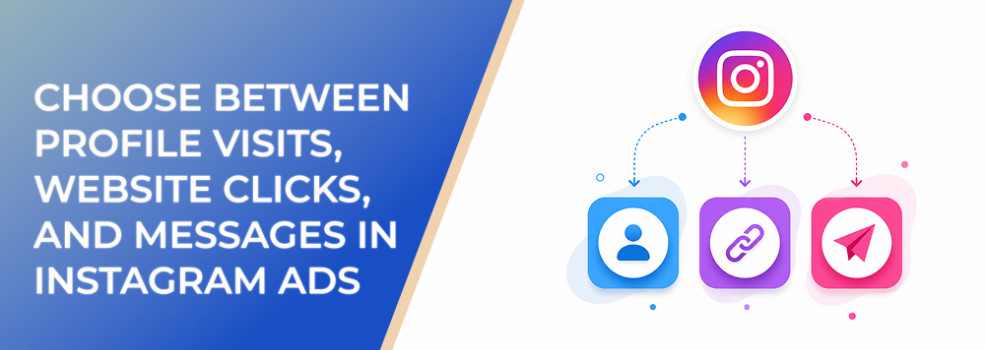
Choosing between profile visits, website clicks, and messages is not just a setup decision.
It is a funnel decision.
Each Instagram ad goal tells the campaign to pursue a different user behavior. Instagram Ad Tools commonly support goals such as more profile visits, website visits, or messages when creating ads from Instagram.
For marketers, the practical question is: which behavior is most valuable right now?
The Problem
The problem is that advertisers often choose the goal before they understand the buyer’s next step.
They choose profile visits because they want more visibility. They choose website clicks because traffic feels measurable. They choose messages because conversations feel like leads.
But the right goal depends on what the audience is ready to do.
If users need trust, profile visits may be the right next step. If users need product or offer details, website clicks may be better. If users need reassurance, price clarification, availability, or qualification, messages may be strongest.
Why This Problem Hurts Performance
Choosing the wrong goal sends budget toward the wrong behavior.
A profile-visit campaign may build awareness but fail to create immediate leads. A website-click campaign may generate traffic without enough intent. A message campaign may create conversations that the team cannot handle or qualify.
This affects CPC, CPA, CAC, ROAS, and conversion rate.
It also affects audience learning. If the campaign attracts users who take the wrong action, future optimization can drift toward more of those users.
Common Scenarios Where This Happens
An ecommerce brand sends cold users directly to a product page when they first need brand trust. Profile visits may have been a better bridge.
A B2B service sends users to a long website page when the real barrier is a specific question. Messages may create better-qualified conversations.
A creator chooses messages for a low-ticket digital product that users could buy directly. Website clicks may create a cleaner path.
A local business chooses profile visits when the user really needs to book, call, or ask about availability.
An agency tests all three goals without separating KPIs, making it impossible to know which path produced the most useful action.
Why the Problem Happens
This happens because campaign goals are often chosen from the advertiser’s perspective rather than the user’s perspective.
The advertiser wants traffic. The user wants reassurance.
The advertiser wants leads. The user wants to know whether the service is available in their area.
The advertiser wants sales. The user wants to see proof before buying.
Goal selection should reflect the user’s next decision, not only the advertiser’s final desired outcome.
Another cause is weak audience intent. If the audience is broad, the same goal may attract mixed behavior. A more relevant audience makes the selected goal easier to evaluate.
The Solution
The solution is to choose the goal by matching audience readiness, offer complexity, and conversion path.
Choose profile visits when trust comes first
Profile visits are useful when users need to understand who you are before acting.
Use this goal when:
The brand is unfamiliar.
The Instagram profile contains strong proof.
The buying decision is visual or trust-based.
Followers, profile actions, or bio-link taps are meaningful.
You want users to evaluate your credibility before deeper conversion.
Profile visits are especially useful for creators, local services, consultants, personal brands, restaurants, coaches, boutiques, and early-stage brands.
Choose website clicks when the page carries the conversion
Website clicks are useful when the destination is ready to continue the sale.
Use this goal when:
The landing page is specific.
The offer is clear.
The user needs details, pricing, product specs, or a form.
The page has one obvious next step.
You can measure post-click behavior.
Website clicks are useful for ecommerce, lead magnets, product pages, event registrations, appointment pages, demos, content funnels, and comparison pages.
Choose messages when conversation improves conversion
Messages are useful when the user needs a direct answer before taking action.
Use this goal when:
The offer is consultative.
Pricing depends on the customer’s situation.
Availability matters.
Qualification is required.
The user may have objections before converting.
The team can respond quickly.
Messages are useful for local services, high-ticket sales, B2B services, appointment-based businesses, recruiting, custom products, real estate, coaching, and agencies.
How LeadEnforce Helps
LeadEnforce is relevant when goal selection depends on reaching people who are more likely to take the intended action.
Choosing the right goal is the first step. But the goal still needs the right audience. A profile-visit campaign performs differently when shown to users who already follow relevant Instagram profiles. A message campaign performs differently when shown to people from high-intent communities. A B2B website-click campaign performs differently when it reaches professionals who match the buying role.
LeadEnforce helps advertisers build audiences from Instagram profile followers, Facebook group members, LinkedIn-derived professional data, and custom social-profile links. Its Instagram targeting feature focuses on targeting followers of relevant Instagram profiles, its Facebook group targeting feature focuses on reaching group members, and its LinkedIn audience feature supports building Facebook and Instagram audiences from job titles, industries, and companies.
That makes goal testing cleaner.
Instead of asking, “Do messages work?” with a broad audience, you can ask, “Do messages work with people already connected to this niche, competitor, community, or professional segment?”
LeadEnforce does not choose the Instagram goal for you. It helps reduce audience guesswork after you know which action you want to test.
Risks and Considerations
Do not assume a more precise audience automatically fixes a wrong goal.
If the goal is wrong, a relevant audience may still underperform. If the profile is weak, profile visits will not convert into deeper interest. If the landing page is generic, website clicks will leak. If the inbox workflow is slow, messages will lose value.
Audience size also matters. Very narrow source-based audiences can fatigue quickly or produce noisy data.
Compliance and platform policies should also be reviewed, especially when targeting sensitive categories or regulated offers.
Prerequisites and Dependencies
You need a clear ICP, a clear campaign goal, and a clear next step.
If you use LeadEnforce, you also need relevant audience sources: Instagram profiles, Facebook groups, LinkedIn segments, or custom social-profile data that genuinely reflect the target buyer.
For profile visits, the profile must be ready.
For website clicks, the landing page must be ready.
For messages, the inbox workflow must be ready.
You also need success metrics that match the selected goal.
Practical Recommendations
Start with the user’s next decision.
If they need trust, test profile visits.
If they need information or a direct conversion path, test website clicks.
If they need reassurance or qualification, test messages.
Then build the audience around the goal. For profile visits, use audiences likely to recognize the brand category. For website clicks, use users likely to care about the offer. For messages, use audiences where the problem is active enough to justify conversation.
LeadEnforce fits after the goal decision, when you need to test that goal against more relevant audience pools instead of broad interest guesses.
Final Takeaway
Profile visits, website clicks, and messages are different tools for different buyer moments.
Choose profile visits for trust-building, website clicks for off-platform action, and messages for conversation-led conversion. Then support the goal with an audience that is likely to take that action.
Goal clarity improves the campaign. Audience relevance improves the test.
To test goal-specific Instagram audiences with less targeting guesswork, join the free 7-day LeadEnforce trial period.
Related LeadEnforce Articles
- How to Target Your Ideal Customers on Instagram — Helps advertisers think through audience relevance when running Instagram campaigns.
- Improve Instagram Ads Targeting by Testing for Customer Fit Instead of Reach — Supports the idea of testing audiences by customer fit, not just reach.
- Poor Instagram Audience Performance? Use Comparison Tests to Find the Real Constraint — Useful for comparing goal performance across audience groups.
- What to Do When Your Instagram Audience Is Too Limited — Helps marketers expand audience tests without losing relevance.