A landing page has one job: convert visitors into leads or customers. Yet many landing pages fail—not because of poor traffic quality, but due to avoidable structural and psychological mistakes. Research consistently shows that even small usability or messaging errors can reduce conversions by double-digit percentages. Understanding these pitfalls is essential for improving performance without increasing ad spend.
Below are the most damaging landing page mistakes, supported by real-world data, along with practical guidance on how to correct them.
1. Weak or Unclear Value Proposition
Visitors decide whether to stay on a page within seconds. If the value proposition is vague, generic, or buried below the fold, conversions suffer.
Key statistics:
-
Users form an impression of a webpage in about 50 milliseconds.
-
Pages with a clear, benefit-driven headline can improve conversion rates by over 30% compared to feature-focused messaging.
Common errors include:
-
Using buzzwords instead of concrete outcomes
-
Failing to explain who the offer is for
-
Not answering “Why should I care?” immediately
Best practice: Place a concise, outcome-oriented headline at the top of the page, supported by a short subheading that clarifies the value in plain language.
2. Too Many Calls to Action
While it may seem logical to give users multiple options, choice overload often leads to inaction.
Key statistics:
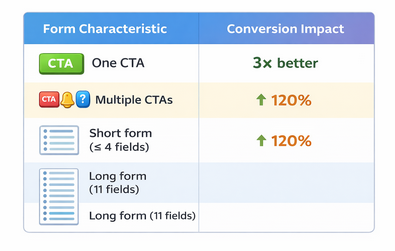
How CTA Quantity and Form Length Affect Conversion Rates
-
Landing pages with a single call to action convert up to 3× better than pages with multiple competing CTAs.
-
Reducing the number of form fields from 11 to 4 can increase conversions by more than 120%.
Common errors include:
-
Multiple primary buttons with different goals
-
Navigation menus that distract users
-
Secondary offers that compete with the main conversion action
Best practice: Design the page around one primary conversion goal and remove or visually de-emphasize all other actions.
3. Slow Page Load Speed
Speed is not a technical detail—it is a conversion factor. Every extra second of load time increases friction and abandonment.
Key statistics:
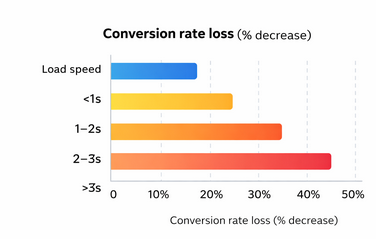
Conversion Loss by Page Load Time: Slower pages dramatically reduce conversion rates
-
A 1-second delay in page load time can reduce conversions by up to 7%.
-
Over 50% of users abandon pages that take longer than 3 seconds to load.
Common errors include:
-
Uncompressed images
-
Excessive scripts and third-party tools
-
Heavy animations or video backgrounds
Best practice: Optimize images, limit unnecessary scripts, and regularly test page speed on both desktop and mobile devices.
4. Lack of Trust Signals
Even highly interested users hesitate when they don’t trust the offer or the company behind it.
Key statistics:
-
92% of users hesitate to convert if a page lacks credibility indicators.
-
Adding trust elements such as testimonials or certifications can increase conversions by 15–40%.
Common errors include:
-
No social proof or customer validation
-
Missing privacy or security reassurance
-
Overpromising without evidence
Best practice: Use authentic testimonials, recognizable logos, clear privacy statements, and realistic claims to reduce perceived risk.
5. Poor Mobile Experience
With mobile traffic often exceeding 60% of total visits, a desktop-only mindset is a costly mistake.
Key statistics:
-
Mobile users are 5× more likely to abandon a task if the site isn’t mobile-friendly.
-
Responsive landing pages convert up to 64% better than non-optimized ones.
Common errors include:
-
Text that is too small to read
-
Forms that are difficult to complete on mobile
-
CTAs placed too close together
Best practice: Design mobile-first, simplify layouts, and test forms on real devices—not just emulators.
6. Asking for Too Much Information Too Soon
Long or intrusive forms create psychological resistance, especially at the first point of contact.
Key statistics:
-
Each additional form field can reduce conversion rates by approximately 11%.
-
Short forms consistently outperform long forms for top-of-funnel offers.
Common errors include:
-
Requesting non-essential personal or business data
-
Using multi-step forms without clear progress indicators
-
Not explaining why information is required
Best practice: Ask only for information necessary to move the conversation forward. Additional data can be collected later.
Conclusion
Most landing page failures are not caused by lack of traffic, but by avoidable design and messaging mistakes. By clarifying the value proposition, simplifying the user journey, improving speed, and building trust, conversion rates can often be improved dramatically without increasing marketing spend.
Regular testing, user behavior analysis, and data-driven optimization are the fastest ways to turn underperforming landing pages into reliable conversion assets.
Recommended Reading
To deepen your understanding of conversion optimization, consider reading: