Customer Relationship Management (CRM) systems store some of the most valuable first-party data available to marketing teams. Unlike third-party audiences, CRM exports contain verified identifiers, behavioral history, lifecycle stage information, and revenue data. When structured correctly, this data becomes the foundation for high-performing custom audiences across advertising platforms.
Research consistently shows that first-party data significantly outperforms third-party segments. According to industry studies, campaigns using first-party data can generate up to 2–3x higher return on ad spend (ROAS) compared to non-segmented prospecting campaigns. Additionally, properly segmented CRM-based retargeting campaigns often deliver 50% lower cost per acquisition (CPA).
However, simply uploading a raw CRM export rarely produces optimal results. High-value audience creation requires intentional segmentation, data normalization, enrichment, and ongoing optimization.
Step 1: Clean and Normalize CRM Data
Before segmentation begins, data quality must be addressed. Poor formatting and incomplete identifiers significantly reduce audience match rates.
Key normalization actions:
-
Standardize phone numbers to international format
-
Remove duplicate records
-
Validate email formatting
-
Separate first and last names
-
Standardize country and state fields
Match rates for custom audiences typically range between 40% and 70%, depending on data hygiene. Cleaned and enriched CRM files frequently improve match rates by 15–25%.
Higher match rates directly impact scale, cost efficiency, and optimization performance.
Step 2: Segment by Revenue Contribution
Not all customers carry equal value. A high-value audience strategy begins with revenue-based segmentation.
Core segments to build:
-
Top 10–20% revenue contributors
-
Repeat purchasers (2+ transactions)
-
High average order value (AOV) customers
-
Lapsed high-value customers
Studies indicate that the top 20% of customers often generate 60–80% of total revenue. By isolating these users into a dedicated custom audience, marketers can:
-
Prioritize upsell and cross-sell campaigns
-
Build high-quality lookalike audiences
-
Protect budget from low-value impressions
Revenue segmentation transforms CRM exports from static contact lists into performance multipliers.
Step 3: Use Lifecycle-Based Segmentation
Lifecycle targeting ensures messaging relevance and reduces audience fatigue.
Recommended lifecycle segments:
-
New leads (0–30 days)
-
Marketing Qualified Leads (MQLs)
-
Sales Qualified Leads (SQLs)
-
Active customers
-
Churned customers (90+ days inactive)
Lifecycle-based personalization can increase conversion rates by 20–40%, particularly when creative aligns with stage-specific intent.
For example:
-
MQLs may respond to product education
-
SQLs require trust reinforcement and urgency
-
Churned customers benefit from reactivation incentives
Granular lifecycle segmentation ensures budget efficiency and improved engagement metrics.
Step 4: Enrich CRM Records for Greater Precision
CRM exports often lack behavioral or firmographic depth. Enrichment increases targeting accuracy.
Possible enrichment layers include:
-
Company size
-
Industry
-
Job title
-
Website behavior data
-
Engagement scoring
Enriched CRM-based audiences enable more refined targeting strategies such as:
-
Enterprise vs. SMB segmentation
-
Decision-maker targeting
-
High-intent account clusters
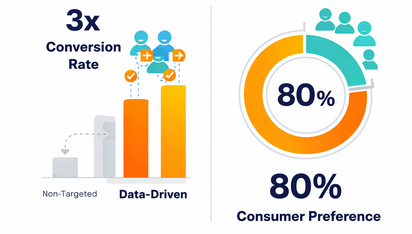
Effectiveness of personalized, data-driven advertising: higher conversion rates and stronger consumer engagement
Data-enriched custom audiences typically outperform non-enriched lists due to improved message alignment and reduced waste.
Step 5: Exclude Low-Intent or Converted Users
High-value audience strategy is not only about inclusion but also exclusion.
Common exclusion segments:
-
Recently converted customers (if campaign goal is acquisition)
-
Low engagement contacts
-
Inactive or outdated records
-
Refund or churned accounts (depending on strategy)
Exclusion logic can reduce wasted impressions by up to 30% in performance campaigns.
A disciplined exclusion framework protects return on ad spend and ensures accurate reporting.
Step 6: Build Lookalike Audiences from High-Value Segments
Once high-performing CRM segments are validated, they become seed audiences for lookalike expansion.
Lookalikes built from:
-
Top revenue customers
-
Long-term subscribers
-
High-LTV accounts
consistently outperform broader audience seeds.
Industry benchmarks show that lookalike audiences built from high-LTV customers can deliver 30–50% higher ROAS compared to lookalikes based on all customers.
The quality of the seed audience directly determines the quality of the expansion.
Measurement and Optimization Framework
Creating high-value custom audiences is not a one-time upload process. It requires structured testing.
Recommended testing approach:
-
Test revenue tiers separately
-
Compare lifecycle segments head-to-head
-
Evaluate enriched vs. non-enriched lists
-
Monitor match rate changes over time
Key performance indicators to track:
-
Match rate
-
Conversion rate
-
Cost per acquisition
-
Return on ad spend
-
Customer lifetime value impact
Ongoing optimization ensures that CRM-based audiences remain aligned with business objectives and evolving customer behavior.
Strategic Advantages of CRM-Based Custom Audiences
When executed correctly, CRM-driven audience creation provides:
-
Greater budget control
-
Higher personalization accuracy
-
Improved scaling potential
-
Reduced reliance on third-party data
-
Stronger compliance with privacy-first marketing trends
As third-party data signals continue to decline, first-party CRM data becomes the core asset for sustainable advertising performance.
Recommended Reading
To expand your strategy further, consider exploring the following articles:
Conclusion
Creating high-value custom audiences from CRM exports requires more than exporting a contact list and uploading it to an ad platform. It demands data normalization, revenue segmentation, lifecycle mapping, enrichment, exclusion discipline, and structured testing.
Organizations that operationalize CRM-based audience frameworks consistently achieve stronger match rates, higher conversion performance, and improved return on ad spend.
In a privacy-first ecosystem, first-party CRM data is no longer optional. It is the foundation of durable, scalable advertising performance.