
Creative Briefs That Produce Better Ads
Modern ad performance depends on speed, consistency, and alignment. Creative teams are expected to produce more variations across more channels than ever before, often under tight timelines. When briefs are vague or overloaded with opinions, creatives rely on assumptions—and assumptions are expensive.
According to industry surveys, marketers report that poorly defined briefs are one of the top three causes of underperforming ads. Teams that use structured creative briefs see significantly faster turnaround times and fewer revision cycles, directly reducing production costs and time-to-launch.
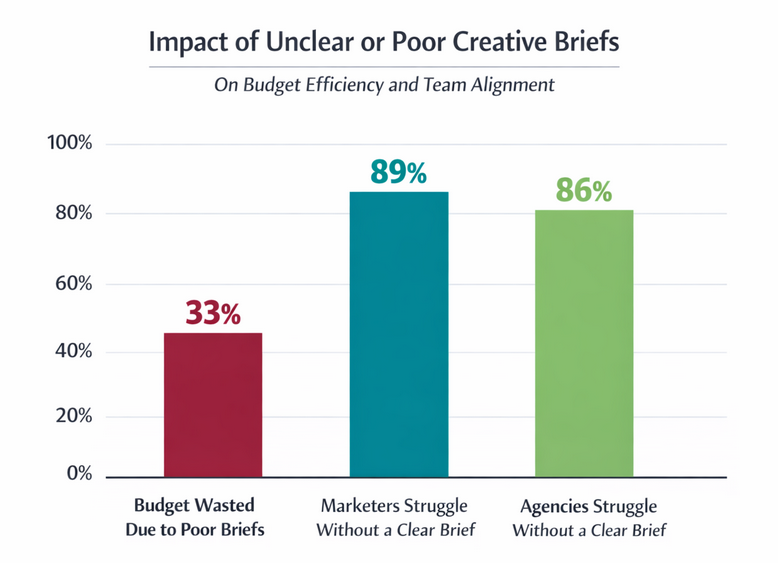
Impact of unclear or poor creative briefs on budget efficiency and team alignment
A strong brief does not limit creativity. It removes uncertainty, allowing ideas to focus on what actually moves performance metrics.
What Separates High-Performing Briefs From Weak Ones
The difference between a helpful brief and a harmful one is clarity of intent. High-performing briefs answer the right questions and ignore the noise.
Effective briefs typically:
-
Define a single, clear objective tied to a measurable outcome
-
Focus on one core audience insight, not a demographic dump
-
Communicate one primary message instead of multiple competing ideas
-
Provide constraints that guide creativity rather than restrict it
In contrast, weak briefs often include long background sections, internal jargon, or multiple objectives that dilute the message.
The 7 Elements of a Performance-Driven Creative Brief
A creative brief designed for better ads can usually fit on one page. The following elements consistently appear in briefs that lead to strong creative output.
1. Objective
State exactly what the ad needs to achieve. This should be tied to a performance metric such as click-through rate, conversion rate, or qualified traffic—not a vague goal like “brand awareness.”
2. Target Audience Insight
Go beyond age and location. Identify a specific problem, motivation, or objection the audience has at the moment they see the ad. Ads perform better when they speak to a single, real tension.
3. Key Message
Define one main takeaway. If the audience remembers only one thing after seeing the ad, what should it be?
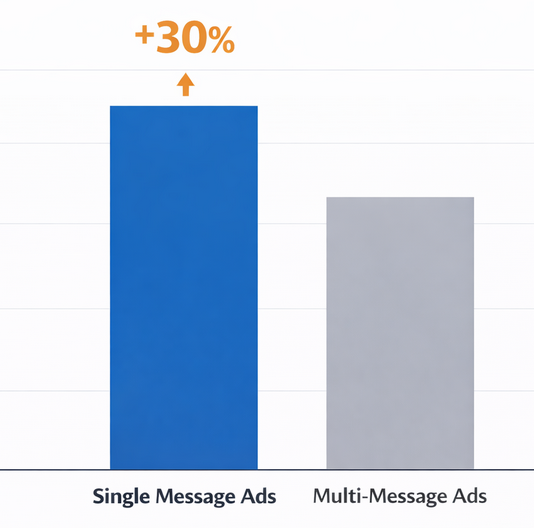
Single-message ads show over 30% higher recall and engagement compared to multi-message ads
Research shows that ads built around a single dominant message outperform multi-message ads by over 30% in recall and engagement metrics.
4. Value Proposition
Explain why the offer or message matters now. This is where differentiation lives. What makes this message more compelling than alternatives the audience is already seeing?
5. Proof or Support
Include one or two credibility elements: a data point, result, guarantee, or mechanism. Ads that include specific proof points often see higher trust and lower bounce rates.
6. Format and Channel Context
Briefs should acknowledge where the ad will run. Creative that works in native feeds, for example, often looks very different from creative designed for display or video placements.
7. Constraints and Mandatories
List what must be included and what must be avoided. Clear constraints reduce revisions and creative fatigue. Examples include brand tone, visual limitations, or compliance requirements.
Common Creative Brief Mistakes to Avoid
Even experienced teams fall into predictable traps when writing briefs.
-
Trying to solve multiple problems with one ad
-
Including strategy debates instead of decisions
-
Overloading the brief with internal context the audience will never see
-
Using subjective language like “premium,” “exciting,” or “eye-catching” without defining what that means
Studies show that ads requiring more than three revision rounds are significantly more likely to miss performance benchmarks due to delayed testing and launch.
How Better Briefs Improve Testing and Optimization
Creative testing only works when variables are controlled. Well-written briefs make it easier to produce variations that isolate specific hypotheses—headline, angle, or visual—rather than changing everything at once.
Teams that standardize creative briefs across campaigns report more consistent test results and clearer learnings. This leads to faster optimization cycles and more confident scaling decisions.
In performance-focused environments, the creative brief becomes a testing document as much as a creative one.
Measuring the Impact of Creative Brief Quality
The quality of a creative brief can be measured indirectly through outcomes:
-
Fewer revisions per asset
-
Faster time from brief to launch
-
Higher initial performance before optimization
-
Clearer insights from creative tests
Industry benchmarks suggest that improving creative clarity can increase ad efficiency metrics by 15–25% without increasing media spend.
Final Thoughts
Great ads rarely start with great ideas. They start with clear thinking. A well-written creative brief aligns strategy, creative, and performance goals before production begins. When briefs are concise, focused, and grounded in real audience insight, the resulting ads are not only more creative—but more effective.