Always-on campaigns rely on continuous delivery, making them especially vulnerable to creative fatigue. Research shows that ads exposed more than four times to the same user often experience a decline in click-through rate of up to 40%. Without a clear refresh structure, performance naturally erodes over time.
A strong cadence ensures:
-
Sustained engagement
-
Better cost efficiency
-
More accurate testing cycles
-
Consistent audience relevance
Signs Your Creative Needs Refreshing
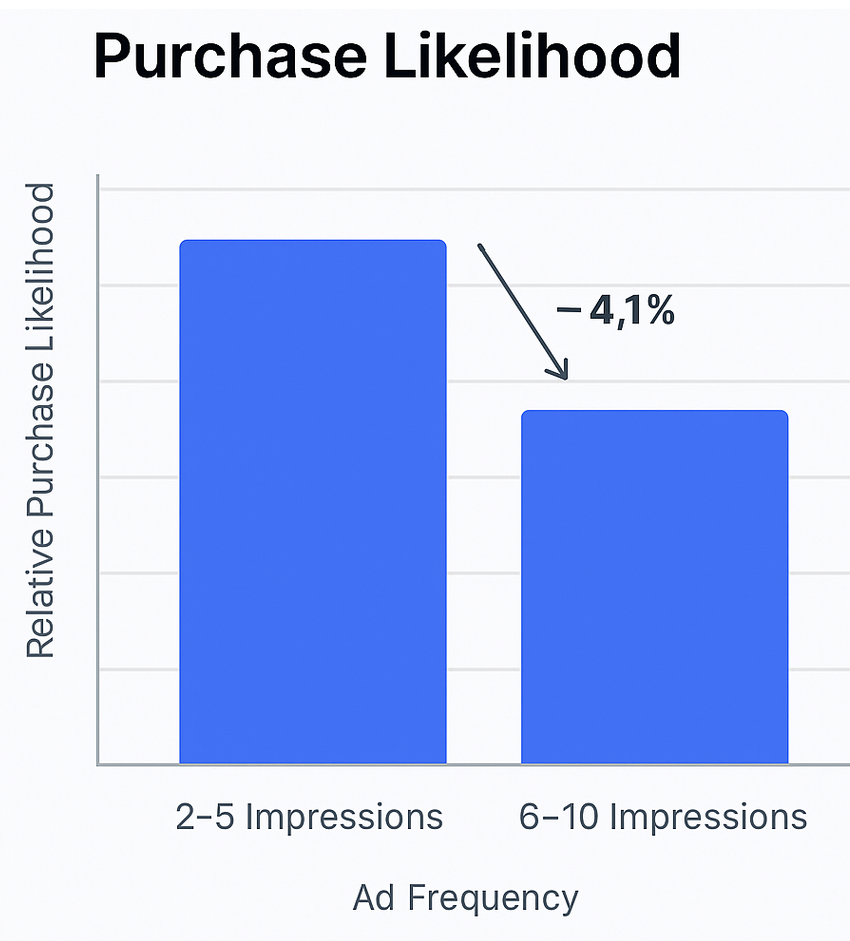
Ad frequency beyond optimal levels correlates with a measurable drop in purchase likelihood, highlighting the risk of overexposure
Understanding the indicators helps prevent efficiency loss. Common signs include:
-
Rising cost per result over a 7–14 day period
-
Falling CTR, often decreasing by 15–30% before a full drop-off
-
Lower ad frequency impact, where results degrade after 4–6 exposures
-
Declining conversion rate despite stable traffic volume
Setting the Right Refresh Cadence
Ideal refresh frequency varies by industry, ad format, and funnel stage. Still, several guidelines can help frame expectations:
1. Awareness Campaigns
Audiences here are broad, meaning fatigue appears slowly. A creative rotation every 3–4 weeks often maintains top-of-funnel efficiency.
2. Consideration Campaigns
Since these users require multiple touchpoints, refreshes every 2–3 weeks keep message relevance high.
3. Retargeting Campaigns
These audiences are the smallest and fatigue the fastest. Refreshing creatives every 7–14 days prevents oversaturation and maintains strong conversion momentum.
How to Structure a Refresh Workflow
A predictable workflow prevents last-minute redesigns and helps teams maintain creative consistency.
Step 1: Build a Creative Library
Studies show that campaigns with at least 5–7 ready-to-rotate assets experience up to 32% higher performance stability over time.
Step 2: Label Variations by Purpose
Organize creatives based on messaging stages:
-
Product education
-
Social proof
-
Objection handling
-
Seasonal or promotional messaging
Step 3: Track Performance in 7-Day Intervals
Monitoring data trends weekly makes fatigue easier to identify. CTR drops of 20% or more from baseline usually signal it’s time to rotate.
Step 4: Retire and Reintroduce
Older creatives can return later if performance rebounds. Many advertisers see a 10–18% lift when reintroducing previously successful creatives after a 60–90 day rest.
Recommended Creative Mix for Longevity
A diversified mix helps extend campaign life. A solid structure includes:
-
40% educational content
-
30% product-focused demonstrations
-
20% testimonials or social proof
-
10% experimental formats
Short-form videos generally outperform static images over time, with some benchmarks showing up to 25% higher conversion rates for mobile-optimized vertical formats.
How to Measure Refresh Success
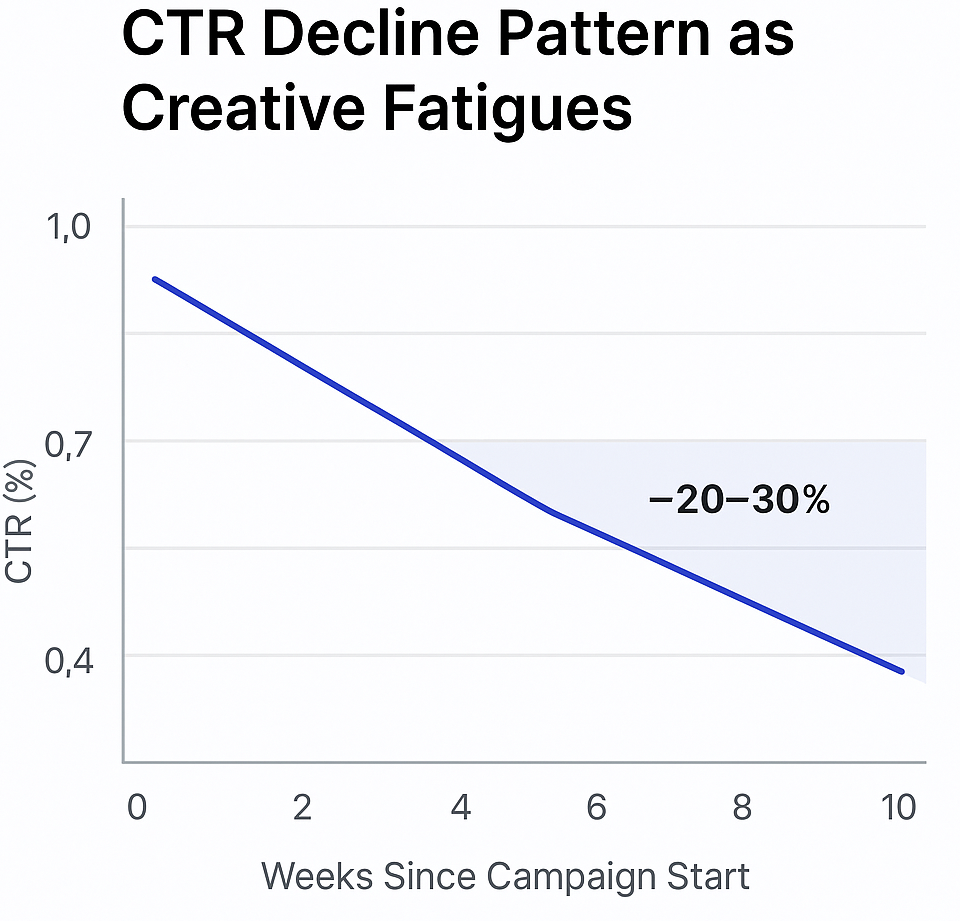
Click-through rate trends typically show a 20–30% decline over the creative lifecycle, signaling when refreshes preserve engagement
Use consistent KPIs to understand the impact of each rotation:
-
CTR change across refresh cycles
-
Cost per result before vs after refresh
-
Conversion rate stability
-
Frequency vs performance correlation
The best results come when refreshes align with performance trends rather than a fixed calendar only.
Conclusion
An effective creative refresh cadence keeps always-on campaigns performing reliably while reducing the risk of long-term fatigue. Build a library, monitor trends, rotate smartly, and allow data—not assumptions—to determine the ideal timeline.