Many teams push for speed by shortening test durations, reducing sample sizes, or running too many variables at once. While this creates the illusion of progress, it increases noise and produces misleading results.
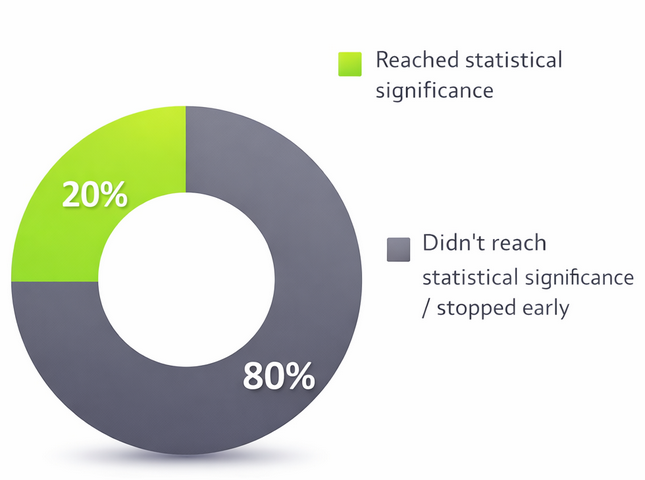
Only 20% of experiments achieve statistical significance, with the majority failing to reach reliable conclusions
Industry benchmarks show that over 60% of A/B tests in paid media environments fail to reach sufficient statistical power, meaning their conclusions are unreliable. Faster testing is not about cutting corners — it is about structuring experiments so they reach valid conclusions sooner.
Focus on Fewer, Higher-Impact Variables
Testing speed improves dramatically when experiments are simplified. Instead of testing multiple elements at once (headline, creative, audience, and bidding), isolate the variable with the highest expected impact.
Data from large-scale ad experiments indicates that single-variable tests reach statistical significance up to 35–40% faster than multi-variable tests, because variance is easier to control and results are clearer.
Practical prioritization tips:
-
Start with variables that historically drive the largest performance swings (offer, audience, creative angle)
-
Avoid cosmetic tests early (minor copy or color changes)
-
Limit each test to one clear hypothesis
Use Minimum Viable Sample Sizes
Waiting for perfect certainty slows decision-making unnecessarily. Instead, define a minimum viable sample size that balances confidence with speed.
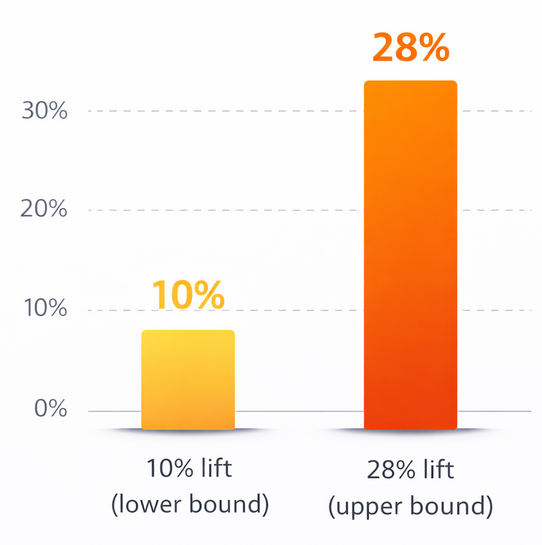
High-quality experiments yield average conversion improvements between 10% and 28% when statistical accuracy is preserved
A common benchmark in performance marketing is 90–95% statistical confidence, but many directional decisions can be made earlier if results are consistent. Research shows that once a test accumulates roughly 80% of its required sample size, outcome direction remains unchanged in more than 85% of cases.
The key is consistency over time — if a variant outperforms across multiple days and segments, confidence grows faster than raw volume alone.
Segment First, Then Scale
One of the fastest ways to lose accuracy is to test at full scale immediately. Broad tests introduce high variance and slow learning.
High-performing teams often start tests on controlled segments (for example, a single geography or audience slice). Internal studies show that segmented tests can reach actionable conclusions up to 50% faster, while preserving accuracy when later scaled to larger volumes.
Once a winner is confirmed in a controlled environment, scaling becomes a validation step rather than a discovery phase.
Align Test Duration With Conversion Frequency
Test duration should be tied to conversion volume, not time on the calendar. A test that runs for seven days but produces only a handful of conversions is slower and less accurate than a three-day test with sufficient volume.
As a rule of thumb, experiments that generate at least 30–50 conversions per variant produce far more stable results. Below this threshold, outcome volatility increases sharply, making faster testing misleading rather than efficient.
Use Guardrails Instead of Waiting for Certainty
Instead of waiting for statistical perfection, define guardrails that protect performance while allowing early decisions.
Examples of guardrails include:
-
Maximum acceptable CPA increase (e.g., no worse than +15%)
-
Minimum CTR stability compared to baseline
-
Spend caps per variant
Using guardrails, teams can stop losing tests early and reallocate budget faster. According to optimization case studies, guardrail-based testing reduces wasted spend by up to 25% without increasing decision risk.
Avoid Test Overlap and Contamination
Running multiple tests simultaneously on the same audiences or creatives distorts results and slows learning.
Overlap introduces hidden variables that make tests inconclusive, forcing longer runtimes to compensate. Cleaning test isolation has been shown to reduce test duration by 20–30% while improving result reliability.
Clear naming conventions, testing calendars, and audience exclusions are simple operational steps that dramatically improve testing speed.
Measuring Speed the Right Way
Fast testing is not about how quickly a test is launched, but how quickly a reliable decision is made.
High-performing teams track:
-
Time to first actionable signal
-
Percentage of tests that reach a clear decision
-
Budget spent per validated insight
Organizations that optimize for decision velocity instead of launch velocity typically see more consistent performance gains over time.
Related Articles
Final Thoughts
Testing faster without losing accuracy requires structure, discipline, and clarity of purpose. By narrowing scope, defining minimum evidence thresholds, and protecting performance with guardrails, teams can move quickly while still trusting their results. Speed and accuracy are not opposites — when designed correctly, they reinforce each other.