A precise B2B targeting strategy no longer relies on a single data dimension. Combining firmographic and behavioral targeting allows revenue teams to identify not only the right companies, but also the right timing and intent.
B2B demand generation has evolved beyond static company filters. While firmographic segmentation remains foundational, it does not reveal buying intent or readiness. Behavioral data adds dynamic context, enabling marketers and sales teams to prioritize accounts that are actively researching, comparing, or engaging.
According to industry research, organizations using intent data in combination with firmographics report up to 2x higher conversion rates and 30–40% shorter sales cycles compared to teams relying on firmographics alone. Additionally, 70% of the buyer’s journey is completed before a prospect speaks with sales, making behavioral insight critical.
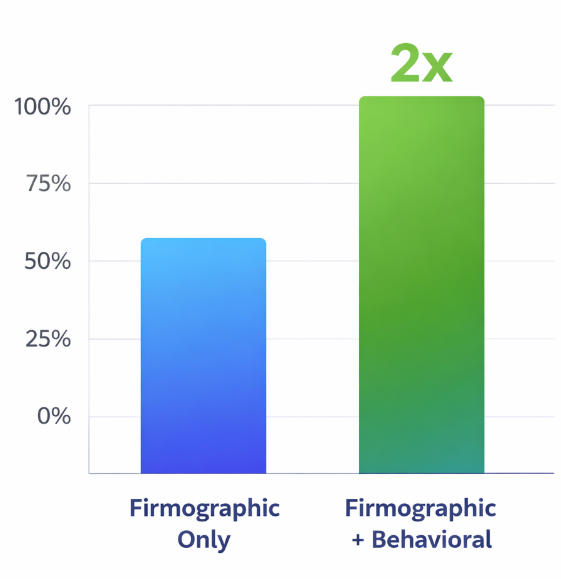
Comparison of average conversion rates: traditional firmographic targeting vs combined firmographic and behavioral targeting
The strategic advantage lies in integrating both dimensions into a unified targeting framework.
Understanding Firmographic Targeting
Firmographic targeting segments companies based on static attributes such as:
-
Industry or vertical
-
Company size (employees or revenue)
-
Geographic location
-
Growth stage
-
Technology stack
This approach ensures alignment with ideal customer profile (ICP) criteria. For example, a SaaS provider serving mid-market fintech companies in North America can filter accounts precisely based on those attributes.
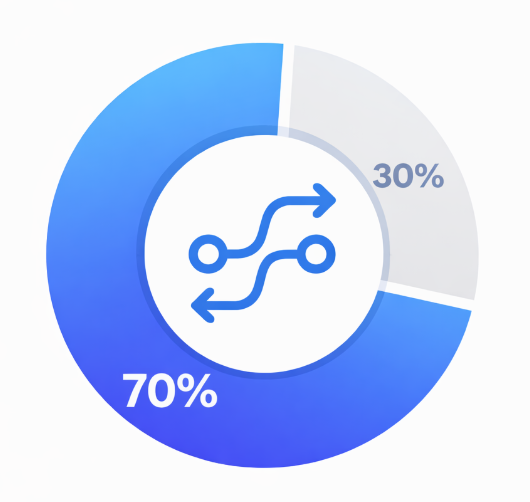
Percentage of the buyer’s journey completed before first direct engagement with sales
However, firmographics alone cannot answer key questions:
-
Is the company actively researching solutions?
-
Are decision-makers engaging with relevant content?
-
Is there a current initiative driving urgency?
Without behavioral signals, targeting remains broad and timing-agnostic.
Understanding Behavioral Targeting
Behavioral targeting analyzes real-time and historical engagement signals, including:
-
Website visits and page depth
-
Content downloads
-
Search intent data
-
Ad engagement
-
Email interactions
-
Technology adoption signals
Behavioral insights reveal where an account is in the buying journey. For example, repeated visits to pricing pages or integration documentation strongly indicate late-stage consideration.
Research shows that companies responding to behavioral intent signals within 24–48 hours can increase deal close probability by over 20%.
Why Combining Both Is Critical
Separately, each targeting method has limitations:
-
Firmographics identify fit but not timing.
-
Behavioral signals identify interest but not qualification.
When combined, they create a high-precision model:
Firmographic Fit + Behavioral Intent = Prioritized Revenue Opportunity
This dual-layer filtering reduces wasted ad spend, improves sales productivity, and increases marketing ROI.
Step-by-Step Framework to Combine Firmographic and Behavioral Targeting
1. Define Your Ideal Customer Profile
Start with a well-documented ICP. Quantify attributes such as:
-
Minimum and maximum company size
-
Target industries
-
Required technologies
-
Geographic focus
Analyze historical closed-won deals to validate patterns.
2. Map Behavioral Signals to Buying Stages
Categorize behavioral events into funnel stages:
-
Early-stage: blog visits, educational content engagement
-
Mid-stage: comparison page visits, webinar attendance
-
Late-stage: pricing views, demo requests, integration documentation views
Assign weighted scoring to each action.
3. Apply a Two-Tier Qualification Model
Use firmographics as the primary qualification layer. Only accounts that meet ICP thresholds should proceed to behavioral evaluation.
Next, score behavioral activity within the ICP-qualified pool.
This prevents teams from chasing high-activity accounts that do not meet revenue or strategic criteria.
4. Implement Dynamic Segmentation
Segment accounts into actionable categories such as:
-
High Fit / High Intent
-
High Fit / Low Intent
-
Low Fit / High Intent
-
Low Fit / Low Intent
Sales should prioritize High Fit / High Intent accounts. Marketing automation should nurture High Fit / Low Intent accounts.
5. Align Sales and Marketing Workflows
Operational alignment is essential. Define:
-
Intent score thresholds for MQL handoff
-
SLA response time for high-intent accounts
-
Personalized messaging frameworks by segment
Organizations with strong sales-marketing alignment achieve 36% higher customer retention and 38% higher sales win rates.
Practical Example
Consider a B2B cybersecurity provider targeting financial institutions with 500–5,000 employees.
Firmographic filter:
-
Industry: Financial services
-
Employees: 500–5,000
-
Region: North America and Europe
Behavioral signals:
-
Multiple visits to compliance-related resources
-
Whitepaper download on regulatory frameworks
-
Pricing page revisit within 7 days
Such accounts would receive immediate outbound sales engagement supported by tailored messaging referencing compliance priorities.
Common Mistakes to Avoid
-
Over-weighting engagement volume without considering account fit.
-
Ignoring buying committee complexity in behavioral tracking.
-
Failing to refresh firmographic data regularly.
-
Delayed sales follow-up after high-intent activity.
Data decay can exceed 30% annually in B2B databases, making continuous enrichment necessary.
Measuring Performance
To evaluate the impact of combined targeting, track:
-
Conversion rate by segment
-
Average sales cycle length
-
Cost per qualified opportunity
-
Revenue per targeted account
-
Pipeline velocity
Compare performance between firmographic-only and combined targeting cohorts to quantify uplift.
Strategic Benefits
Organizations integrating both data dimensions consistently report:
-
Higher pipeline efficiency
-
Reduced customer acquisition cost
-
More accurate forecasting
-
Improved account-based marketing performance
The future of B2B targeting lies in predictive models that continuously recalibrate based on both structural and behavioral intelligence.
Recommended Reading
Conclusion
Firmographic targeting ensures strategic alignment. Behavioral targeting ensures timely engagement. When combined within a structured scoring and segmentation framework, they create a powerful engine for revenue acceleration.
Precision in both who you target and when you engage determines modern B2B success.