Deleting a Meta business portfolio can look like a simple admin cleanup task. For advertisers, it is rarely that simple.
A business portfolio can sit behind ad accounts, Pages, Instagram profiles, people, partners, Pixels, lead access, and campaign workflows. If you delete the wrong portfolio without checking what depends on it, you can interrupt media buying, lose access to shared assets, slow down testing, and create avoidable reporting confusion.
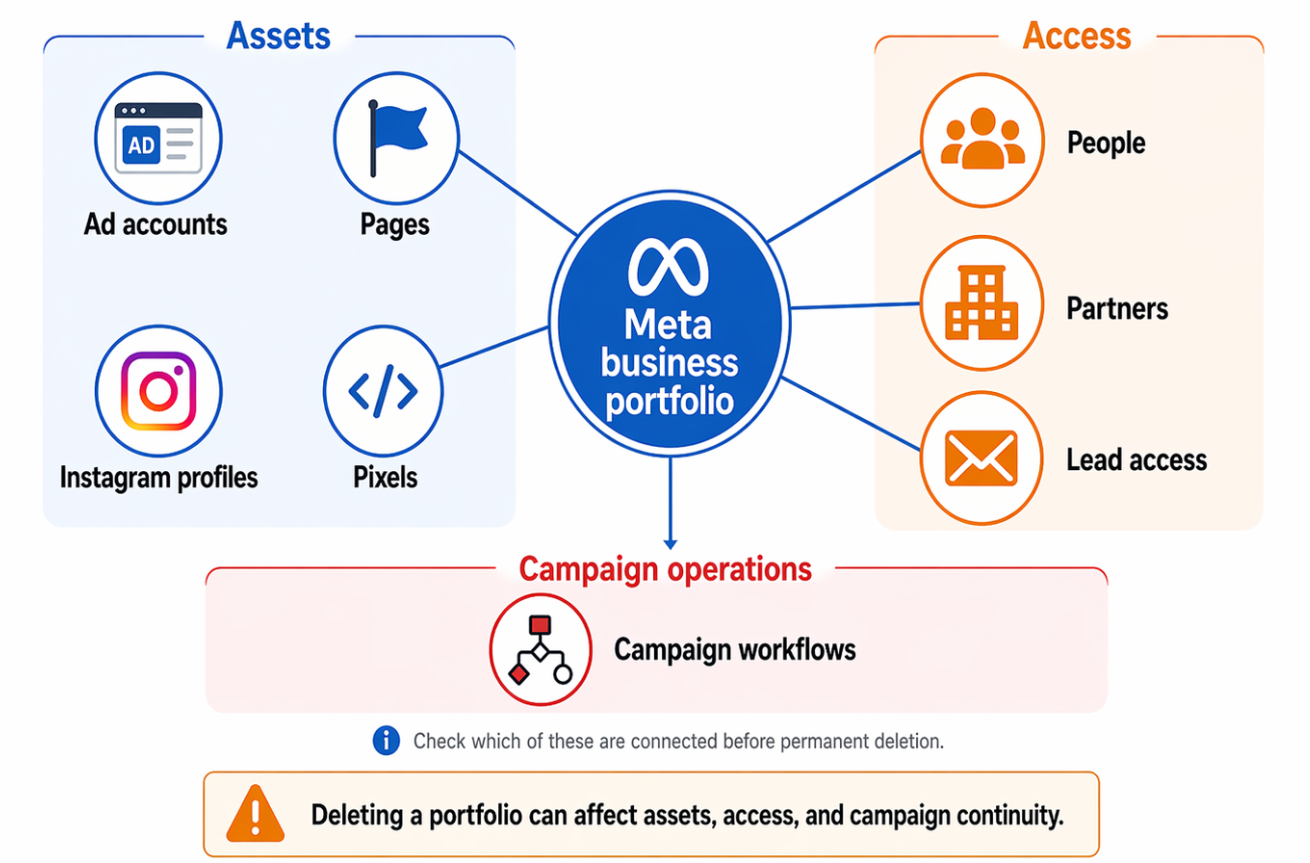
Before deleting a Meta business portfolio, advertisers should check the 8 asset, access, and workflow areas that may depend on it
Meta’s own guidance says this article is for business portfolio owners with full control access who want to permanently delete their business portfolio in Meta Business Suite. The basic path is Settings, Business info, then Permanently delete business.
For performance marketers, the bigger question is not only “How do I delete it?” It is “What happens to my campaigns, audiences, and account structure if I delete it?”
What happens when you delete a Meta business portfolio?
A Meta business portfolio is the management layer that connects business assets, access, and permissions. Deleting it is a permanent administrative action, not a campaign optimization tactic.
Meta says a business is pending deletion for 24 hours, and after 24 hours deleted businesses cannot be reopened. That means advertisers should treat deletion as a final cleanup step after confirming that active campaigns, audiences, billing, access, and reporting dependencies are accounted for.
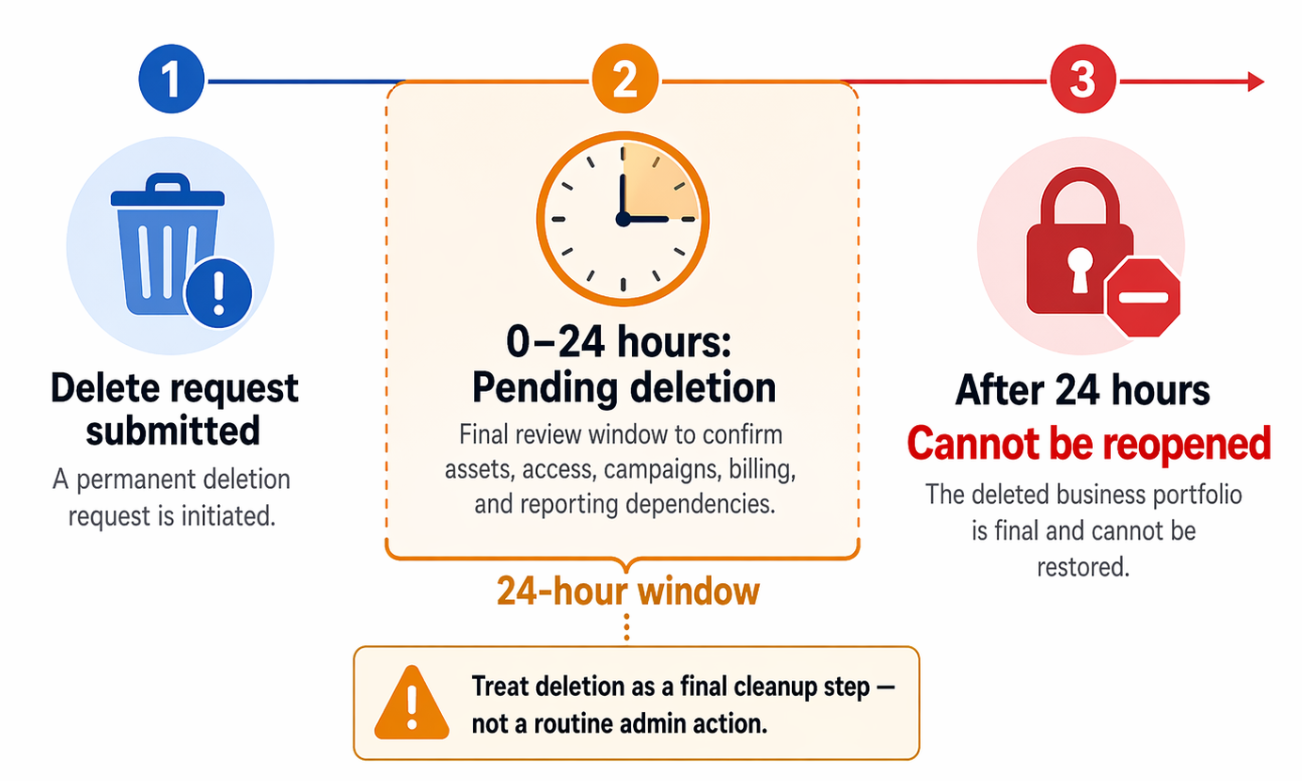
Meta gives business owners a 24-hour pending-deletion window. After that, the deleted business portfolio cannot be reopened
Meta also notes that when a business portfolio is deleted, access you have to another business’s assets can be removed, including Pages, ad accounts, and Meta Pixels. For agencies, freelancers, and multi-brand advertisers, this matters because the portfolio may be connected to client-side or partner-side assets that are not obvious at first glance.
Why this matters for campaign performance
A portfolio deletion can affect performance indirectly. It may not change your targeting algorithm by itself, but it can disrupt the operational systems that support your campaigns.
If your team loses access to an ad account, you may delay budget shifts, creative launches, audience tests, and campaign edits. If people or partners are removed from assets unexpectedly, reporting and optimization workflows can stall. If a Page, Instagram account, Pixel, or lead access setup is tied to the portfolio, you may create friction around retargeting, conversion tracking, or lead handling.
That friction can show up as:
- Slower campaign launches.
- Missed optimization windows.
- Delayed creative testing.
- Confused ownership of Pages or ad accounts.
- Interrupted lead follow-up.
- Fragmented reporting across old and new structures.
- A rushed move back to broad targeting because existing audiences are not ready.
For paid social teams, the cost is not only administrative. It can affect CPA, CAC, ROAS, learning stability, and the speed at which campaigns move from testing to scale.
When deleting a business portfolio makes sense
Deleting a Meta business portfolio can be reasonable when the portfolio is truly unused, duplicated, obsolete, or tied to a business that no longer operates.
Common advertiser scenarios
- An agency may create a temporary portfolio for a client, then need to clean it up after the engagement ends.
- A small business owner may accidentally create several portfolios while setting up Facebook Ads, Instagram, or Meta Business Suite and want to consolidate everything into one clean structure.
- A startup may rebrand, merge teams, or move assets into a new portfolio controlled by a central marketing operations owner.
- A B2B lead-generation team may discover that Pages, ad accounts, lead forms, and people are scattered across multiple portfolios, causing confusion over who owns campaign execution.
- An affiliate marketer or freelancer may no longer need a portfolio created for a short-term project and wants to remove it to avoid mistakes when launching ads.
In each case, deletion is less about “starting fresh” and more about removing unnecessary account complexity.
If deletion fails during this process, review the companion guide on business portfolio deletion blockers before creating another ad account or rebuilding your campaign structure.
Business impact of deleting without preparation
The biggest risk is losing momentum.
Performance marketing depends on fast decisions: which audience to pause, which creative to scale, which placement to isolate, which lead source to clean up, which campaign should receive more budget. When access and assets are unclear, those decisions slow down.
CPC and CPA impact
If a portfolio cleanup forces you to rebuild campaigns under time pressure, you may temporarily rely on broader audiences or weaker targeting logic. That can increase wasted impressions and reduce the quality of early traffic.
Higher CPC is not guaranteed, but poor audience fit often makes paid social less efficient. If the new campaign structure reaches people who are less relevant to the offer, the funnel has to work harder to generate the same lead or sale.
CAC and ROAS impact
CAC can increase when the team loses access to proven audiences, historical campaign learnings, or operational processes used to qualify leads. ROAS can suffer if retargeting and prospecting audiences are not rebuilt thoughtfully.
Lead quality impact
For lead-generation campaigns, the risk is especially practical. If lead forms, lead access, CRM workflows, or Page ownership are affected, the team may still generate leads but handle them poorly. Poor routing and slow follow-up can make a campaign look weak even when the media targeting is acceptable.
Campaign learning impact
Campaign learning depends on consistent signals and a stable testing environment. A messy account transition can make it harder to compare old and new results. You may not know whether performance changed because of account structure, audience quality, creative, budget, landing page, or conversion signal quality.
What advertisers should check before deletion
Before you delete a business portfolio, do a campaign-first review. The goal is not to document every setting for its own sake. The goal is to protect revenue-generating activity.
Confirm whether deletion is actually necessary
Sometimes you do not need to delete the entire portfolio. You may only need to remove a Page, clean up people access, disconnect an old partner, or consolidate assets into a better-managed portfolio.
If the issue is clutter, deletion may be too aggressive. If the issue is ownership, access cleanup may solve it. If the issue is a duplicate business portfolio with no active assets, deletion may be appropriate.
Identify active advertising assets
Check which ad accounts, Pages, Instagram profiles, Pixels, catalogs, lead forms, and partner permissions are associated with the portfolio.
Ask one practical question: “Would any live or planned campaign be delayed if this disappeared tomorrow?”
If the answer is yes, deletion should wait until the campaign plan is protected.
Review Page and Instagram ownership
Meta’s search result summary notes that Pages added to a business portfolio can be moved to a different business portfolio. For advertisers, that means Pages should not be treated as minor assets. A Page is often tied to ad identity, social proof, comments, messaging, lead forms, and Instagram connectivity.
Before deletion, confirm who should control each Page and Instagram profile after the cleanup.
Review people and partner access
Agencies, media buyers, founders, employees, contractors, and freelancers may have access through the portfolio. Removing the portfolio can disrupt who can manage campaigns or view results.
Make sure there is at least one responsible owner with full control over the assets that remain in use.
Review audiences and campaign dependencies
Advertisers should check whether any important audiences, campaign structures, or retargeting workflows are tied to the assets inside the portfolio.
Do not assume you can rebuild everything quickly. Audience strategy is often more fragile than it looks, especially when campaigns rely on specific communities, warm traffic, Instagram engagement, lead lists, or profile-based segments.
For teams already stuck in a deletion error, use the companion article on how to troubleshoot why your Meta portfolio cannot be deleted.
Risks and considerations
Deleting a Meta business portfolio should not be used as a shortcut for fixing poor campaign performance.
If campaigns are underperforming because the audience is too broad, the offer is weak, the creative is unclear, or the landing page does not convert, deleting the portfolio will not solve the root issue.
Before acting, consider these risks:
- Poor audience fit may follow you into the new structure if you do not improve targeting strategy.
- Too-small audiences can limit delivery, especially in niche B2B, local, or high-ticket campaigns.
- Weak creative can still waste spend even when the account structure is clean.
- Low-quality conversion signals can mislead optimization, especially when lead quality is not reviewed after submission.
- Platform metrics can be misread during transitions because account structure, campaign learning, budgets, and attribution windows may change at the same time.
- Compliance still matters. Make sure audience creation, data use, and targeting practices align with applicable platform policies and your own business requirements. Do not treat account cleanup as a substitute for policy review.
Prerequisites before deletion
Deletion is safest when the marketing team has the following in place:
- A clear ICP and buyer profile.
- A list of active campaigns and planned launches.
- A confirmed owner for each Page, Instagram profile, ad account, and key asset.
- An active ad account that will remain available after cleanup.
- A reliable campaign objective for current media buying.
- Sufficient budget to test rebuilt audiences without overreacting to early volatility.
- Strong creative and offer strategy.
- Reliable conversion tracking and lead-quality review.
- Enough audience size for the next campaign phase.
- Clear success metrics such as CPA, CAC, ROAS, lead-to-opportunity rate, or purchase conversion rate.
Without these dependencies, deletion can create more confusion than clarity.
Practical recommendations for advertisers
Treat deletion as a media operations decision
Do not let one person delete a portfolio without input from whoever owns ads, reporting, lead flow, and client access. The person who sees the delete button may not understand every campaign dependency.
Separate asset cleanup from campaign optimization
Deleting a portfolio is not the same as improving targeting. If performance is poor, diagnose the campaign first: audience, offer, creative, landing page, budget, conversion event, and lead quality.
Create a replacement audience plan
Before removing the old structure, decide how prospecting and retargeting will work afterward. Identify which audiences you will keep, rebuild, replace, or test.
Preserve performance context
Document what was working before the cleanup: best campaigns, best audience types, highest-quality lead sources, strongest creatives, and strongest landing pages. This prevents the team from confusing account cleanup with a full strategy reset.
Rebuild with higher-intent segments
Once the account structure is clean, prioritize audiences that match your ICP and show stronger relevance. This is where group-based, Instagram-based, and profile-based audience creation can help reduce wasted impressions.
Test before scaling
Do not move a large budget into a newly reorganized structure without controlled testing. Start with clear hypotheses, compare audience quality, and watch downstream metrics rather than only front-end CPC.
Final takeaway
Deleting a Meta business portfolio is a permanent account-structure decision that can affect access, campaign continuity, audience planning, and marketing operations. Handle it as part of a broader paid social cleanup process, then rebuild your campaigns around better audience quality and clearer testing priorities.
Join the free LeadEnforce trial period to start building more precise paid social audiences before your next campaign test.