A sudden drop in feedback score rarely shows up as a dramatic alert. Instead, delivery quietly tightens.
You’ll usually notice it through indirect signals: CPM increases without clear competition changes, impressions slow down despite stable budgets, and frequency rises faster than expected. By the time performance clearly declines, the system has already started limiting how aggressively your ads can enter auctions.
Understanding how feedback score affects delivery is critical if you want to prevent these slow, compounding losses.
Why Feedback Score Directly Impacts Delivery
When feedback score drops, Meta doesn’t just “penalize” your ad. It changes how often your ad is allowed to compete.
This happens at the auction level.
Each impression opportunity considers:
-
Your bid and estimated action rate.
-
Competing advertisers targeting the same user.
-
User experience signals, including negative feedback.
If your ad accumulates negative signals, Meta reduces its effective competitiveness. You don’t get banned — you just start losing auctions you previously would have won.
This is why performance degradation feels gradual instead of immediate.
A campaign that was stable yesterday can start showing:
-
Higher CPM despite unchanged targeting.
-
Lower impression volume even with sufficient budget.
-
More volatile delivery pacing across the day.
These are not random fluctuations. They are early signs that the system is deprioritizing your ads.
What Actually Causes a Feedback Score Drop
Feedback score is not driven by one metric. It’s an aggregate of user reactions to your ad experience.
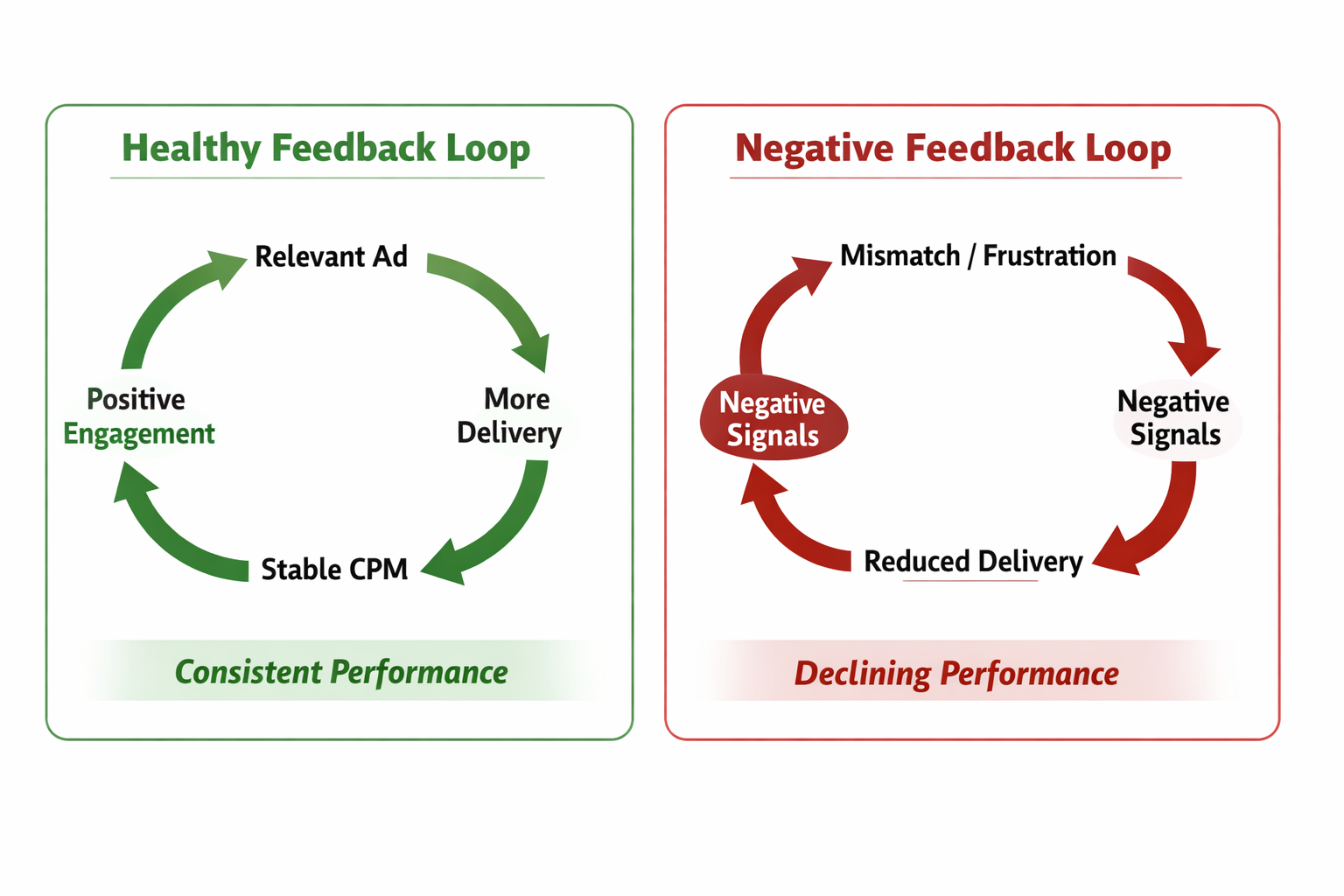
In practice, drops usually come from a combination of the following:
1. Mismatch Between Ad Promise and Landing Page
This is the most common cause.
If users click expecting one thing and land on something else, you’ll see:
-
Higher bounce rates within seconds.
-
Increased “Hide Ad” or “Report Ad” signals.
-
Lower downstream engagement.
A typical scenario:
You promote a “Free Demo” in the ad, but the landing page immediately asks for detailed company information. Users feel misled, even if the offer technically exists.
The system interprets this as a poor user experience, not just weak conversion. If you want to go deeper on this, read How to Create a High-Converting Landing Page.
2. Overly Aggressive Creative Angles
Certain hooks attract attention but generate negative sentiment.
Examples include:
-
Fear-based messaging (“You’re losing money every day you wait”).
-
Overpromising outcomes (“Guaranteed pipeline in 30 days”).
-
Clickbait-style curiosity gaps.
These creatives often produce strong CTR initially. Then feedback signals accumulate, and delivery tightens.
You may even see this pattern:
-
CTR stays high.
-
CPM increases sharply.
-
Conversion rate drops.
This combination often indicates feedback-related pressure.
3. Audience Saturation Without Creative Variation
When the same users repeatedly see similar ads, tolerance decreases.
This shows up as:
-
Frequency climbing above 2.5–3.0 in a short period.
-
Declining engagement rates.
-
Gradual increase in negative feedback signals.
Even if users don’t explicitly hide the ad, passive disengagement contributes to lower perceived quality.
Over time, Meta reduces delivery to that audience segment.
If this pattern looks familiar, review Ad Fatigue on Facebook: How to Spot It Early and Fix It Fast.
4. Poor Post-Click Experience (Speed, UX, Friction)
Feedback isn’t limited to what happens inside the ad.
Landing page issues matter:
-
Slow load times, especially on mobile.
-
Broken layouts or unclear structure.
-
Long forms without visible value.
If users abandon quickly, the system correlates that behavior with low-quality traffic.
This reduces your competitiveness in future auctions.
How Delivery Limits Actually Show Up in Campaigns
Feedback-related delivery limits rarely appear as a single metric change. Instead, you’ll see a pattern across multiple signals.
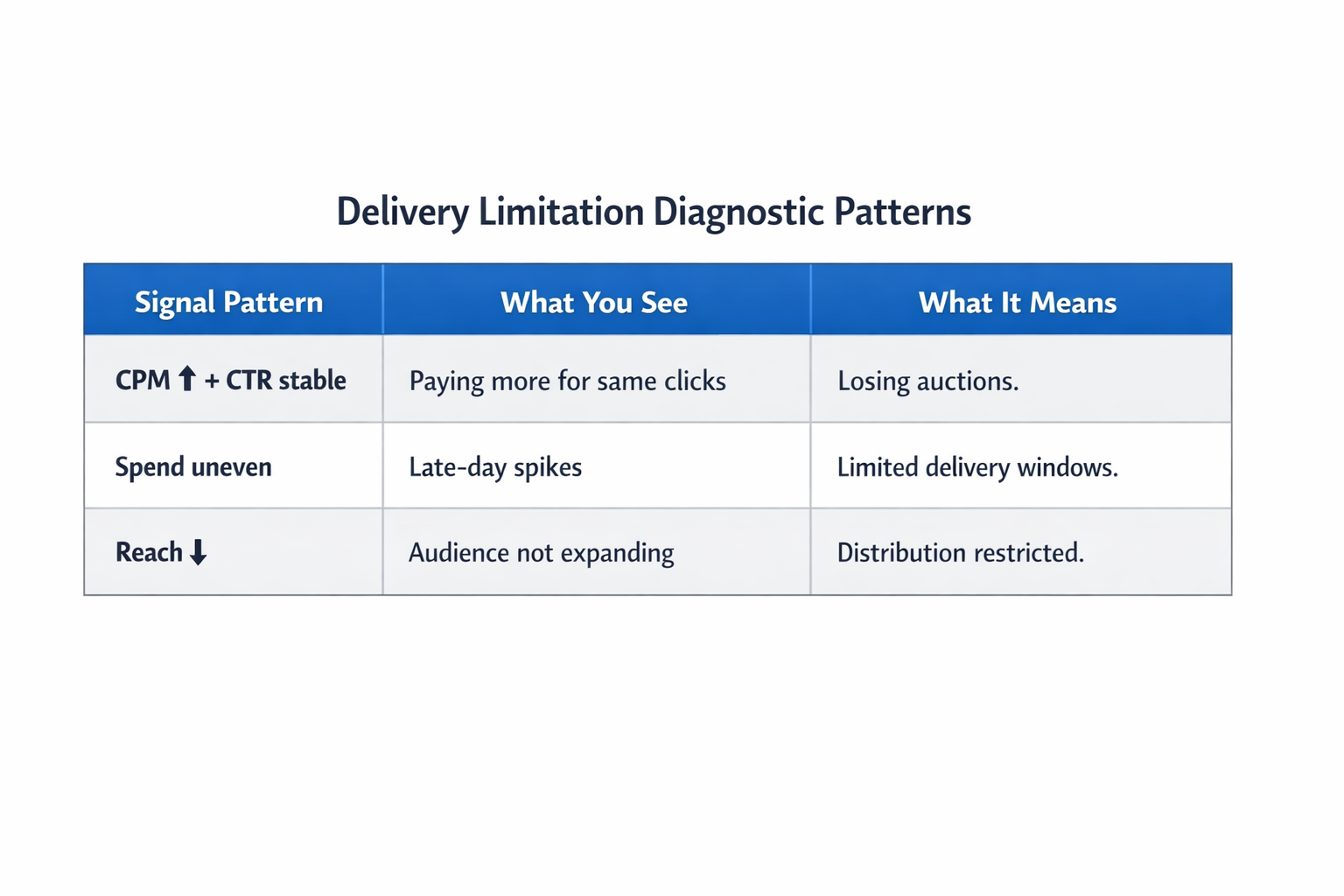
Watch for combinations like:
-
CPM rising while CTR remains stable.
→ Indicates you’re still attracting clicks, but losing auctions more often. -
Spend pacing becomes uneven.
→ Budget spends late in the day instead of evenly across hours. -
Learning phase resets after minor changes.
→ System struggles to stabilize due to inconsistent feedback signals. -
Reach declines despite unchanged audience size.
→ Platform restricts how widely your ad is distributed.
If you only look at one KPI, you might misinterpret the issue. The pattern matters more than any single metric.
How to Prevent Feedback Score Declines
Prevention is less about reacting to scores and more about controlling inputs that generate feedback.
Align Ad and Landing Page Expectations
This is the highest-leverage fix.
Make sure:
-
The headline in the ad matches the first screen of the landing page.
-
The offer is immediately visible without scrolling.
-
The next step feels consistent with what was promised.
If the ad says “Book a Demo,” the landing page should not feel like a gated whitepaper funnel.
Even small mismatches can compound at scale.
Moderate Creative Claims Without Killing Performance
Strong hooks are necessary, but they need to stay credible.
Instead of:
-
“Guaranteed results in 30 days.”
Use:
-
“See how similar companies increased pipeline in 30 days.”
This keeps curiosity while reducing the risk of negative reactions.
You’re not just optimizing for clicks — you’re optimizing for post-click satisfaction.
Rotate Creatives Before Fatigue Becomes Visible
Don’t wait for CTR to drop.
A more reliable approach is to monitor:
-
Frequency trends over time.
-
Engagement rate per impression.
-
Early CPM movement within the same audience.
If frequency rises and CPM starts creeping up, introduce variation even if performance looks stable.
This prevents silent feedback accumulation.
Improve Post-Click Experience as a Performance Lever
Many teams treat the landing page as separate from paid performance. In reality, it directly affects delivery.
Focus on:
-
Load speed under 2–3 seconds on mobile.
-
Clear visual hierarchy in the first screen.
-
Reducing unnecessary form fields.
When users move smoothly from click to action, feedback signals improve naturally.
Control Audience Expansion Quality
Broad targeting increases scale, but it also increases variance in user intent.
If feedback score drops after expanding targeting:
-
Check which segments are receiving impressions.
-
Compare engagement rates across audience clusters.
-
Narrow or exclude low-intent segments.
The system will continue exploring broadly unless you constrain it.
For a deeper breakdown, read Facebook Ad Targeting 101: How to Reach the Right Audience.
What to Do If Your Feedback Score Already Dropped
Once delivery is limited, fixing it requires more than minor adjustments.
You need to reset the input conditions.
A practical recovery approach:
-
Pause or reduce spend on affected creatives.
Continuing to push the same ads accelerates negative signal accumulation. -
Launch new creatives with adjusted messaging.
Focus on clarity and realistic expectations. -
Audit the landing page experience.
Fix mismatches before relaunching traffic. -
Segment audiences more tightly during recovery.
Prioritize higher-intent users to rebuild positive signals.
Recovery takes time because the system needs consistent positive feedback to re-expand delivery.
There is no instant reset.
Final Takeaway
Feedback score is not a surface-level metric — it’s a proxy for how the system evaluates user experience at scale.
When it drops, you’re not just losing engagement. You’re losing auction access.
The key shift is this: you’re not optimizing ads in isolation. You’re managing a full experience loop — from impression to post-click behavior.
Teams that treat feedback signals as a core performance input avoid delivery limits altogether. Those that ignore them usually notice only when performance has already compressed.