Market expansion has always been a high-stakes initiative. Traditionally, businesses relied on broad segmentation, assumptions, and trial-and-error campaigns to establish a foothold in new regions or industries. Today, data-driven targeting transforms this process into a structured, evidence-based strategy.
Organizations that leverage data effectively can identify ideal customer profiles, prioritize high-potential segments, and optimize outreach from day one. The result is faster traction, improved conversion rates, and more efficient use of marketing budgets.
Why Data-Driven Targeting Matters
Entering a new market introduces multiple uncertainties: unfamiliar buyer behavior, unknown competitive dynamics, and limited brand awareness. Data-driven targeting reduces these uncertainties by replacing assumptions with actionable insights.
According to recent industry reports, companies that use advanced audience targeting see up to a 2.5x increase in marketing ROI and a 30–50% reduction in customer acquisition costs. Additionally, 80% of B2B buyers expect personalized experiences, making precise targeting not just an advantage, but a requirement.
By analyzing firmographic, behavioral, and intent data, businesses can focus their efforts on accounts that are most likely to convert, rather than casting a wide and inefficient net.
Key Data Sources for Market Entry
Successful targeting depends on the quality and diversity of data inputs. The most effective strategies combine multiple data layers:
-
Firmographic data: Industry, company size, revenue, and geographic location help define the structural characteristics of target accounts.
-
Technographic data: Insights into the technologies used by potential customers reveal compatibility and readiness for specific solutions.
-
Intent data: Signals derived from online behavior indicate which companies are actively researching relevant products or services.
-
Behavioral data: Engagement metrics from campaigns, website visits, and content interactions refine audience prioritization.
Integrating these data sources allows marketers to build highly granular segments and tailor messaging accordingly.
Building an Ideal Customer Profile (ICP)
An Ideal Customer Profile serves as the foundation for entering new markets. It defines the attributes of organizations most likely to derive value from a product or service.
A robust ICP includes:
-
Industry verticals with proven demand
-
Company size and revenue thresholds
-
Key decision-makers and stakeholders
-
Common pain points and objectives
-
Technology stack alignment
Data-driven insights ensure that the ICP is not static. Instead, it evolves based on performance metrics and real-world feedback from campaigns.
Segmenting and Prioritizing Target Accounts
Not all prospects within a new market are equal. Effective segmentation enables businesses to rank accounts based on likelihood to convert and potential lifetime value.
Common segmentation approaches include:
-
Tier-based segmentation: Dividing accounts into high, medium, and low priority tiers
-
Intent-based segmentation: Prioritizing accounts with active buying signals
-
Geographic segmentation: Focusing on regions with higher demand or lower competition
Research shows that companies using account prioritization strategies achieve up to 20% higher sales productivity, as teams focus on the most promising opportunities.
Personalization at Scale
Data-driven targeting enables personalized engagement without sacrificing scalability. By leveraging dynamic content and audience segmentation, businesses can deliver relevant messaging to each segment.
Examples of personalization include:
-
Industry-specific value propositions
-
Role-based messaging for decision-makers
-
Content tailored to the buyer’s stage in the journey
Personalized campaigns can increase conversion rates by up to 202%, highlighting the importance of aligning messaging with audience needs.
Measuring and Optimizing Performance
Continuous optimization is essential when entering new markets. Data-driven strategies allow marketers to track performance in real time and adjust tactics accordingly.
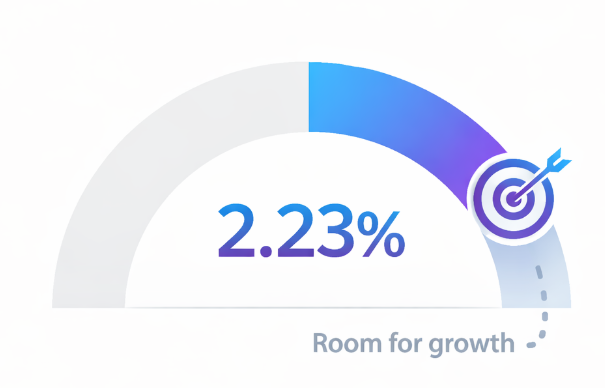
Typical B2B conversion rates remain low, emphasizing the need for data-driven targeting strategies
Key performance indicators (KPIs) include:
-
Conversion rates by segment
-
Cost per acquisition (CPA)
-
Engagement metrics (click-through rates, time on site)
-
Pipeline velocity and deal size
Organizations that adopt continuous optimization practices are 1.8x more likely to outperform competitors in revenue growth.
Common Challenges and How to Overcome Them
While data-driven targeting offers significant advantages, it also presents challenges:
-
Data quality issues: Inaccurate or outdated data can lead to poor targeting decisions
-
Integration complexity: Combining multiple data sources requires robust infrastructure
-
Over-segmentation: Excessive granularity can reduce campaign efficiency
To address these challenges, businesses should invest in data validation processes, scalable platforms, and clear segmentation frameworks.
Conclusion
Entering new markets is no longer a process driven by guesswork. Data-driven targeting provides a systematic approach to identifying, engaging, and converting high-value audiences.
By leveraging high-quality data, refining ICPs, prioritizing accounts, and continuously optimizing campaigns, organizations can reduce risk and accelerate growth in unfamiliar markets.
Recommended Articles