Digital advertising ecosystems have become radically transparent. Meta, Google, LinkedIn, TikTok, and other platforms provide searchable ad libraries. Competitive intelligence tools aggregate creatives, landing pages, traffic patterns, and estimated spend.
On the surface, this seems like a strategic goldmine. In practice, most teams use competitor ads for inspiration rather than analysis.
According to industry research:
-
Over 80% of B2B buyers review multiple vendors before making a purchasing decision.
-
72% of marketers say competitive intelligence influences campaign planning.
-
Yet fewer than 35% of marketing teams report having a formalized competitor ad analysis process.
The gap between access and application is where performance advantage is won—or lost.
Why Finding Ads Is Easy
There are three reasons discovery has become commoditized:
1. Platform Ad Libraries
Major platforms are required to provide transparency databases. With minimal effort, marketers can view:
-
Active creatives
-
Messaging variations
-
Format usage (video, carousel, static)
-
Target geographies
2. Competitive Intelligence Tools
Modern tools aggregate:
-
Creative history
-
Estimated traffic and impressions
-
Landing page snapshots
-
Funnel structure signals
3. Social Virality and Public Campaigns
High-performing ads frequently surface organically through engagement, shares, and retargeting exposure.
Visibility is no longer a differentiator. Interpretation is.
Why Turning Ads into Insights Is Hard
Raw ad visibility does not reveal:
-
Audience segmentation logic
-
Conversion economics
-
Creative testing strategy
-
Budget allocation structure
-
Funnel performance metrics
A competitor’s most visible ad is not necessarily their most profitable one.
Without context, teams fall into common traps:
-
Copying messaging without understanding positioning
-
Replicating formats without audience fit validation
-
Misinterpreting brand campaigns as direct-response plays
-
Overestimating performance based on longevity alone
Competitive intelligence becomes valuable only when connected to strategic hypotheses and measurable objectives.
From Observation to Intelligence: A Structured Framework
To convert competitor ads into actionable insights, teams need a repeatable analytical system.
1. Map Messaging to Buyer Stage
Classify ads by funnel stage:
-
Awareness: Problem framing, educational angles
-
Consideration: Comparison, differentiation
-
Decision: Offers, urgency, proof
Quantify distribution. If 60% of a competitor’s ads are mid-funnel, they may be protecting existing demand rather than expanding market reach.
2. Identify Creative Testing Patterns
Look for:
-
Hooks repeated across variations
-
Headline swaps with identical visuals
-
Same copy in multiple formats
-
Landing page consistency across creatives
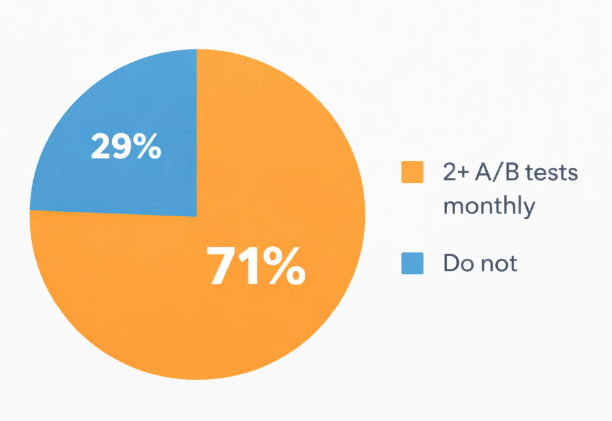
Most companies (71%) use frequent A/B testing as part of their optimization process
This reveals experimentation logic. Structured testing signals maturity and performance optimization discipline.
3. Analyze Positioning Signals
Evaluate:
-
Value propositions emphasized
-
Pain points prioritized
-
Pricing visibility
-
Social proof usage (case studies, testimonials, statistics)
Positioning clarity often predicts conversion performance more than creative design.
4. Assess Funnel Cohesion
A high-performing ad cannot compensate for a misaligned landing experience. Evaluate:
-
Message match
-
CTA continuity
-
Offer alignment
-
Page load speed and UX clarity
Research shows that improving landing page alignment can increase conversion rates by 20–40%.
Quantifying Competitive Gaps
Actionable insight emerges when qualitative analysis meets quantification.
Key measurable signals include:
-
Ad longevity (suggests sustained ROI)
-
Creative volume (indicates testing scale)
-
Format diversity (signals channel experimentation)
-
Geographic segmentation breadth
-
Offer variation frequency
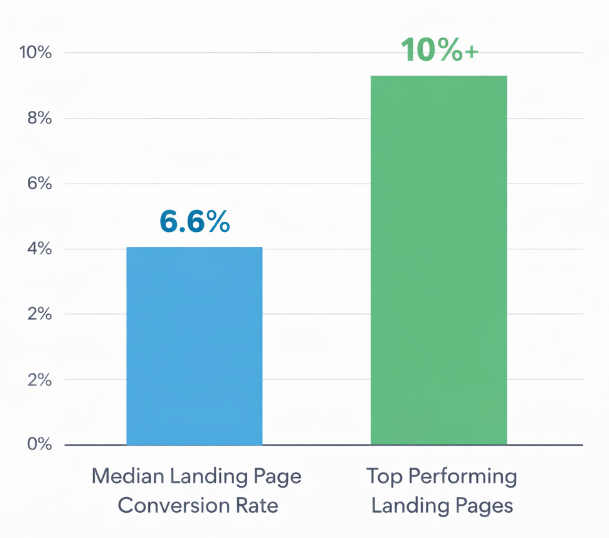
Median landing page conversion rates compared to top performing pages highlight the potential lift from systematic optimization
Organizations running 15 or more creative variants per campaign typically outperform those running fewer than five, particularly in paid social environments.
The objective is not imitation—it is opportunity identification.
The Strategic Questions Most Teams Don’t Ask
Instead of asking “What are they running?”, ask:
-
What audience segment does this creative likely target?
-
What economic model supports this messaging angle?
-
What hypothesis are they validating?
-
What does their ad mix suggest about CAC tolerance?
-
What is missing from their positioning that we can exploit?
Competitive intelligence should reduce uncertainty, not increase noise.
Building an Internal Competitive Intelligence System
To operationalize competitor ad insights:
-
Schedule recurring analysis (weekly or bi-weekly).
-
Standardize documentation (creative theme, funnel stage, positioning angle).
-
Integrate findings into campaign briefs.
-
Compare competitor messaging against your ICP segmentation.
-
Track performance deltas after implementing derived hypotheses.
Teams that treat competitive monitoring as a structured discipline—not occasional inspiration—gain measurable advantages in CAC efficiency and conversion rate optimization.
Conclusion
Competitor ad discovery has become effortless. Strategic interpretation remains rare.
The advantage no longer belongs to the team with access to data. It belongs to the team with the discipline to analyze it systematically, connect it to economic models, and act with precision.
Visibility creates awareness. Structure creates advantage.
Recommended Reading
To deepen your competitive and demand generation strategy, explore:
-
From Cold Traffic to Qualified Leads: A Full-Funnel Blueprint
-
How Influencers and Creators Can Monetize Instagram Follower Audiences
Understanding competitor advertising is one layer of growth. Converting intelligence into revenue requires integrating targeting precision, data enrichment, and buyer intent alignment into every campaign decision.