In today’s B2B environment, attention is fragmented and competition is intense. Research consistently shows that only a small fraction of first-time website visitors are ready to speak with sales. According to multiple industry benchmarks, over 95% of website visitors are not sales-ready during their initial interaction. Meanwhile, organizations that implement structured lead nurturing generate significantly more sales-ready opportunities at a lower cost.
A full-funnel strategy aligns traffic acquisition, data capture, segmentation, nurturing, and qualification into a cohesive system. Without this structure, marketing generates noise instead of revenue.
This blueprint breaks down the process into three strategic stages:
-
Top of Funnel (TOFU): Attract and identify
-
Middle of Funnel (MOFU): Educate and nurture
-
Bottom of Funnel (BOFU): Qualify and convert
Stage 1: Attracting and Identifying Cold Traffic (TOFU)
1.1 Defining High-Value Audiences
Cold traffic is not the problem. Unqualified traffic is.
Before launching campaigns, define:
-
Ideal Customer Profile (ICP)
-
Target industries
-
Company size
-
Geographic focus
-
Decision-maker roles
Organizations that tightly define ICPs see higher conversion rates and improved pipeline velocity.
1.2 Traffic Acquisition Channels
Effective full-funnel systems diversify acquisition across:
-
LinkedIn advertising
-
Search engine marketing
-
Content marketing
-
Industry media placements
-
Retargeting campaigns
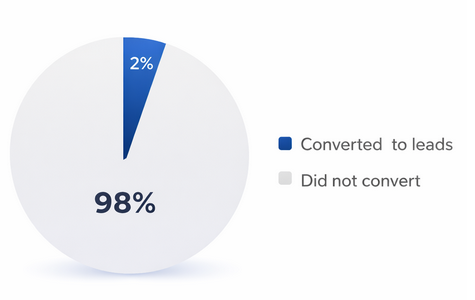
Only 2% of B2B website traffic converts into leads, highlighting the importance of advanced identification and enrichment strategies
LinkedIn remains one of the most effective B2B channels, with a majority of B2B marketers reporting it as a top-performing paid platform.
1.3 Visitor Identification and Data Enrichment
Most visitors will not fill out a form. That does not mean they are anonymous.
Modern visitor identification and data enrichment technologies allow marketing teams to:
-
Reveal company-level visitor data
-
Match traffic to firmographic attributes
-
Prioritize accounts based on ICP fit
This transforms “cold traffic” into actionable account intelligence.
Without identification, the funnel leaks at the very first step.
Stage 2: Nurturing and Educating Prospects (MOFU)
Once visitors are identified, the focus shifts to engagement and qualification.
2.1 Segmentation and Personalization
Segment audiences based on:
-
Industry
-
Company size
-
Engagement behavior
-
Content consumed
-
Funnel stage
Personalized campaigns significantly outperform generic messaging. Targeted emails and ads generate materially higher engagement compared to non-segmented outreach.
2.2 Multi-Touch Nurture Sequences
B2B buyers require multiple interactions before conversion. Research shows that enterprise buyers often consume numerous pieces of content before engaging with sales.
Effective nurture sequences include:
-
Educational emails
-
Case studies
-
Industry reports
-
Retargeting ads
-
Webinar invitations
Consistency is critical. Sporadic communication reduces conversion probability.
2.3 Behavioral Scoring
Lead scoring models assign weighted values to actions such as:
-
Pricing page visits
-
Multiple return sessions
-
High-intent content downloads
-
Demo page engagement
This allows marketing teams to distinguish casual researchers from active buyers.
Organizations using structured lead scoring report stronger alignment between marketing and sales teams.
Stage 3: Qualification and Conversion (BOFU)
The bottom of the funnel is where pipeline is created.
3.1 Defining Marketing Qualified Leads (MQLs)
A clear MQL definition should combine:
-
ICP fit
-
Engagement score
-
Buying signals
-
Recency of activity
Ambiguity at this stage creates friction between marketing and sales.
3.2 Sales Activation
When high-intent behavior is detected, speed matters.
Studies show that rapid follow-up dramatically increases contact and qualification rates. Delays reduce the likelihood of conversion.
Activation tactics include:
-
Personalized outreach
-
Account-based advertising
-
Sales-trigger alerts
-
Tailored landing pages
3.3 Closed-Loop Feedback
Revenue teams must continuously analyze:
-
Conversion rates by channel
-
Pipeline contribution by segment
-
Cost per qualified lead
-
Sales cycle length
Organizations that measure full-funnel performance outperform those that rely solely on surface-level metrics like traffic or clicks.
Key Metrics Across the Funnel
To maintain control of performance, track:
Top of Funnel:
-
Cost per visitor
-
Visitor-to-lead identification rate
-
ICP match rate
Middle of Funnel:
-
Engagement rate
-
Lead score progression
-
Email and retargeting performance
Bottom of Funnel:
-
MQL-to-SQL conversion rate
-
Opportunity creation rate
-
Cost per opportunity
-
Customer acquisition cost
Data transparency enables optimization.
Common Full-Funnel Mistakes
-
Driving traffic without identification strategy
-
Over-reliance on form fills
-
No structured lead scoring
-
Slow sales response times
-
Lack of marketing-sales alignment
Each of these breaks the funnel and inflates acquisition costs.
Building a Sustainable Full-Funnel Engine
A high-performing funnel is not a campaign. It is an integrated system combining:
-
Precise targeting
-
Visitor identification
-
Data enrichment
-
Behavioral scoring
-
Automated nurturing
-
Real-time sales activation
When executed correctly, cold traffic becomes qualified pipeline at scale.
Recommended Reading
For deeper insights into funnel optimization and B2B lead generation, explore:
-
Why Ads Become Irrelevant Even When Targeting Stays the Same
-
How to Collect Zero-Party Data Through Paid Social Campaigns
Conclusion
Converting cold traffic into qualified leads requires more than advertising. It demands structure, intelligence, and operational discipline.
By aligning acquisition, identification, nurturing, and qualification into a unified system, organizations reduce waste, increase pipeline predictability, and accelerate revenue growth.
The companies that master the full funnel do not just generate traffic. They generate opportunity.