Most advertisers treat paid social like a lab. Test a new audience. Test a new ad. Hope one wins. Repeat.
But testing alone doesn't build long-term growth. One-off wins fade quickly. Scaling gets unpredictable. Performance swings become hard to diagnose.
To get consistent results from Facebook and Instagram ads, you need more than testing.
You need a system.
This article introduces a practical, four-layer framework for building a paid social system — one that’s measurable, repeatable, and built to adapt.
What is a paid social system?
A paid social system is not a set of tricks or a high-budget setup. It's a structured way of organizing campaigns, creative, audiences, and operations — so that decisions are made faster, lessons are retained, and scaling becomes repeatable.
Instead of asking "What should we test next?" each week, a system helps you ask:
-
Where is performance dropping — and why?
-
What part of our funnel needs attention?
-
What proven creative or audience can we reuse?
With a system, you stop reinventing the wheel. You start compounding results.
The four-layer framework
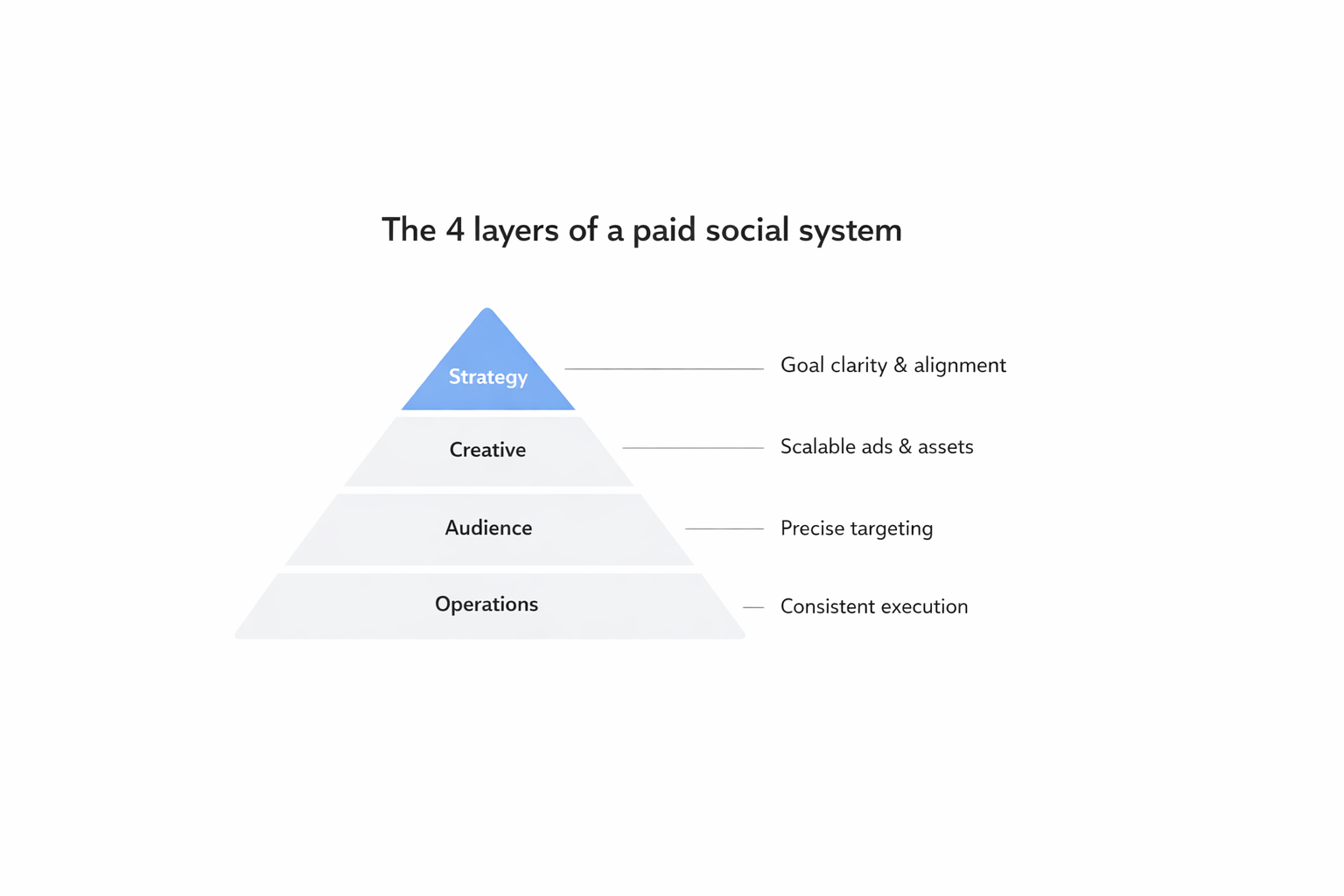
A strong paid social system has four interlocking layers:
-
Strategic foundation – Defines how paid ads support your business model and goals.
-
Creative architecture – Provides modular assets for different funnel stages.
-
Audience logic – Uses behavioral signals to structure targeting.
-
Operational rhythm – Creates repeatable processes for learning and scaling.
Let’s unpack each layer.
1. Strategic foundation: align paid social with business outcomes
Most ad accounts chase ROAS, but ignore why they're running ads in the first place.
Your system starts with a clear foundation:
-
Business model – Are you selling high-ticket services, consumable products, subscriptions, or limited-time drops?
-
Primary growth lever – Are you driving revenue through conversion rate, AOV, retention, or referrals?
-
Role of paid social – Is it your main acquisition channel, a retargeting layer, or a way to fill the top of the funnel?
Your strategy sentence should look like this:
"We use paid social to acquire [audience type] with [message type], to drive [business outcome], tracked over [time window]."
This keeps campaigns connected to long-term goals, not just weekly results.
2. Creative architecture: build modular, layered creative
Random ad uploads don’t scale. To build a system, you need structure — a creative architecture built around jobs to be done.
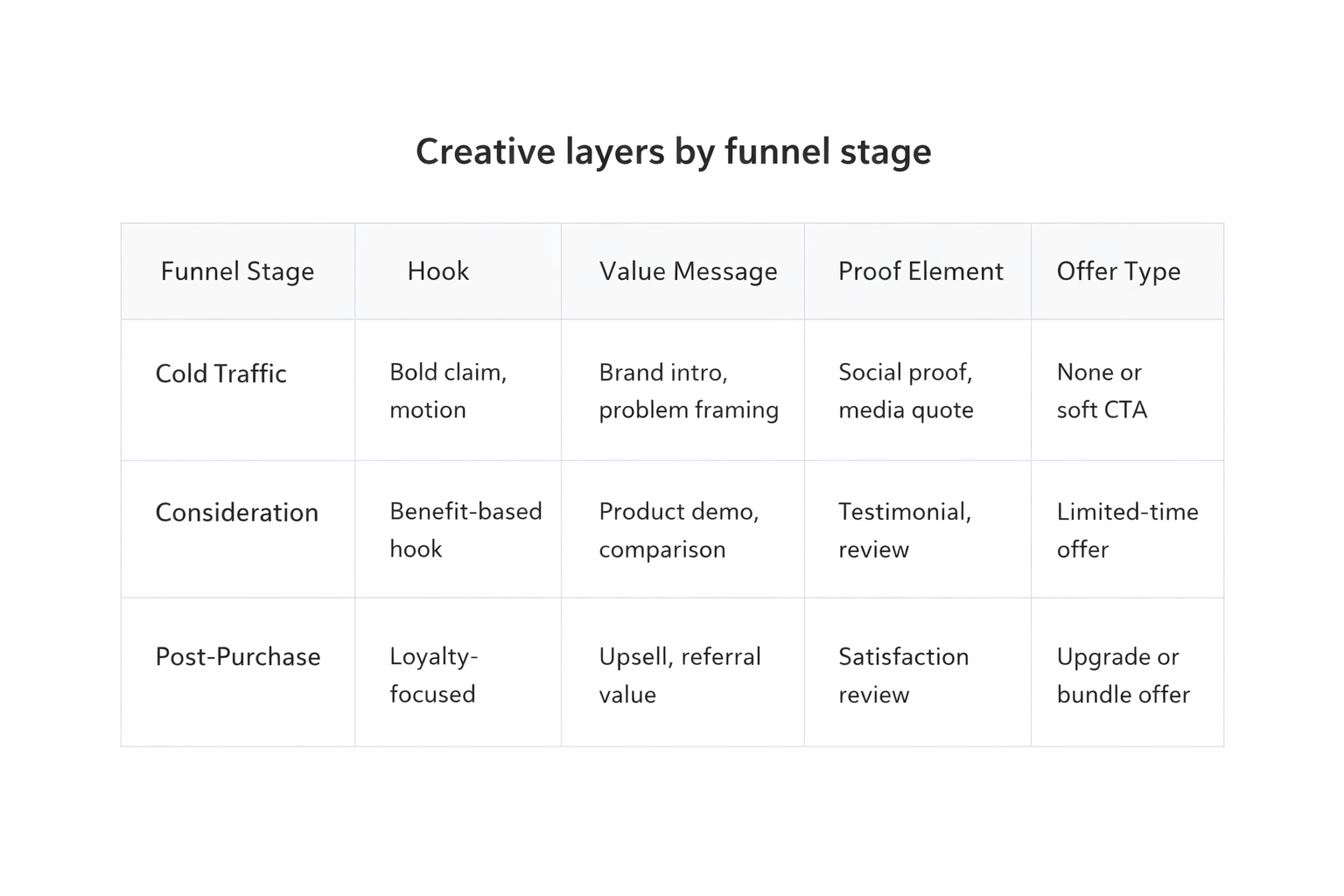
Think of creative in layers. Each ad should include one or more of the following:
-
Hook layer – Captures attention; examples include: bold headlines, motion graphics, or unusual visuals.
-
Value layer – Explains benefits or solves a pain point; examples include: product demos, side-by-side comparisons, or founder voiceovers.
-
Proof layer – Builds trust or removes objections; examples include: customer reviews, guarantee badges, or UGC snippets.
-
Offer layer – Encourages action now; examples include: limited-time discounts, bonuses, or “ending soon” messages.
These elements can be mixed and matched depending on funnel stage. Instead of inventing new ads each time, you pull from a library of proven pieces.
Tip: Organize your ads by function — not just format. For example, tag videos by “education,” “objection handling,” or “urgency.”
If you’re building that asset bank, consider using a creative testing matrix to test message layers without burning budget.
3. Audience logic: segment by behavior, not interests
Relying on interest-based targeting limits performance. A system uses behavioral signals to structure audience logic.
Here’s a better way to segment:
-
Cold – Users who’ve never interacted with your brand but resemble high-value customers; often built from lookalikes or external signals.
-
Engaged – People who watched your videos, liked your posts, or visited a product page.
-
Consideration – Visitors who added to cart, initiated checkout, or visited multiple times.
-
Post-purchase – Buyers who returned to browse again, opened follow-up emails, or have high potential LTV.
Why this structure matters:
-
Each stage has a specific goal – Cold = awareness; Engaged = education; Consideration = conversion; Post-purchase = retention.
-
Creative aligns with intent – Don’t show discount-heavy ads to cold leads or brand story videos to repeat buyers.
-
Budget flows strategically – You don’t waste money targeting everyone the same way.
For a deeper breakdown, see this article on mapping audiences to funnel stages.
4. Operational rhythm: create a cadence for decisions and learning
Even with great strategy and assets, most systems break down in execution. Why? There’s no operational rhythm.
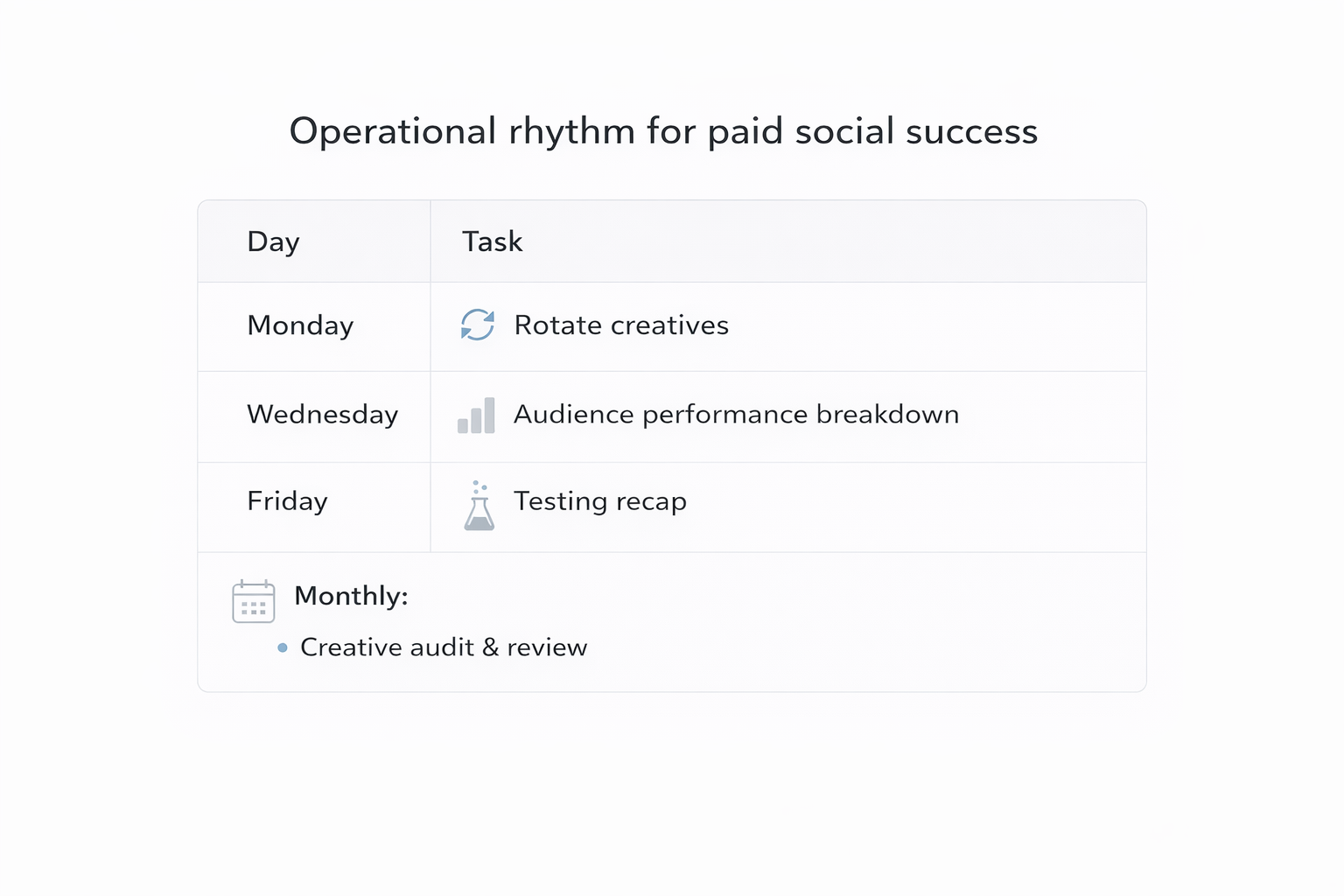
A system needs processes for:
-
Reviewing results – Weekly check-ins on creative fatigue, CTRs, thumb-stop rate, and stage-specific performance.
-
Deploying creative – Set schedules for launching, pausing, and rotating creative by type or funnel.
-
Logging learnings – Maintain a simple internal doc to capture what worked, why, and where to reuse it.
-
Scaling and adapting – Use performance signals (e.g., rising frequency, falling ROAS) to decide when to scale, duplicate, or iterate.
Example cadence:
-
Weekly – Launch new creatives, check funnel metrics, rotate fatigued assets.
-
Biweekly – Review attribution windows, test new offers, update landing page alignment.
-
Monthly – Summarize learnings, archive underperformers, audit spend by audience.
This rhythm prevents panic decisions. It gives your team focus and creates a feedback loop that improves over time.
Want to go deeper? This breakdown of how to turn campaign data into strategy is a great next step.
Why systems outperform scattered testing
Testing is how you learn.
Systems are how you scale.
Without a system, you waste time redoing what worked before — or miss why it worked at all.
You get stuck in short-term thinking, hoping for a breakthrough.
With a system, you:
-
Build assets once and reuse them intentionally;
-
Know which metrics to watch — and when they matter;
-
Make faster, clearer decisions when performance dips;
-
Train new team members using processes, not tribal knowledge.
You’re no longer guessing. You’re operating.
Recap: the four-layer system
| Layer | Focus | Outcome |
|---|---|---|
| Strategic foundation | Align ads with business model | Clear goals, defined success metrics |
| Creative architecture | Organize content by function | Reusable, funnel-specific ads |
| Audience logic | Segment based on behavior | Precise targeting with relevant messaging |
| Operational rhythm | Systematize launches and reviews | Faster testing, scalable wins, fewer surprises |
The sooner you shift from testing what works to building systems that explain why it works, the faster you scale — with less risk.