AI has become the default in digital advertising. Platforms automate targeting, optimize budgets, and generate creatives. The barriers to entry are lower than ever — but so is the uniqueness of execution.
When everyone uses the same tools, campaigns begin to look and perform alike. Advertisers who want to stay competitive need more than automation. They need strategy, insight, and systems that AI can’t replicate.
Here’s how to stay ahead.
AI Is No Longer a Differentiator
When AI tools were new, early adopters had a performance advantage. Now, nearly every advertiser — from solo entrepreneurs to Fortune 500 brands — uses the same technology.
| Platform AI Automates | Human Strategist Adds |
|---|---|
| Budget allocation | Brand positioning |
| Creative variations | Insight-driven messaging |
| Placement optimization | Platform-specific strategy |
| Audience expansion | Real intent-based segmentation |
AI handles execution, not thinking
Most advertising teams now rely on AI for:
-
Copy generation, such as headlines, product descriptions, and CTAs produced through ChatGPT or built-in platform tools;
-
Visual assets, often created through template-based tools like Canva, AdCreative.ai, or image-generation models;
-
Media buying, where Meta’s algorithm allocates budget and adjusts placements for “optimal” performance.
These features reduce friction and save time. But they also lead to uniformity. If you and your competitor use the same logic and tools, your ads start competing on luck or budget — not creativity or strategy.
For a deeper look at how automated campaigns are reshaping performance expectations, see Will Fully Automated AI-Driven Ads Change the Future of Facebook Campaigns?
The Hidden Risks of Over-Reliance on Platform AI
AI can optimize what it sees. But if you're not careful, it can also distort or flatten your strategy.
You stop learning why things work
Advertisers who let the algorithm decide everything lose critical insights, such as:
-
Which messages drive conversions, not just clicks or likes;
-
Which audiences are truly profitable, beyond blended CPA;
-
Which creative elements matter, and which are just filler.
Without structured learning, your team becomes reactive. You chase performance without understanding what causes it.
Platform incentives don’t always align with yours
Platforms optimize for engagement, retention, and ad spend. That may not match your business goals.
AI tends to:
-
Favor scale over precision, expanding audiences past your ideal customer;
-
Prioritize top-funnel engagement metrics, which can look good on paper but don’t translate to revenue;
-
Optimize for what’s easiest to measure, not what matters most — such as customer lifetime value or qualified leads.
Letting the system make all your decisions may lead to short-term results, but it limits long-term control and profitability.
What Still Gives You a Competitive Edge
With the basics automated, your leverage comes from what the system can’t replicate. That includes how well you know your market, how quickly you act on data, and how clearly you position your brand.
1. Build strategy on first-party and behavioral data
Data from real customer interactions is more actionable than anything Meta or Google guesses.

Focus on:
-
Segmented CRM lists, such as high-LTV buyers, dormant leads, or repeat purchasers;
-
Behavioral signals, like support chat topics, survey responses, or on-site browsing patterns;
-
Group-based or follower-based interest data, available through tools like LeadEnforce, which can target Facebook group members or Instagram followers.
These data sources lead to more relevant campaigns. They also help you shape messaging that AI-generated audiences won’t account for.
For more on how to structure your inputs to guide optimization, see A Practical Framework for AI Ad Optimization.
Why it matters
As platforms restrict third-party tracking, advertisers who rely on interest-based automation will lose targeting precision. Those with owned insights will gain control and sustainability.
2. Create ads that clarify, not just capture
AI-generated ads tend to be attention-seeking. They use bold headlines, bright visuals, and short slogans. But attention alone doesn’t convert — understanding does.
What works better:
-
Creative frameworks, such as problem → value prop → proof → CTA;
-
Context-aware messaging, where the ad reflects the user’s stage in the funnel or recent behavior;
-
Original source material, like real testimonials, founder narratives, or user-generated content.
Avoid generic creative that could apply to any brand. Focus on clarity, context, and authenticity.
Why it matters
Ads that rely on surface-level interest can work for a moment — but fatigue quickly. Creative built on relevance and real value has longer shelf life and better conversion potential.
3. Treat platforms differently — because users do
Facebook and Instagram operate under the same ad system, but user behavior on each platform is distinct.
Design creative and campaign structure accordingly:
-
On Facebook, users often browse longer content, participate in discussions, and click through to external links. It’s ideal for lead generation, webinars, and product education.
-
On Instagram, users scroll fast, respond to visual triggers, and expect mobile-first, native experiences. It’s better for product drops, quick offers, and visually-driven campaigns.
Why it matters
When you run the same ad across both platforms, you’re leaving performance on the table. Platform-native creative — not just sizing, but tone and structure — is still one of the biggest performance levers.
How to Use AI Without Losing the Competitive Edge
You don’t need to abandon AI — but you do need to direct it.
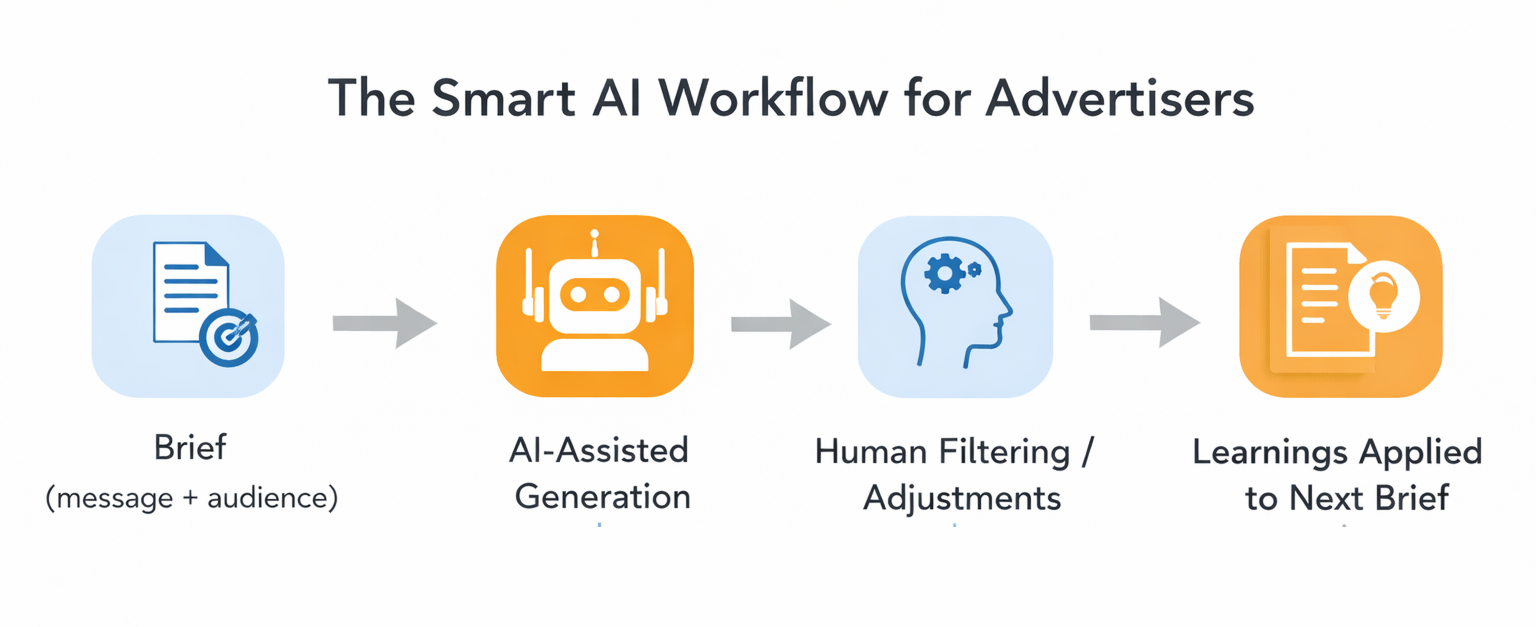
Use AI to multiply your input, not replace it
AI works best when it has constraints and clear direction. Use it for:
-
Generating variations once you’ve locked your strategic angle;
-
Speeding up concept testing, so you can compare hooks, formats, and messages efficiently;
-
Simplifying post-production, such as resizing assets, reformatting headlines, or building versions for different placements.
But let your inputs — the core idea, the message hierarchy, the segmentation strategy — come from human insight.
If you’re relying on generic AI outputs, you may be feeding your campaigns the wrong signals. Explore why that happens in Why AI Targeting Isn’t Enough Without Better Inputs.
Why it matters
If you feed the algorithm weak input, it will produce average output — no matter how fast it runs. The advantage lies in your brief, not just the tools.
For Smaller Advertisers: The Playing Field Just Shifted
Most people assume AI benefits large advertisers most. That’s only half true. Bigger brands can afford more testing and data — but they’re slower to adapt and more risk-averse.
Smaller advertisers can compete by:
-
Acting faster, without layers of approval or brand compliance delays;
-
Targeting narrower segments, where automation fails or lacks reach;
-
Using overlooked data, like group-based interests, custom-built Lookalikes, or micro-behavior audiences.
Tools like LeadEnforce offer access to audiences that Meta doesn’t expose through its default targeting — giving small advertisers reach without needing scale.
To see how smaller teams are adapting faster with smarter tools, read How AI Tools Are Reshaping Facebook Ads for Small Businesses.
Why it matters
The best-performing campaigns are usually the ones competitors can’t copy. Specificity, not size, creates separation in performance.
Final Thought: AI Sets the Floor, Not the Ceiling
AI gives everyone the same infrastructure. That means the baseline is higher — but so is the competition.
To stand out:
-
Know your audience better than the platform does;
-
Make creative that reflects real-world insight, not marketing trends;
-
Use automation to move faster, but never stop thinking critically.
If performance is stalling despite solid-looking campaigns, the problem may run deeper. The Real Reason Your Facebook Ads Are Failing outlines what most advertisers miss.
The advertisers who outperform in an AI-powered world won’t be the ones who automate the most. They’ll be the ones who combine automation with sharper thinking, deeper research, and clearer execution.